

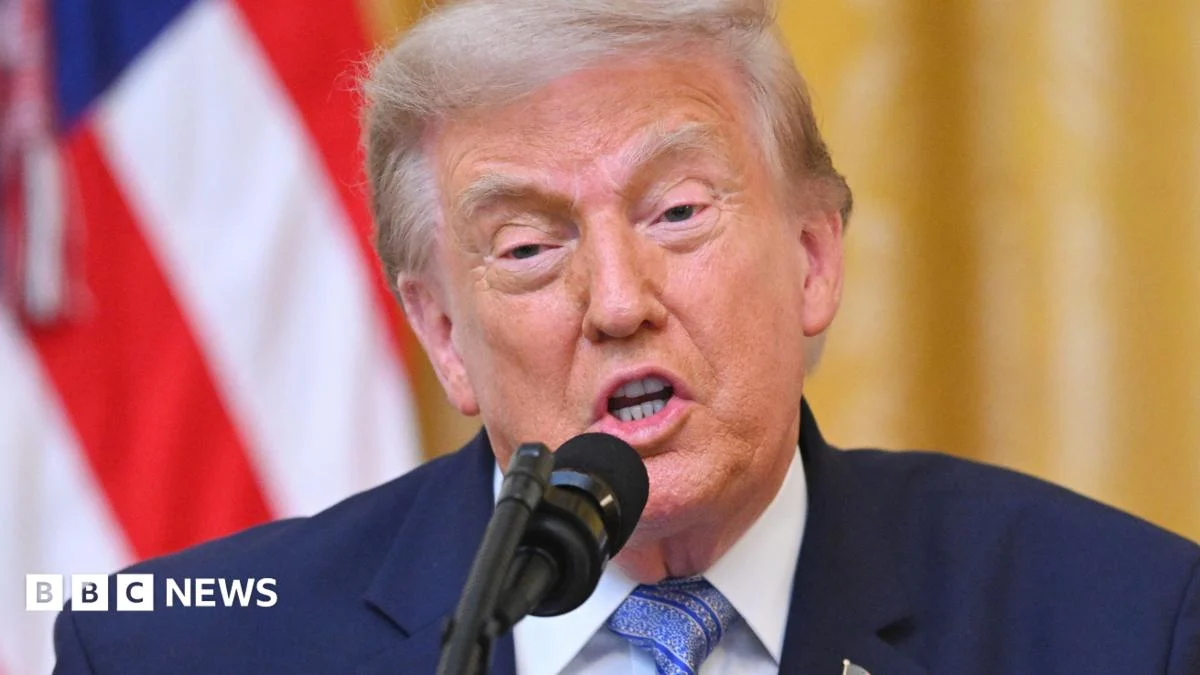
Speaking from the White House on a Thursday evening, former President Donald Trump launched a series of expansive claims, asserting that China actively meddled in the 2020 presidential election, which he lost to Joe Biden. The televised address, delivered three months ahead of critical midterm elections, saw Trump repeatedly making unsubstantiated allegations of voter fraud and foreign interference, themes that have become central to his post-presidency political narrative. During the half-hour speech, Trump stated that he had declassified hundreds of intelligence files which, according to his interpretation, supported his claims that Beijing had attempted to sway the election outcome in favor of his Democratic opponent. This assertion stands in direct contradiction to the unanimous conclusions of the US intelligence community, which has previously determined that China did not interfere in the 2020 election.
The White House Address: Unpacking the Allegations
The core of Trump’s address revolved around what he described as a sophisticated and covert Chinese operation to compromise American electoral integrity. He specifically accused China of the "illicit acquisition" of approximately 220 million voter files, containing personal information. Trump alleged that voter data in 18 states was "bought, stolen or hacked by China," further claiming that "those responsible for sounding the alarm" about these discoveries failed to disclose them to government officials or Congress.
It is important to note that a significant amount of voter data, including names, addresses, and party affiliations, is publicly available through state election offices and often accessible for political campaigns, researchers, and the general public, sometimes for a fee. However, Trump did not present any concrete evidence during his speech to substantiate his claims that China had exploited this information to alter voting systems, manipulate voter behavior, or directly influence election outcomes. The hundreds of pages of intelligence documents released by the White House concurrent with Trump’s address were heavily redacted, making independent verification of his claims challenging for journalists and the public. The BBC, among other news organizations, indicated it was in the process of reviewing these documents.
Beyond the China allegations, Trump also raised broader concerns about the security of US election infrastructure. He contended that American voting machines are "extremely exposed" to interference from foreign adversaries, specifically naming Russia, China, and Iran. While shortcomings in US election infrastructure have been well-documented over the years, many improvements and security enhancements were implemented following the 2016 election, during which the US intelligence community concluded that Russia had engaged in a concerted campaign of meddling, including hacking, social media influence operations, and funding of on-the-ground political activities.
Intelligence Community’s Stance: Contradictory Findings
Trump’s pronouncements directly challenged the established findings of the US intelligence community. A comprehensive 2021 report by the US National Intelligence Council, which represents the analytical community’s collective assessment, stated with "high confidence" that China did not engage in interference efforts aimed at changing the outcome of the 2020 presidential election.
The report explicitly stated, "We assess that China did not deploy interference efforts and considered but did not deploy influence efforts intended to change the outcome of the US presidential election." It further elaborated on the likely reasoning behind China’s decision, suggesting that Beijing "did not view either election outcome as being advantageous enough for China to risk blowback if caught." This assessment highlighted a strategic calculus by China, weighing the potential benefits of interference against the significant diplomatic and economic repercussions should such actions be discovered. The intelligence community’s conclusion was a stark contrast to the findings regarding Russia’s actions in 2016, where extensive evidence pointed to a deliberate and multifaceted campaign.
China’s Vehement Denial
In immediate response to Trump’s speech, China’s foreign ministry issued a strong denial, dismissing the allegations of Chinese meddling in the 2020 presidential election as "entirely fabricated." Foreign ministry spokesman Lin Jian characterized Trump’s claims as "malicious smears" that have "long been proven to be groundless." Beijing consistently rejects accusations of interference in the internal affairs of other nations, particularly regarding electoral processes, often framing such allegations as attempts to scapegoat China for domestic political issues. The swift and unequivocal nature of China’s denial underscored the sensitivity of such accusations and the ongoing geopolitical tensions between Washington and Beijing.
Echoes of 2020: A History of Disputed Outcomes
Trump’s primetime address is situated within a broader historical context of his consistent questioning of election integrity, particularly after his 2020 defeat. Following the election, Trump and his allies launched dozens of unsuccessful legal challenges across multiple states, alleging widespread voter fraud and irregularities. These lawsuits were almost universally rejected by courts, including the Supreme Court, due to a lack of credible evidence. State election officials, both Republican and Democrat, and independent audits consistently affirmed the integrity of the 2020 results.
The US Cybersecurity and Infrastructure Security Agency (CISA), a component of the Department of Homeland Security responsible for protecting the nation’s critical infrastructure, including election systems, famously declared the 2020 election "the most secure in American history." CISA, along with other federal and state election security experts, found no evidence that any voting systems were compromised or that widespread fraud impacted the election outcome. This official consensus stands in direct opposition to the narrative presented by Trump.
Allegations of Domestic Fraud: Michigan and Non-Citizens
Beyond the international focus, Trump also delved into claims of domestic election irregularities. He alleged that a state investigation by Michigan law enforcement uncovered a voter registration fraud scheme orchestrated by a Democratic-affiliated group. Trump claimed that the Federal Bureau of Investigation (FBI) subsequently constrained Michigan authorities from taking action before the statute of limitations expired, effectively allowing the alleged scheme to go unpunished. "It was pay, play and cheat," Trump asserted, though he again provided no verifiable evidence of votes being changed, tabulations being altered, or voting machines being hacked as a result of this alleged scheme.
Separately, Trump stated that the Department of Homeland Security had identified 278,000 non-citizens registered to vote. While the presence of non-citizens on voter rolls can occasionally occur due to administrative errors or outdated information, Trump did not provide data or evidence to indicate whether any of these individuals had actually voted or, more crucially, if their participation had any material impact on any election outcome. Voter registration laws in the United States generally require proof of citizenship, and systems are in place to cross-reference data and remove ineligible voters, although these processes are not always instantaneous or perfectly error-free.
Legislative Push: The SAVE America Act
Towards the conclusion of his speech, Trump reiterated his call for the passage of the "SAVE America Act." This proposed legislation aims to enact significant changes to federal election law, including a ban on most mail voting, a requirement for proof of citizenship for voter registration, and mandatory photo identification to cast a ballot. These provisions are frequently championed by Republicans who argue they are necessary to enhance election security and prevent fraud, while Democrats and voting rights advocates often counter that such measures could disenfranchise eligible voters, particularly minorities, the elderly, and those in rural areas, and make voting more difficult.
The SAVE America Act has been stalled in the Senate for months, facing significant opposition from Democrats and the procedural hurdles of the legislative body. Trump encouraged Americans to urge their representatives in Congress to support its passage. However, without a significant shift in bipartisan support or a willingness from Republicans to alter longstanding Senate procedures, such legislative efforts are almost certainly doomed to fail in the current political climate.
Political Repercussions and Democratic Backlash
The timing of Trump’s address, just three months before the November midterm elections, was not lost on his political opponents. Democrats swiftly accused Trump of attempting to sow doubts about the security and legitimacy of the upcoming elections, which will determine control of both the House of Representatives and the Senate for the remainder of President Biden’s term.
Top Senate Democrat Chuck Schumer posted on social media shortly after the speech, declaring, "Let’s be clear – in America, voters choose their leaders, not the other way around." He added a forceful pledge: "Democrats will fight like hell to make sure every American voter can cast their ballot freely, without obstruction or interference from Donald Trump." Former Vice President Kamala Harris, moments before Trump’s remarks, wrote on X (formerly Twitter), "He wants you to lose confidence in our electoral system so you stay home this November," directly attributing a strategic motive to Trump’s rhetoric. These reactions highlight the deep partisan divide over election integrity issues and the perceived political implications of Trump’s ongoing narrative.
Media Response and Broader Implications
During his address, Trump also directed criticism at several major media outlets, including ABC, NBC, and CNN, for not broadcasting his speech live on television. He suggested that these networks should have their broadcast licenses revoked, a familiar refrain from his presidency when he felt media coverage was unfair or insufficient. This attack underscored his ongoing adversarial relationship with much of the mainstream media and his belief that they are complicit in suppressing information he deems important.
The speech is widely seen as an effort to mobilize his base, maintain his influence within the Republican party, and lay groundwork for potential future political campaigns, including a possible 2028 presidential bid. By consistently questioning the legitimacy of past elections and the security of future ones, Trump fuels a narrative that resonates strongly with a segment of the electorate that believes the system is rigged against them. However, for a significant portion of the American public, particularly independents and Democrats, these claims contribute to cynicism and distrust in democratic institutions, potentially exacerbating political polarization.
Timing and Context: Midterms and Public Opinion
The timing of Trump’s White House address also coincided with the release of a new poll from Washington Post-Ipsos, which indicated a significant drop in his approval rating to 37%. The poll suggested that many voters were pessimistic about key national issues, including the rising cost of living and broader geopolitical concerns. This context suggests that the speech may have been an attempt to redirect public attention, energize his supporters, and frame the upcoming midterms as a battle against systemic corruption and foreign interference, rather than a referendum on current economic or social policies.
In summary, Donald Trump’s primetime address marked a continuation of his post-2020 election strategy: to consistently challenge the legitimacy of past electoral outcomes and raise alarms about future election security. While his claims about Chinese interference and domestic voter fraud remain largely unsubstantiated and contradict official intelligence assessments, the speech served as a powerful reminder of the enduring political divisions surrounding election integrity in the United States, with significant implications for public trust, legislative debates, and the tone of future political campaigns.