


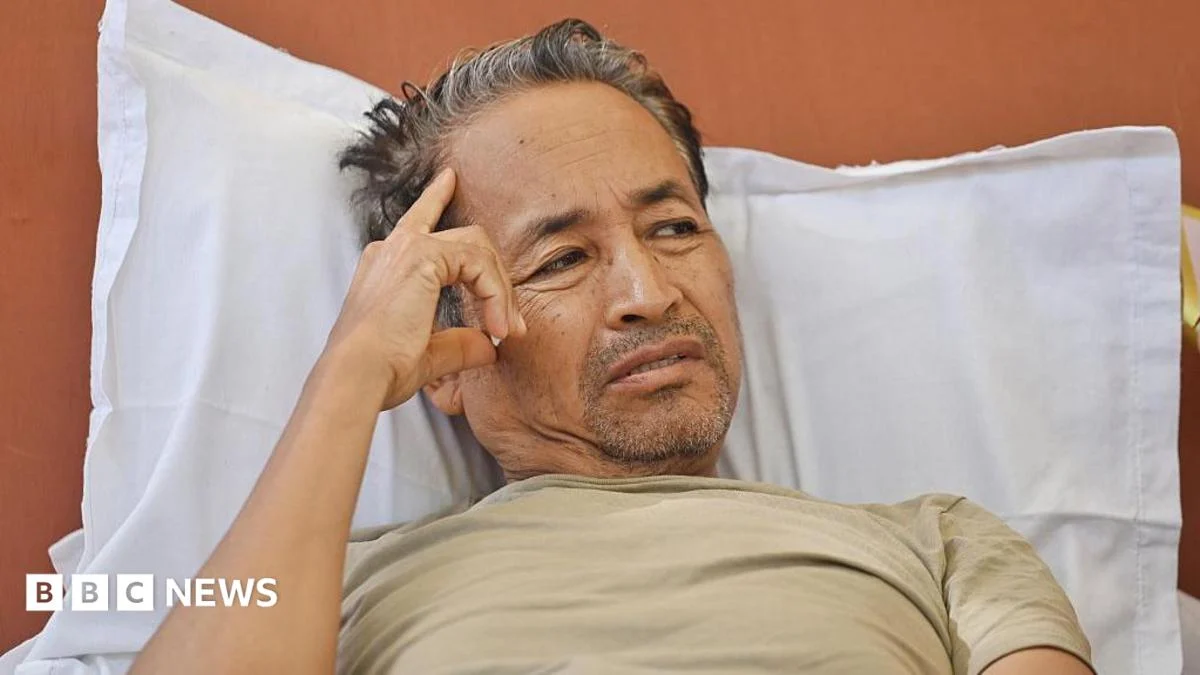
Renowned Indian activist and educationist Sonam Wangchuk, who had been on an indefinite hunger strike for 20 days in Delhi, was forcibly removed from his protest site on Saturday morning. The 59-year-old Magsaysay awardee had been advocating for comprehensive educational reforms and accountability regarding rampant exam paper leaks, a cause championed by the online satirical movement known as the Cockroach Janta Party (CJP). His removal, executed by a large contingent of police and paramilitary personnel, occurred just days before a planned march to India’s parliament, casting a shadow over the future of the burgeoning youth movement.
The Escalation of a Peaceful Protest
Wangchuk’s protest at Jantar Mantar, a historic protest venue in the heart of Delhi, had garnered significant attention. Known for his innovative work in education and sustainable development, particularly in Ladakh, Wangchuk had embarked on the hunger strike consuming only salt and water. His health had visibly deteriorated, with reports indicating a loss of more than 9kg and significant physical pain, yet his resolve remained unshaken. "I’ve grown weak from the outside but I’m strong from within," Wangchuk had told a cheering crowd just days before his removal, affirming his intent to participate in the scheduled march to parliament. He even quipped that his "ghost would join the march" if he succumbed before then, underscoring the deep commitment that resonated with thousands of frustrated students and young people across the nation.
The movement he was supporting, the Cockroach Janta Party (CJP), emerged in May as a satirical response to the systemic issues plaguing India’s examination system. The CJP, whose members metaphorically refer to themselves as "cockroaches" to signify their resilience and pervasiveness in uncovering corruption, quickly gained a massive following on social media. Their primary demands revolved around ensuring transparency and fairness in national examinations, holding officials accountable for paper leaks, and advocating for the resignation of Education Minister Dharmendra Pradhan. The catalyst for their intensified protests was the cancellation of a key entrance exam for aspiring doctors in early May following a paper leak, an incident that impacted millions of students nationwide and further eroded public trust in educational institutions.
A Chronology of Events Leading to Forced Removal
The sequence of events leading to Wangchuk’s forced removal paints a clear picture of escalating tensions between the protesters and the authorities:
- Early May: The Cockroach Janta Party (CJP) is formed as an online satirical movement protesting against recurring paper leaks and other irregularities in India’s top competitive examinations. A significant incident, the cancellation of a major entrance exam for medical aspirants due to a paper leak, fuels public outrage and solidifies the CJP’s mandate.
- Late May/Early June: Sonam Wangchuk, a revered educationist and activist known for inspiring the Bollywood film ‘3 Idiots’ and his work in environmental and educational reforms in Ladakh, joins the CJP’s cause, embarking on an indefinite hunger strike at Jantar Mantar in Delhi. His participation elevates the movement’s profile significantly.
- Throughout June: Wangchuk continues his fast, attracting widespread support from students, civil society members, and opposition leaders. His health steadily declines, becoming a central point of concern and public discourse. Despite his deteriorating condition, he repeatedly expresses his unwavering commitment to the cause and the planned march.
- Thursday, July 18: The Delhi High Court takes cognizance of Wangchuk’s health, issuing an order instructing the federal government to regularly monitor his condition and provide necessary medical treatment if required. This order signals official acknowledgment of the gravity of Wangchuk’s protest and health.
- Friday, July 19: Amidst growing pressure, former Delhi Chief Minister and Aam Aadmi Party leader Arvind Kejriwal visits Wangchuk at Jantar Mantar, expressing solidarity and appealing to the government to engage with the protesters. Kejriwal’s visit, captured in videos shared by the CJP, highlights the increasing political attention on the protest. Opposition MPs also begin condemning the government’s inaction and the "shocking coercive state violence." Wangchuk, despite his frail health, reiterates his commitment to the upcoming march.
- Saturday, July 20, 07:30 local time (02:00 GMT): Dozens of police and paramilitary personnel "swoop in" on the protest stage at Jantar Mantar where Wangchuk was lying. Videos from the site show chaos as protesters attempting to intervene are pushed away. Wangchuk is covered with bedsheets and swiftly removed from the stage. An ambulance is seen speeding away minutes later.
- Saturday, July 20, Post-Removal: Wangchuk’s wife, Gitanjali Angmo, posts on X (formerly Twitter) confirming his admission to Safdarjung Hospital and demanding that no treatment be administered orally or intravenously without consent from her, his family, and his monitoring doctors. Simultaneously, CJP founder Abhijeet Dipke announces he has begun an indefinite fast in Wangchuk’s place, vowing the march to parliament will proceed as planned. Dipke also reports being confined by police at a friend’s house earlier that morning, preventing him from reaching the protest site.
Official Statements and Medical Condition
Following Wangchuk’s removal, authorities and medical personnel provided updates on his condition and the rationale behind the action. Dr. Charu Bamba, Medical Superintendent of Safdarjung Hospital, where Wangchuk was admitted, stated that he was "fully alert and stable." She further elaborated, "He is somewhat weak due to prolonged fasting and is experiencing mild dehydration; otherwise, all his vital parameters are stable. He is being continuously examined and monitored, and his treatment is under way." This official medical assessment aimed to reassure the public about his immediate well-being.
Concurrently, Sachin Sharma, Deputy Commissioner of Police, clarified the police action, stating that Wangchuk had been moved "in compliance with [a court] order, and based on health conditions and medical advice." He added, "Sonam Wangchuk has been moved to a government hospital for much-needed medical intervention and is currently under medical supervision." This statement directly referenced the Delhi High Court order from Thursday, which had mandated the federal government to monitor Wangchuk’s health and provide necessary treatment, thus framing the police action as a fulfillment of judicial directives aimed at safeguarding his life. However, the use of force and the manner of removal raised questions among civil society groups about the state’s approach to peaceful protest.
The Broader Context: India’s Examination Crisis
The CJP’s movement and Wangchuk’s hunger strike are symptomatic of a much larger and deeply entrenched problem within India’s educational and public employment sectors: the recurring issue of exam paper leaks and systemic irregularities. India conducts some of the world’s largest competitive examinations, attracting millions of aspirants each year for coveted government jobs and limited seats in prestigious higher education institutions. For many, these exams represent the sole pathway to upward mobility and a secure future.
However, the integrity of these examinations has been repeatedly compromised by widespread leaks, cheating scandals, and administrative inefficiencies. Over the past decade, dozens of major national and state-level exams have been cancelled or postponed due to paper leaks, impacting tens of millions of students. Such incidents lead to immense financial strain for families, wasted years of preparation, and profound psychological distress, including anxiety and depression, among aspirants. The economic cost of these cancellations, including re-conducting exams and the loss of productivity, runs into hundreds of crores of rupees annually. More critically, they erode public trust in governance and foster a pervasive sense of injustice among the youth.
The CJP’s adoption of the "cockroach" moniker symbolizes not only the resilience of the students but also the persistent and difficult-to-eradicate nature of corruption within the system. Their online satirical approach, leveraging memes, hashtags, and viral content, has allowed them to rapidly mobilize a large, digitally native youth demographic, transforming what began as an online protest into a tangible on-ground movement at Jantar Mantar.
Reactions, Demands, and Future Implications
The forceful removal of Sonam Wangchuk has intensified the political fallout and galvanized the protesters. CJP founder Abhijeet Dipke, who reported being prevented from leaving a friend’s house by police on Saturday morning, immediately began his own indefinite fast, declaring, "If they think that taking Wangchuk away will end this movement, they are mistaken. We will remain here, and will march to parliament on 20 July." This resolve indicates that the movement, far from being extinguished, may be entering a new phase of confrontation.
The CJP’s demands have also escalated. Initially focused on Education Minister Dharmendra Pradhan’s resignation for taking "moral responsibility" for the paper leaks, the movement now directly calls for Prime Minister Narendra Modi’s resignation. "Until now, we were demanding Dharmendra Pradhan’s resignation, but after this despicable act, we will now demand the resignation of Narendra Modi," Dipke told the BBC, reflecting a significant broadening of their political target. Education Minister Pradhan, on his part, has previously dismissed the CJP and its supporters as "the B-team of disruptive elements," and the Modi government has, to date, refrained from engaging directly with the protesters’ demands.
Opposition parties have swiftly condemned the state’s action against Wangchuk. MPs from various opposition factions described the event as "shocking coercive state violence" and "an assault on democracy." Arvind Kejriwal’s earlier appeal to the government to listen to the students and Wangchuk, suggesting that "Pradhan should be removed from his post and replaced by Wangchuk," highlights the growing political pressure on the ruling dispensation. The incident at Jantar Mantar is likely to become a focal point for the opposition to critique the government’s handling of dissent and youth grievances.
The implications of Wangchuk’s forced removal are far-reaching. It raises critical questions about the right to peaceful protest in India, particularly when such demonstrations challenge governmental inaction on systemic issues. The state’s intervention, while framed as a medical necessity based on a court order, is perceived by many as an attempt to suppress a legitimate and rapidly growing youth movement. The upcoming march to parliament, scheduled for Monday, July 22, will be a crucial test of the CJP’s continued organizational capacity and the government’s response to sustained dissent. The incident may also serve as a rallying cry for more students and civil society groups to join the movement, potentially expanding its geographical reach and intensity beyond Delhi. As India grapples with high youth unemployment and intense competition for limited opportunities, the integrity of its examination system remains a deeply sensitive and politically charged issue, and the "cockroaches" show no signs of retreating.