


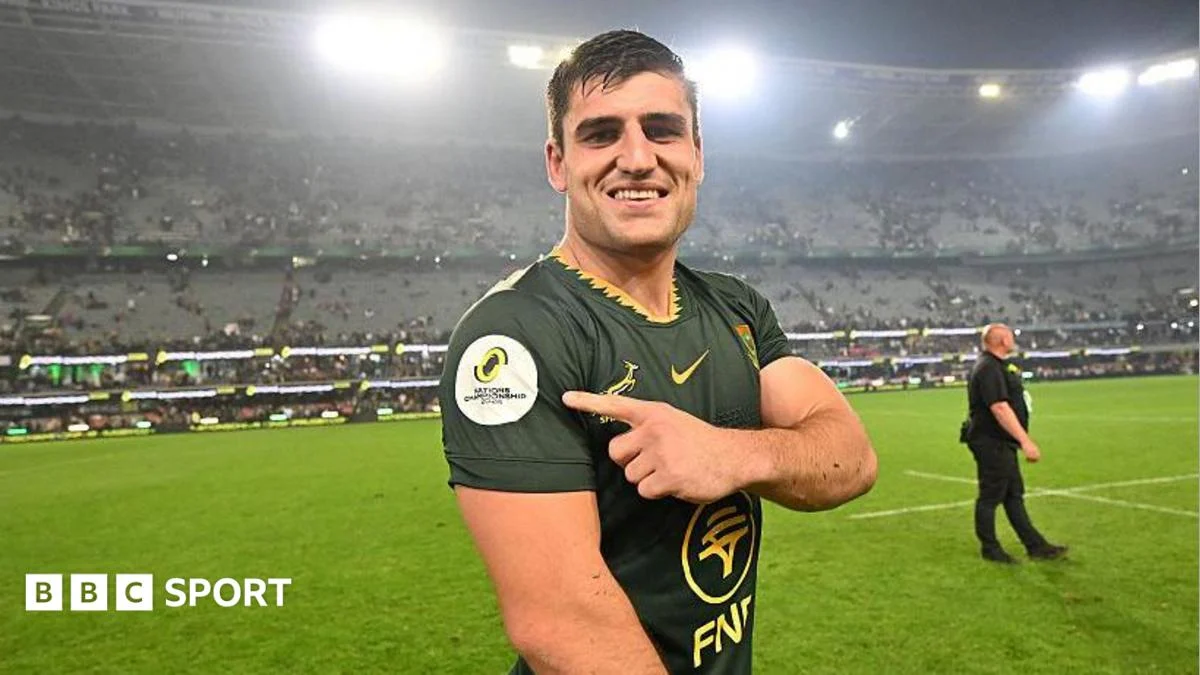
South Africa asserted their dominance with a commanding seven-try, bonus-point victory over Wales in the third round of the Nations Championship, held in Durban. The Springboks, the reigning double world champions, showcased their depth and tactical prowess by comfortably overcoming a Welsh side that struggled to find any attacking foothold throughout the match. The final scoreline of 43-0 underscores the significant gulf in performance and standing between the two nations on the global rugby stage.
Springboks Cruise to Comprehensive Win
The Springboks’ scoring spree was initiated by number eight Jasper Wiese, followed by tries from scrum-half Cobus Reinach, centre Jessie Kriel, wings Jaco Williams and Kurt-Lee Arendse, scrum-half Herschel Jantjies, and flanker Paul de Villiers. This multi-faceted try-scoring effort highlighted the attacking threats present across the South African backline and forward pack. The conversions were successfully added by Vusi Moyo (three) and Handre Libbok, further extending their lead and securing the crucial bonus point.
Significantly, South Africa achieved this emphatic win without several of their most recognizable stars. Captain Siya Kolisi, Cheslin Kolbe, Ox Nche, and Eben Etzebeth, who was part of a notable contingent of seven missing locks, were all absent from the matchday squad. This demonstrates the formidable depth of talent within the Springbok system, allowing them to rest key personnel while still delivering a dominant performance.
While not reaching the historic levels of humiliation seen in their 73-0 record home loss to South Africa in Cardiff last November, this encounter still proved to be a stark illustration of the widening disparity between the two teams. Wales, under the guidance of head coach Steve Tandy, once again failed to register a single point, their offensive strategies appearing limited and predictable against a resolute South African defence. The aggregate score across their last two encounters now stands at an astonishing 116-0 in favour of the Springboks.
Nations Championship Landscape
The victory marks South Africa’s eleventh consecutive win, solidifying their position at the pinnacle of the world rankings. Wales, conversely, find themselves languishing in 12th place. In the context of the Nations Championship, the Springboks have cemented their lead in the northern hemisphere table at the halfway stage, having secured three wins from their opening fixtures against England and Scotland.
For Wales, this defeat represents their second consecutive loss in the competition. They had previously opened their campaign with a 39-21 victory against Fiji, but followed it with a 35-21 loss to Argentina in San Juan. Head coach Steve Tandy’s inaugural season in charge has concluded with a mixed record of nine defeats and three wins from twelve international fixtures. The victories during his tenure have come against Italy, Fiji, and Japan, highlighting the challenges faced in competing against the established elite of international rugby.
Team News and Tactical Adjustments
Wales captain Dewi Lake was deemed fit to play despite limping off in their previous match against Argentina. However, wing Josh Adams was a late withdrawal due to a calf problem, with Ellis Mee stepping in to fill his place on the wing.
South African coach Rassie Erasmus continued his strategy of extensive rotation, making ten starting alterations to the team that faced their previous opponents. With Sacha Feinberg-Mngomezulu and Handre Pollard sidelined through injury, and Mannie Libbok starting on the bench, 20-year-old Sharks fly-half Vusi Moyo was handed his first cap. This made him the youngest Springbok number 10 to debut, despite having only one club start to his name. Moyo was one of four new Springbok caps, joined by wings Jaco Williams and Kurt-Lee Arendse, Bordeaux prop Carlu Sadie, and Montpellier lock Ruben van Heerden.
Match Progression: A Dominant First Half
The Springboks began the match with immediate intent, a fine break from full-back Aphelele Fassi setting the tone, with the home forwards continuing the momentum. The pressure culminated in the opening try, scored by a charging Jasper Wiese, who capitalized on some uncharactergetic Welsh tackling – a recurring theme of their campaign. Vusi Moyo’s successful conversion marked his first points in international rugby.
Wales had attempted to bolster their midfield, with fly-half Dan Edwards replacing Sam Costelow, and centres Ben Thomas and Max Llewellyn coming in for Joe Hawkins and Eddie James. However, their scrum faltered early on, leading to an ineffective attacking play involving Ben Thomas that resulted in a turnover penalty for Springbok hooker Malcolm Marx. Rampaging lock Cobus Wiese was close to scoring but knocked on.
The Welsh scrum was subsequently dismantled on their own try line, from which Cobus Reinach swiftly exploited the advantage to sprint over for South Africa’s second try. A brief lull followed in the Springbok scoring, as Wales managed to hold on, and the hosts appeared uncharacteristically wasteful in the opposition’s 22-metre area. During this period, the visitors gained some confidence, with returning flanker Alex Mann briefly engaging with the Springbok players.
Home captain Pieter-Steph du Toit believed he had scored, but the try was disallowed by referee Andrew Brace due to obstruction. Despite this, Wales continued to concede scrum penalties. This persistent ill-discipline eventually led to the tourists receiving a general warning from the referee about their conduct. Just before halftime, Jessie Kriel extended South Africa’s lead, gathering a speculative cross-kick from Moyo to score.
Second Half: Continued South African Control
At halftime, Wales made a series of substitutions, introducing Ryan Elias, Nicky Smith, and James Botham for Lake, Rhys Carre, and Aaron Wainwright respectively. Joe Hawkins also replaced Max Llewellyn, resulting in Wales fielding two specialist inside centres in the second half.
The Springboks immediately capitalized on these changes. Another loose kick from Wales was gathered by wing Jaco Williams, who sprinted away to score the bonus-point try. Wales then mounted their most sustained period of pressure, but were unable to breach the Springbok defence, even after a series of tap penalties.
Further discipline concerns arose for Wales, who received another warning from the referee. South Africa, despite again failing to immediately convert pressure into points, eventually extended their lead. The Springboks introduced Damian Willemse from the bench, but it was another replacement, scrum-half Herschel Jantjies, who pounced to score in his first Test appearance in three years.
Adding to Wales’ woes, replacement prop Ben Warren was shown a yellow card for a high tackle on Marco van Staden. South Africa swiftly exploited their numerical advantage, moving the ball left to wing Kurt-Lee Arendse, who glided over for another try. The Springboks concluded their scoring with a trademark driving maul, with flanker Paul de Villiers crashing over, leaving Wales with no answer to their superior power and execution.
Match Details and Officials
South Africa: Fassi; Williams, Kriel, de Allende, Arendse; Moyo, Reinach; Steenekamp, Marx, Sadie, C Wiese, van Heerden, de Villiers, PS du Toit (capt), J Wiese.
Replacements: Venter, Wessels, Louw, Dixon, van Staden, Jantjies, Libbok, Willemse.
Wales: Murray; Rees-Zammit, Llewellyn, B Thomas, Mee; Edwards, Tomos Williams; Carre, Lake (capt), D Lewis, Teddy Williams, Beard, Mann, J Morgan, Wainwright.
Replacements: Elias, N Smith, Warren, F Thomas, Reffell, Botham, Morgan-Williams, Hawkins.
Yellow Card: Warren (Wales) – 65th minute.
Referee: Andrew Brace (IRFU).
Assistant Referees: Pierre Brousset (FFR) & James Doleman (NZRFU).
TMO: Olly Hodges (IRFU).
FPRO: Richard Kelly (NZRFU).
Broader Implications and Future Outlook
This decisive victory for South Africa underscores their status as one of the preeminent forces in world rugby. Their ability to consistently deliver such dominant performances, even with significant personnel changes, highlights the strength and depth of their player pool. The Nations Championship provides a crucial platform for teams to test themselves against diverse opposition, and for South Africa, it serves as a valuable opportunity to refine strategies and blood new talent ahead of future major tournaments.
For Wales, the result is a stark reminder of the considerable work required to bridge the gap with the top-tier nations. Their inability to score points against South Africa, coupled with a worrying trend of conceding heavily, poses significant questions for the Welsh management. The coming months will be critical for Steve Tandy and his coaching staff to analyze these performances, identify areas for improvement, and develop a more potent and resilient Welsh side. The contrast in their performances in the Nations Championship – a strong start followed by significant setbacks – indicates a team in transition, facing the challenging task of rebuilding and regaining competitiveness on the international stage. The aggregate scoreline against South Africa, a reflection of two one-sided encounters, will undoubtedly be a major talking point and a catalyst for introspection within Welsh rugby.