


Spain’s imposing central defender, Aymeric Laporte, has ignited pre-World Cup final tensions by voicing strong criticism of Argentina’s perceived physical and often aggressive playing style. Laporte, a pivotal figure for the European champions, directly accused the reigning world champions of employing tactics that he believes "shouldn’t be allowed in football," particularly at the highest level of competition. The impending showdown between Spain and Argentina for the coveted World Cup trophy is scheduled to take place at the New York New Jersey Stadium on Sunday evening, with kick-off set for 20:00 BST.
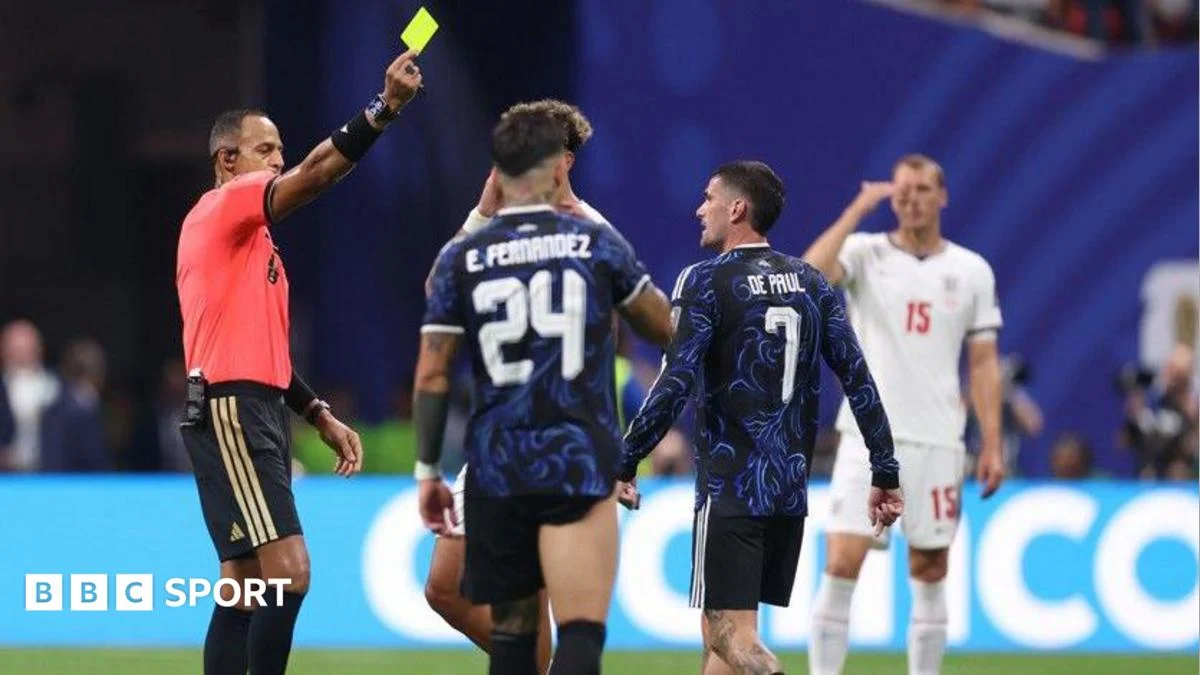
Laporte’s pointed remarks stem from observations of Argentina’s semi-final performance against England, a match that saw the South American giants emerge victorious with two late goals to secure a 2-1 win. During that intense encounter, Argentina reportedly committed 15 fouls, a statistic that has drawn the attention of the Spanish camp. One particular incident, just three minutes into the game, involved an early forceful challenge from behind by Argentina’s Enzo Fernandez on England’s Elliot Anderson. The challenge, which appeared to make contact with the back of Anderson’s neck, notably went unpunished by the match officials, failing to even result in a caution. Further fueling the debate, England fans also voiced strong opinions that Argentina’s match-winning goal should have been disallowed due to an alleged foul by Lionel Messi on Djed Spence in the build-up.
"It’s the referee’s job to keep a handle on these things so the situation doesn’t get out of hand," Laporte, a former Manchester City stalwart, articulated in an interview with the esteemed Spanish sports newspaper Marca. He elaborated on his concerns, stating, "If one or two players are allowed to act that way, the match descends into chaos." The 32-year-old defender emphasized that his apprehension is not about legitimate footballing aggression within the rules, but rather about instances that appear to transgress them. "I’m not at all worried about aggression within the context of football. If it’s within the rules and the referee does their job, I have no problem with it," Laporte clarified.
However, he drew a clear distinction when discussing recent Argentine performances. "It is true, however, that in recent matches we’ve seen things that really surprised us – actions that were allowed to slide," he stated. His focus then turned squarely to Argentina: "Especially with Argentina. They’re a team that likes to leave a mark on their opponents. That sort of thing shouldn’t be allowed in football – particularly in major competitions – because it can unsettle you and make you angry." Laporte’s comments suggest a strategic concern that Argentina’s physical approach, if unchecked by officials, could disrupt Spain’s own game plan and mental composure.
Managerial Perspectives: Focus on Spectacle Over Tactics
In contrast to Laporte’s direct critique, Spain’s head coach, Luis de la Fuente, adopted a more diplomatic and forward-looking stance. De la Fuente, who confirmed that teenage sensation Lamine Yamal is fit and available after a brief period of sitting out training, chose to pivot the conversation towards the magnitude and anticipated quality of the World Cup final. He expressed optimism about the upcoming clash, stating, "On Sunday we will watch a great show, two great national teams, very similar in some aspects in terms of attitudes and talent."
De la Fuente envisioned a captivating contest between two footballing powerhouses. "I think it is going to be an amazing final, each team will try and take the game to their own side," he predicted. He articulated a belief that both Spain and Argentina possess the tactical acumen and individual brilliance to produce a memorable spectacle. "I believe both Spain and Argentina will have a gameplan where talent and good football will rule over everything else," De la Fuente added. He underscored the crucial role of the officiating team in ensuring a fair and high-quality contest. "The referee will be there to support us and that the football is at a level expected of a World Cup final," he concluded, implicitly trusting the officials to manage the game effectively.
Argentina’s Quest for Back-to-Back Glory
The World Cup final represents a significant milestone for Argentina, who are vying to become the first nation since Brazil in 1958 and 1962 to successfully defend their men’s World Cup title. This aspiration underscores the immense pressure and historical significance attached to Sunday’s match. The team’s journey to the final has been characterized by a blend of individual brilliance, particularly from captain Lionel Messi, and a tenacious, often physically demanding, approach to their matches.
Argentina’s manager, Lionel Scaloni, did not face direct questions regarding his team’s tactical approach or Laporte’s comments during his pre-match press conference on Friday. Instead, Scaloni focused on the personal connection he shares with his Spanish counterpart, Luis de la Fuente. Their friendship dates back to 2017, when De la Fuente served as an instructor during Scaloni’s pursuit of his professional coaching license. "He knows me from a personal point of view," Scaloni remarked. However, he tempered this familiarity with a realistic assessment of their footballing discussions. "We are friends but that doesn’t mean he knows what I am thinking about when it comes to football," Scaloni stated.
While acknowledging some similarities in their preferred styles of play, particularly a desire to control possession, Scaloni echoed De la Fuente’s sentiment about the anticipated quality of the final. "We haven’t really been talking about playing style. We do have similar patterns of play when it comes to trying to have possession of the ball," he noted. Ultimately, Scaloni expressed his hope for a high-caliber match: "I hope the game on Sunday will be a great show."
Historical Context and Tactical Implications
The World Cup final is more than just a single match; it’s a culmination of years of dedication, strategic planning, and often, intense competition. Spain, as European champions, have showcased a brand of fluid, possession-based football that has consistently troubled opponents. Their technical proficiency and tactical discipline are well-documented. Argentina, on the other hand, have a rich history of producing tenacious and skillful players, often embodying a fighting spirit that complements their attacking flair.
Laporte’s concerns, while potentially perceived as mind games by some, highlight a recurring debate in international football: the balance between physicality and fair play. The International Football Association Board (IFAB), the body responsible for the Laws of the Game, continually seeks to maintain a level of fluidity and encourage attacking play. However, the interpretation and enforcement of these laws by referees in high-stakes matches can significantly influence the flow and nature of the game.
The history of World Cup finals is replete with examples of matches where physicality played a significant role. The 2006 final between Italy and France, for instance, is often remembered for its intense duels and the controversial red card issued to Zinedine Zidane. While such moments can add drama, they also raise questions about the officiating and the potential for aggressive tactics to overshadow the beautiful game.
The data from Argentina’s semi-final performance, with 15 fouls committed, suggests a deliberate strategy to disrupt England’s rhythm and prevent them from establishing control. While such tactics are not inherently illegal, Laporte’s argument centers on instances where these challenges may have crossed a perceived line, particularly when coupled with a perceived lack of consistent officiating. The potential impact of such a style on Spain’s own game, which relies on intricate passing and intelligent movement, is a key tactical consideration. If Argentina can effectively disrupt Spain’s passing lanes and impose their physical presence, it could force Spain into less comfortable areas of the pitch, potentially leading to turnovers and counter-attacking opportunities for the Albiceleste.
Broader Impact and Expectations
The World Cup final is the pinnacle of international football, watched by billions worldwide. The narrative surrounding the match often extends beyond the tactical battle on the pitch, encompassing the historical significance, the individual brilliance of star players, and the broader cultural impact of the tournament. Laporte’s comments, therefore, add another layer to the pre-match discourse, inviting discussions about the spirit of the game and the responsibilities of both players and officials.
The expectation for Sunday’s final is a captivating display of footballing talent. Spain will undoubtedly aim to control possession and dictate the tempo, while Argentina will look to leverage their attacking prowess and potentially their physical edge. The role of the referee will be paramount in ensuring that the game is played within the spirit of fair competition, allowing the skill and artistry of both teams to shine through. As the world tunes in, the focus will be on whether talent and good football prevail, as De la Fuente and Scaloni both hope, or if the intensity of the contest leads to a more contentious and physical affair, as Aymeric Laporte has cautioned. The stage is set for a historic encounter, and the way it unfolds will be closely scrutinized by fans, pundits, and players alike.