



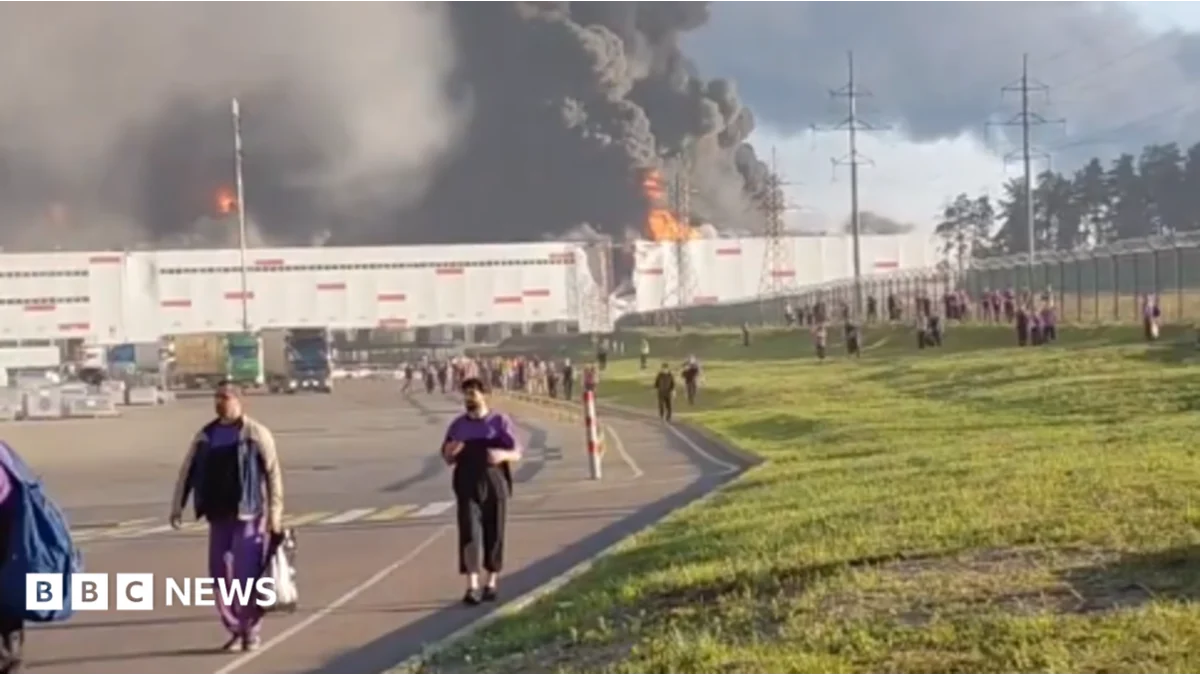
A coordinated wave of Ukrainian drone attacks has resulted in the deaths of eight people and injuries to 62 others, striking two prominent logistics warehouses belonging to Wildberries, Russia’s largest online retailer. The assaults, which unfolded overnight, represent a notable intensification of Ukraine’s strategy to target key Russian infrastructure deep within its territory, prompting strong condemnation from Russian officials and a defiant justification from Kyiv.
The most severe incident occurred at a Wildberries warehouse in Tambov, a city approximately 295 miles (475 km) south-east of Moscow, where seven fatalities and 25 injuries were reported. Tambov region governor Evgeniy Pervyshov stated on Telegram that seven individuals working the night shift died instantly, and 25 people sustained injuries, with seven in serious condition, primarily from shrapnel wounds. He characterized the attack as the "largest and most inhumane" in terms of drone numbers and casualties experienced by the Tambov region. Simultaneously, another Wildberries logistics facility in Elektrostal, within the Moscow region, was hit, leading to one death and 37 injuries, eight of which were described as serious by Moscow region governor Andrei Vorobyov.
Visuals of Devastation and Civilian Impact
Unverified images and videos circulating from the scenes painted a grim picture of the destruction. Footage from one of the warehouse strikes depicted massive flames engulfing a vast logistics building, with colossal plumes of black smoke billowing into the night sky. Other clips captured the chaotic aftermath, showing dozens of terrified workers scrambling into a car park area, attempting to flee as explosions continued to rock the facilities. One particularly harrowing video appeared to show the structural integrity of a warehouse failing, its walls disintegrating under the intense heat and force of the inferno. The nighttime nature of the attacks amplified the terror, catching many workers off guard and highlighting the indiscriminate dangers faced by civilians in such strikes.
Kyiv’s Justification and Strategic Objectives
Ukrainian President Volodymyr Zelensky swiftly acknowledged the attacks, asserting that they had targeted "major logistics facilities" which, he claimed, had been instrumental in "supply[ing] sanctioned components for drone production and navigation equipment." This statement underscores Kyiv’s assertion that even ostensibly civilian logistics hubs can play a dual-use role in sustaining Russia’s military efforts. Zelensky further clarified that Ukraine’s operations were a direct response to "Russian strikes on our civilian infrastructure and on our cities and communities." He highlighted that just overnight into Wednesday, 14 people had been killed in Russian attacks across Ukraine, framing the drone strikes as a necessary retaliatory measure. Beyond the Wildberries warehouses, Zelensky also confirmed that Ukrainian forces had struck targets in the Sea of Azov, the Black Sea, and Russian-annexed Crimea, along with an unspecified "oil facility."
Russian Defensive Efforts and Broader Infrastructure Damage
Russian authorities detailed their efforts to intercept the incoming drones. Governor Pervyshov reported that 28 drones were successfully shot down on approach to the Tambov region. In the Moscow region, Governor Vorobyov stated that a total of 48 drones were intercepted overnight. Despite these defensive measures, some drones evidently penetrated, causing significant damage and casualties. Vorobyov also disclosed that a Russian oil depot in the Moscow region had been struck by a falling drone, an incident he described as having "the most serious consequences" from the night’s assaults. Firefighters, emergency services, and the Ministry of Emergency Situations were actively working at the scene of the oil depot strike, though a detailed assessment of the damage was not immediately provided. Zelensky’s independent confirmation of striking an "oil facility" corroborated this aspect of the Russian reports.
The Wildberries Nexus: A Civilian Giant with Strategic Implications
Wildberries, often characterized as the "Russian Amazon," holds a dominant position in Russia’s e-commerce landscape. The merged RWB group, which combines Wildberries with advertising company Russ, was valued at approximately $12.6 billion (£9.3 billion) by Forbes Russia in 2026, underscoring its immense economic footprint. Tatyana Kim, the CEO of Wildberries and one of Russia’s first female billionaires, expressed the company’s distress, calling it a "terrible night" for both Russia and the enterprise.
While Wildberries primarily serves civilian consumers, Zelensky’s specific claim about the facilities supplying "sanctioned components for drone production and navigation equipment" suggests that Ukraine perceives these large-scale logistics operations as having strategic military relevance. In a wartime economy, the lines between civilian and military infrastructure can blur, as vast transportation and warehousing networks capable of moving consumer goods can also be utilized, directly or indirectly, for military logistics, including the transit of dual-use components that could be redirected for military manufacturing. This interpretation elevates the targeting of such facilities from mere economic disruption to a strategic move aimed at degrading Russia’s industrial and military supply chains.
The Escalating Drone War: A Chronology of Intensification
The recent strikes on Wildberries warehouses are not isolated incidents but rather part of an evolving and escalating drone campaign by Ukraine against Russian territory.
- Early Stages (2022-Early 2023): Initially, Ukrainian drone attacks on Russian soil were less frequent and largely confined to border regions, often targeting military installations or acting as symbolic gestures. The focus was primarily on disrupting immediate frontline logistics or conducting reconnaissance.
- Mid-2023: A noticeable shift occurred as Ukraine began deploying longer-range drones capable of reaching Moscow and other major cities deeper within Russia. These attacks frequently targeted government buildings, financial districts, and other symbolic targets, aiming to sow unease and demonstrate Ukraine’s reach.
- Late 2023-Present: The strategy has further matured, with a pronounced shift towards critical infrastructure. Ukrainian drones have increasingly focused on oil refineries, military airfields, industrial facilities, and now major logistics hubs. This strategic pivot aims to directly impact Russia’s ability to finance and sustain its full-scale invasion by degrading its energy production, military logistical capabilities, and industrial output. Ukraine’s continuous development of more sophisticated and longer-range unmanned aerial vehicles (UAVs) has been crucial to this escalation, challenging Russia’s extensive but often thinly spread air defense networks.
Broader Implications: Economic Disruption and Strategic Pressure
Ukraine has openly intensified its long-range drone attacks on Russia’s critical energy infrastructure, directly impacting fuel supplies. Earlier this month, Kyiv claimed that nearly 43% of Russia’s oil refining capacity had been "disabled" as a result of these strikes, though the BBC has not independently verified this figure. The cumulative effect of these attacks has been significant enough for Russian President Vladimir Putin to make a rare admission last month that fuel shortages had indeed been caused by Ukrainian drone strikes. In early July, Putin signed into law a bill aimed at boosting supplies to the domestic fuel market, a clear indicator of the economic pressure being exerted.
Ukraine maintains that Russian oil and gas facilities are legitimate targets because Moscow heavily relies on fossil fuel exports to finance its full-scale invasion, which commenced in February 2022. By striking these vital economic arteries, Ukraine aims to diminish Russia’s financial capacity to wage war and to create domestic pressure within Russia regarding the costs of the conflict.
The targeting of a major logistics company like Wildberries, even if its primary function is civilian, underscores the blurring lines in modern warfare where economic infrastructure can become strategically relevant. The attacks aim not only to inflict physical damage but also to create a psychological impact, fostering a sense of vulnerability and insecurity within Russia. The human cost of these attacks, with eight lives lost and dozens injured, tragically highlights that the conflict’s repercussions are increasingly extending beyond the front lines, impacting civilian workers in what were once considered safe interior regions. This latest series of drone strikes marks a significant escalation, signaling Ukraine’s resolve to continue its deep strikes and pressure Russia’s war machine through multifaceted strategic attacks.