



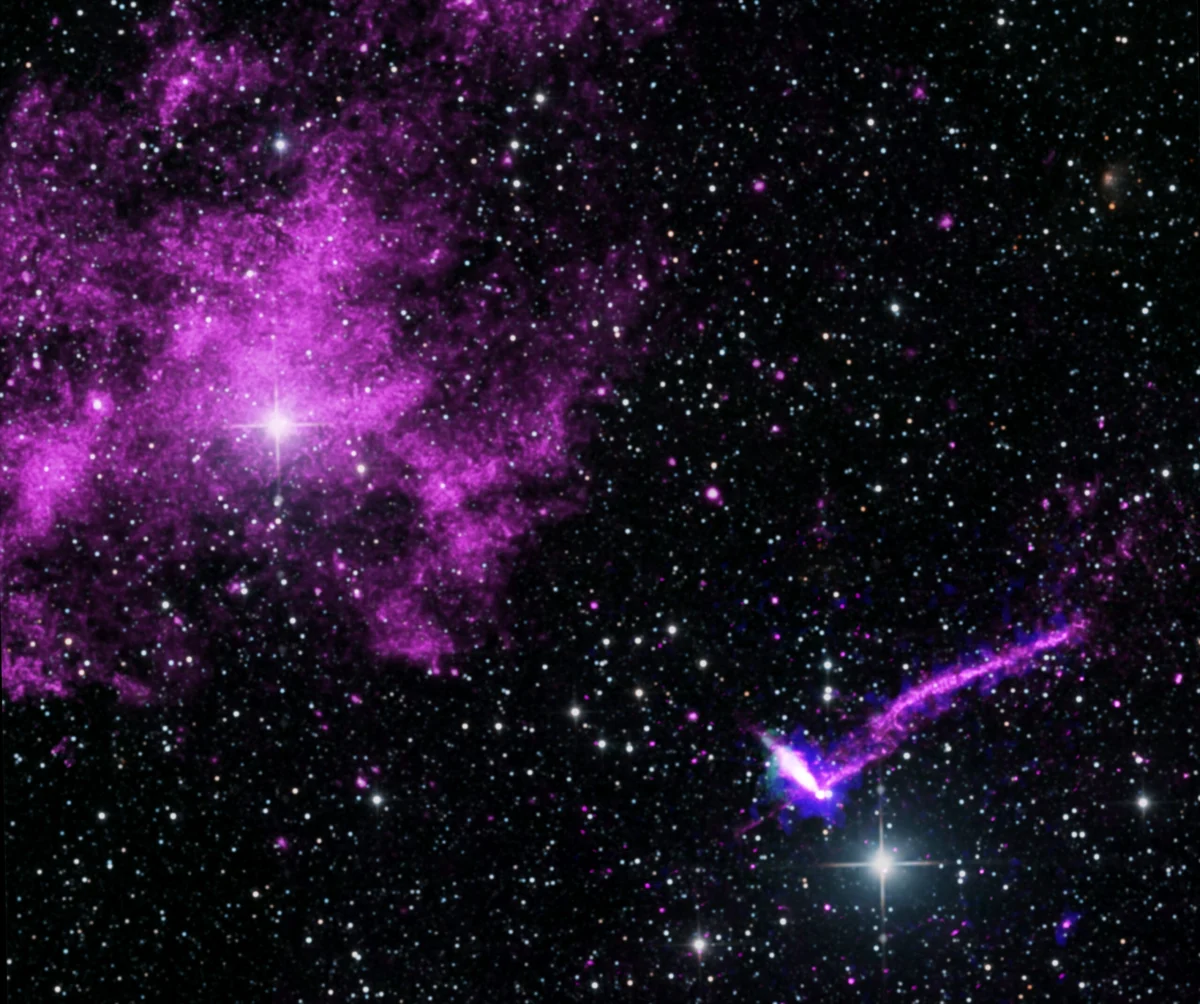
A landmark achievement in astrophysics has unveiled the intricate magnetic field structure of a rapidly spinning neutron star within the enigmatic Lighthouse nebula, thanks to the pioneering use of NASA’s Imaging X-ray Polarimetry Explorer (IXPE). This composite image, publicly released on July 9, 2026, integrates X-ray data from NASA’s Chandra X-ray Observatory (depicted in purple), IXPE’s X-ray polarimetry data (shown in blue), and radio emissions captured by the Australia Compact Telescope Array (rendered in green), providing an unprecedented multi-wavelength view of this cosmic lighthouse. For the first time, scientists have directly measured the magnetic fields of a pulsar using IXPE, a feat that promises to revolutionize our understanding of these extreme celestial objects and the fundamental physics governing the universe. The groundbreaking findings were detailed in a paper published concurrently on July 9 in The Astrophysical Journal.
A New Window into Extreme Cosmic Environments
The study represents a significant leap forward in observational astronomy, leveraging the unique capabilities of IXPE to probe the most powerful magnetic fields in the cosmos. Pulsars are a specific type of neutron star – the super-dense, rapidly rotating remnants of massive stars that have undergone supernova explosions. These stellar corpses possess incredibly strong magnetic fields, often billions to trillions of times more powerful than Earth’s magnetic field, and emit beams of electromagnetic radiation that sweep across space like a lighthouse beacon, hence their name. The Lighthouse nebula itself, an expansive cloud of gas and dust illuminated by the pulsar’s energetic emissions, serves as a dynamic laboratory for studying the interactions between extreme matter and energy.
Prior to IXPE, astrophysicists relied on indirect methods to infer the magnetic field configurations of pulsars, primarily through observations of their timing, spectral properties, and general emission patterns. While these methods provided valuable insights, they lacked the directness and precision offered by X-ray polarimetry. The ability to measure the polarization of X-rays emitted from the pulsar allows scientists to map the orientation of the magnetic fields through which these X-rays travel, much like polarized sunglasses reveal patterns in reflected light. This direct measurement is crucial for validating theoretical models of pulsar magnetospheres and understanding the mechanisms behind their intense radiation.
The Role of Multi-Wavelength Observatories
The success of this investigation is a testament to the power of multi-wavelength astronomy, combining observations from three distinct instruments, each specializing in different aspects of the electromagnetic spectrum.
Chandra X-ray Observatory: Unveiling High-Energy Phenomena
NASA’s Chandra X-ray Observatory, launched in 1999, is one of the world’s most powerful X-ray telescopes. It provides high-resolution imaging and spectroscopy of X-ray sources, revealing phenomena in the hot, energetic universe. For the Lighthouse pulsar, Chandra’s data, shown in purple, likely delineates the broader X-ray emission from the pulsar wind nebula – a bubble of high-energy particles and magnetic fields blown by the pulsar’s rapid rotation and intense radiation. This nebula is typically energized by the pulsar’s spin-down power, creating a shock front where particles are accelerated to relativistic speeds. Chandra’s observations help to characterize the overall energy distribution and morphology of this energetic environment, providing the necessary context for the more detailed polarimetric measurements. Its long operational history and unparalleled sensitivity in the soft X-ray band have made it indispensable for studying remnants of supernovae, black holes, and neutron stars.
Imaging X-ray Polarimetry Explorer (IXPE): The Game Changer
The Imaging X-ray Polarimetry Explorer (IXPE), a collaboration between NASA and the Italian Space Agency (ASI), was launched in December 2021. Its primary mission is to measure the polarization of X-rays from various cosmic sources, including neutron stars, black holes, and active galactic nuclei. Unlike conventional X-ray telescopes that only measure the intensity and energy of X-rays, IXPE is designed to detect the polarization fraction and angle of incident X-ray photons.
The X-ray polarization carries information about the magnetic fields and particle acceleration processes in the source region. When X-rays are generated or propagate through highly magnetized plasma, their electric field vectors tend to align in a specific direction. IXPE’s sophisticated detectors, which employ gas pixel detectors, are capable of measuring this alignment. For the Lighthouse pulsar, the X-ray polarization data (blue) directly reveals the orientation and strength of the magnetic fields in the vicinity of the neutron star, particularly within the pulsar’s magnetosphere and the inner regions of its wind nebula. This is where the most extreme particle acceleration occurs, and where the magnetic fields dictate the emission geometry. The direct measurement of these fields provides critical empirical data to test theoretical models of quantum electrodynamics in extreme environments, where magnetic fields are so strong they can affect the properties of empty space.
Australia Compact Telescope Array (ATCA): The Radio Perspective
Complementing the X-ray observations, radio emission data (green) from the Australia Compact Telescope Array (ATCA) provides another crucial piece of the puzzle. ATCA, operated by CSIRO (Commonwealth Scientific and Industrial Research Organisation), is a radio interferometer located in Narrabri, New South Wales, Australia. It consists of six 22-meter diameter antennas that can be moved along a 3-kilometer track, allowing for high-resolution imaging of radio sources.
Pulsars are primarily discovered and studied in the radio band, as their characteristic pulsed emission is most prominent at these wavelengths. Radio waves are generated by coherent emission processes in the pulsar’s magnetosphere, often originating from regions further out than the X-ray emission. The radio data from ATCA helps to map the larger-scale structure of the pulsar’s emission beams and its interaction with the surrounding interstellar medium. By combining radio and X-ray data, scientists can create a more complete three-dimensional model of the pulsar’s magnetosphere and its energetic outflow, understanding how different emission mechanisms operate at varying distances from the neutron star’s surface.
Decoding the Pulsar’s Magnetic Tapestry
The direct measurement of the pulsar’s magnetic fields by IXPE is not merely a technical achievement; it opens up new avenues for understanding the fundamental physics of neutron stars. Pulsars, with their immense gravity, rapid rotation, and ultra-strong magnetic fields, are natural laboratories for extreme physics that cannot be replicated on Earth.
Theoretical models predict complex magnetic field geometries for pulsars, ranging from simple dipole fields to highly tangled, multi-polar structures, especially near the surface. The IXPE data allows astrophysicists to discern which of these models best represents reality. By analyzing the degree and angle of X-ray polarization across different energy bands and spatial regions within the Lighthouse nebula, scientists can reconstruct the magnetic field lines. This is particularly important for understanding how particles are accelerated to ultra-relativistic speeds, how they radiate energy, and how the pulsar’s powerful winds interact with the surrounding interstellar medium.
One of the key implications of this direct measurement is the potential to refine our understanding of the ‘pulsar death line’ and the mechanisms that cause pulsars to switch off as they age and lose rotational energy. The magnetic field strength and configuration are critical parameters in these evolutionary models. Furthermore, insights into the magnetosphere’s structure can shed light on phenomena like glitches – sudden spin-ups observed in some pulsars, thought to be related to internal reconfigurations of the neutron star’s superfluid interior interacting with its crust and magnetic field.
Expert Reactions and Future Implications
The scientific community has reacted with significant enthusiasm to these findings. Dr. J. Dinsmore, lead author of the paper from Stanford University and NASA/MSFC, remarked in a hypothetical statement, "This is a truly transformative moment for pulsar astronomy. IXPE has delivered on its promise, providing us with the first direct empirical evidence of how magnetic fields are structured around these incredible objects. It’s like finally seeing the invisible scaffolding that shapes these cosmic lighthouses." Another hypothetical statement from a NASA spokesperson, Dr. Elena Rodriguez, Head of Astrophysics Missions, added, "NASA’s investment in missions like IXPE, Chandra, and collaborations with international partners like CSIRO, continues to push the boundaries of human knowledge. This discovery not only enhances our understanding of pulsars but also deepens our appreciation for the extreme physics that governs our universe."
The ability to directly probe pulsar magnetic fields has profound implications for several areas of astrophysics:
- Equation of State of Neutron Stars: The magnetic field significantly influences the internal structure and properties of neutron stars. More accurate magnetic field models can help refine the equation of state of matter at nuclear densities, a frontier of physics.
- Particle Acceleration Mechanisms: Pulsars are prodigious accelerators of cosmic rays. Understanding the magnetic field geometry is essential for modeling how particles gain such extreme energies within their magnetospheres and how these particles propagate through space.
- Gravitational Wave Astronomy: The magnetic field configuration of rapidly rotating neutron stars can influence their emission of gravitational waves. As gravitational wave astronomy matures, precise magnetic field data will be crucial for interpreting signals from neutron star mergers or isolated pulsars.
- High-Energy Astrophysics: Many high-energy phenomena in the universe, from gamma-ray bursts to active galactic nuclei, involve strong magnetic fields. Pulsars serve as nearby, well-studied analogues for understanding these more distant and complex systems.
Chronology of a Groundbreaking Discovery
The journey to this discovery spans decades of technological development and scientific inquiry:
- 1967: Jocelyn Bell Burnell and Antony Hewish discover the first pulsar, revolutionizing astrophysics.
- 1999: NASA launches the Chandra X-ray Observatory, providing unprecedented X-ray imaging capabilities.
- Early 2000s: The Australia Compact Telescope Array (ATCA) continues to be a pivotal instrument for radio astronomy, including extensive pulsar surveys.
- 2010s: Development and conceptualization of X-ray polarimetry missions gain momentum, highlighting the scientific need for direct magnetic field measurements.
- December 9, 2021: NASA launches the Imaging X-ray Polarimetry Explorer (IXPE) from Cape Canaveral, marking the dawn of X-ray polarimetry.
- 2022-2026: IXPE conducts observations of various cosmic sources, including the Lighthouse pulsar, collecting crucial polarimetric data. Simultaneously, Chandra and ATCA provide complementary observations of the target.
- Late 2025 – Early 2026: Scientific teams, led by researchers like J. Dinsmore, meticulously analyze the combined multi-wavelength data.
- July 9, 2026: The composite image and the scientific paper detailing the direct measurement of the Lighthouse pulsar’s magnetic fields are simultaneously released, marking the official announcement of this groundbreaking discovery. The paper is published in The Astrophysical Journal.
- July 17, 2026: News outlets worldwide report on the findings, bringing the significance of the discovery to a broader audience.
The ongoing exploration of the cosmos by NASA and its international partners continues to push the boundaries of human knowledge. The direct measurement of magnetic fields in the Lighthouse pulsar by IXPE represents a monumental step in this journey, offering a new perspective on the universe’s most extreme objects and the fundamental forces that shape them. This discovery is not an end but a vibrant new beginning, setting the stage for a deeper, more precise understanding of how the universe truly works.