


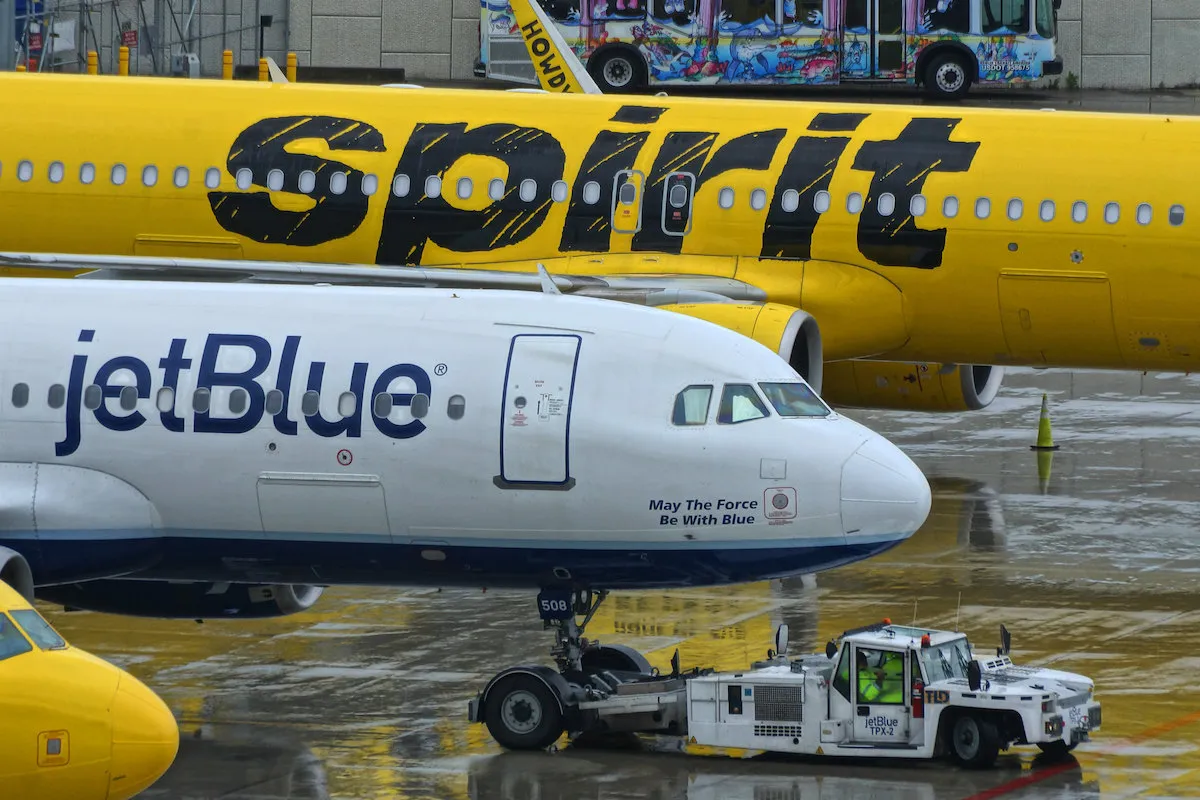
JetBlue Airways has emerged as the winning bidder for the flight slots previously held by Spirit Airlines at New York’s LaGuardia Airport (LGA), a move that marks a significant shift in the competitive landscape of the New York aviation market. According to recent filings in the U.S. Bankruptcy Court for the Southern District of New York, JetBlue submitted a high bid of $58.5 million to acquire 22 takeoff and landing slots at one of the nation’s most capacity-constrained and operationally expensive airports. The acquisition follows a competitive bidding process in which Frontier Airlines served as the primary challenger, offering $57.5 million for the same assets. The outcome of the auction is subject to final approval by the Bankruptcy Court, with a hearing scheduled for Wednesday to formalize the transaction and finalize JetBlue’s expansion at the Queens-based hub.
The acquisition of these slots represents a strategic victory for JetBlue as it seeks to fortify its presence in its home market of New York. For years, the carrier has struggled to find avenues for growth at LaGuardia due to the airport’s stringent "slot" system, which limits the number of flights that can operate per hour to prevent excessive congestion. By securing Spirit’s 22 slots, JetBlue effectively gains the ability to operate 11 additional daily round-trip flights, a substantial increase in capacity that would have otherwise been nearly impossible to obtain through traditional market channels.
The Auction Dynamics and Financial Stakes
The bidding process for Spirit’s LaGuardia assets was part of the low-cost carrier’s broader effort to restructure its finances under Chapter 11 bankruptcy protection. Spirit Airlines, which has faced mounting debt and operational challenges over the last several years, identified its LaGuardia slots as a premium asset capable of generating significant liquidity. Initial estimates provided by Spirit during its bankruptcy proceedings suggested the slots could be valued as high as $60 million, a figure that the JetBlue bid nearly reached.
Frontier Airlines’ participation in the auction underscores the high demand for access to the New York metropolitan area. Frontier, which has been aggressively expanding its footprint across the East Coast, viewed the Spirit slots as an opportunity to establish a more permanent and robust presence at LaGuardia. However, JetBlue’s $1 million premium over Frontier’s bid ultimately secured the assets. For JetBlue, the $58.5 million investment is seen by industry analysts as a necessary cost of doing business in a market where barriers to entry are exceptionally high.
The specific slots in question are located at LaGuardia’s Marine Air Terminal (Terminal A), a historic Art Deco facility that sits apart from the airport’s main terminal complex. Spirit had been the primary tenant of this terminal, utilizing its unique location to manage its New York operations. While the Marine Air Terminal is often viewed as less convenient for passengers connecting to other airlines, its distinct footprint offers a level of operational autonomy that JetBlue can leverage to streamline its ground handling and passenger processing for the additional flights.
Historical Context: From Merger Attempt to Asset Acquisition
The successful bid for Spirit’s slots comes less than a year after JetBlue’s ambitious attempt to acquire Spirit Airlines in its entirety was blocked by federal regulators. In early 2024, a U.S. District Court judge ruled in favor of the Department of Justice (DOJ), blocking the $3.8 billion merger on the grounds that it would harm competition and lead to higher fares for budget-conscious travelers. The court specifically noted that the elimination of Spirit as a standalone "ultra-low-cost carrier" (ULCC) would remove a critical downward pressure on pricing in the industry.
Ironically, the bankruptcy of Spirit has allowed JetBlue to acquire a portion of the very assets it sought in the merger, albeit through a court-sanctioned liquidation process rather than a corporate consolidation. While the DOJ successfully prevented JetBlue from absorbing Spirit’s entire national network, the sale of individual assets like the LaGuardia slots is governed by bankruptcy law, where the primary objective is to maximize value for creditors.
This acquisition also follows the forced dissolution of the "Northeast Alliance" (NEA) between JetBlue and American Airlines. The NEA, which allowed the two carriers to coordinate schedules and share revenue in New York and Boston, was also struck down by a federal judge in 2023 following an antitrust challenge. Deprived of the growth opportunities provided by the NEA and the Spirit merger, JetBlue has been forced to pursue an organic growth strategy centered on acquiring scarce assets whenever they become available on the open market.
Understanding the LaGuardia Slot System
To understand the significance of this transaction, one must consider the unique regulatory environment of New York’s LaGuardia Airport. Unlike most U.S. airports, where airlines can generally add flights as long as they have gate space, LaGuardia is one of only three airports in the country (alongside JFK and Ronald Reagan Washington National) that is "slot-controlled" by the Federal Aviation Administration (FAA).
A slot is essentially a reservation that allows an airline to land or take off during a specific 30-minute window. These slots were established under the High Density Rule to manage the extreme congestion in the New York airspace. Because the total number of slots is capped, they have become incredibly valuable intangible assets. Airlines often hold onto them for decades, and when they do change hands, it is usually through high-stakes auctions or complex asset swaps.
The 22 slots JetBlue is acquiring represent a significant portion of the total operations at Terminal A. For a carrier like JetBlue, which already has a major presence in Terminals B and C, the addition of capacity at Terminal A presents both an opportunity and a logistical challenge. The airline will need to decide whether to split its operations across multiple terminals—a move that can increase costs and complicate passenger connections—or use the new slots to launch specific high-frequency routes that can operate independently of its main hub activities.
Chronology of the Spirit Airlines Bankruptcy and Slot Sale
The path to the current auction began in late 2023 as Spirit Airlines’ financial position began to deteriorate rapidly. The following timeline outlines the key events leading to JetBlue’s successful bid:
- January 2024: A federal judge blocks JetBlue’s $3.8 billion acquisition of Spirit Airlines, citing antitrust concerns.
- March 2024: JetBlue and Spirit officially terminate their merger agreement, with JetBlue paying Spirit a $69 million termination fee.
- Summer 2024: Spirit Airlines struggles with grounded aircraft due to Pratt & Whitney engine issues and a softening of the domestic discount travel market.
- October 2024: Spirit begins discussions with bondholders regarding a potential bankruptcy filing and starts identifying non-core assets for sale, including its New York slots.
- November 2024: Spirit Airlines officially files for Chapter 11 bankruptcy protection in the Southern District of New York.
- Early December 2024: The bankruptcy court authorizes an auction for Spirit’s LaGuardia slots. Frontier Airlines is initially identified as the stalking horse bidder.
- December 2024: JetBlue outbids Frontier in the final round of the auction with a $58.5 million offer.
Implications for the New York Aviation Market
The transfer of slots from Spirit to JetBlue has broad implications for travelers in the New York region. Spirit Airlines operated as an ultra-low-cost carrier, often offering the lowest base fares in the market, albeit with additional fees for bags, seats, and other services. JetBlue, while often more affordable than legacy carriers like Delta or United, operates as a "hybrid" carrier, offering more amenities such as free Wi-Fi, seatback entertainment, and more legroom.
The departure of Spirit from LaGuardia’s Marine Air Terminal marks the end of a specific type of budget service at the airport. While Frontier Airlines continues to operate at LGA, the loss of Spirit’s 11 daily round trips reduces the total number of ULCC seats available to New Yorkers. Fact-based analysis suggests that when a low-cost carrier is replaced by a higher-cost operator, average fares on the affected routes tend to rise—a phenomenon often referred to by economists as the "Southwest Effect" in reverse.
However, JetBlue’s expansion could also lead to increased competition on premium routes. By adding 11 daily flights, JetBlue can increase its frequency to key business destinations such as Boston, Washington D.C., and Chicago. Increased frequency is a primary driver for corporate travel contracts, and this move allows JetBlue to compete more effectively for high-value business travelers who might otherwise choose Delta or American Airlines.
The Historic Marine Air Terminal (Terminal A)
The 22 slots are tied specifically to the Marine Air Terminal, a location steeped in aviation history. Opened in 1940, the terminal was originally built to handle the "flying boats" of Pan American Airways. It is the only active airport terminal in the United States dating back to the first "golden age" of aviation and is listed on the National Register of Historic Places.
In recent decades, the terminal has served as a niche facility, often housing shuttle services or low-cost carriers. Its distance from the newly renovated, multi-billion dollar Terminal B means that passengers using JetBlue’s new slots will experience a very different side of LaGuardia. Terminal A offers a smaller, more intimate environment with shorter security lines, but it lacks the expansive retail and dining options found in the main terminal complex. JetBlue’s management of this split-terminal operation will be a key factor in the success of the acquisition.
Industry Reactions and Future Outlook
While JetBlue has not released an extensive public statement pending the final court approval, industry analysts suggest the move is a defensive necessity. "JetBlue is in a ‘must-grow’ phase in New York," said one aviation consultant. "After the NEA was blocked and the Spirit merger failed, they were at risk of being squeezed out of their own backyard by Delta’s massive expansion at LaGuardia. These 22 slots are a lifeline that keeps them relevant at LGA."
The bankruptcy court’s hearing on Wednesday is expected to be a procedural milestone. Given that the auction was competitive and resulted in a price near Spirit’s own valuations, there are few grounds for creditors to object. Furthermore, because this is a sale of assets in bankruptcy rather than a merger, it is less likely to trigger the same level of antitrust scrutiny that derailed the JetBlue-Spirit merger, though the DOJ maintains the right to review any significant transfer of airport slots.
As Spirit Airlines continues its restructuring process, the sale of its LaGuardia slots may be followed by the divestiture of other assets, including slots at other constrained airports or aircraft leases. For JetBlue, the focus now shifts to operational integration. The airline must coordinate with the Port Authority of New York and New Jersey to manage the transition at Terminal A and determine which routes will best utilize the newly acquired capacity.
In the broader context of the U.S. airline industry, this transaction highlights the ongoing volatility of the low-cost carrier sector. As Spirit shrinks to survive, larger players like JetBlue are poised to capture the resulting market share, further consolidating the industry even in the absence of large-scale mergers. For the New York traveler, the arrival of more JetBlue "blue" at the historic Marine Air Terminal signals a new chapter in the ever-evolving story of LaGuardia Airport.