

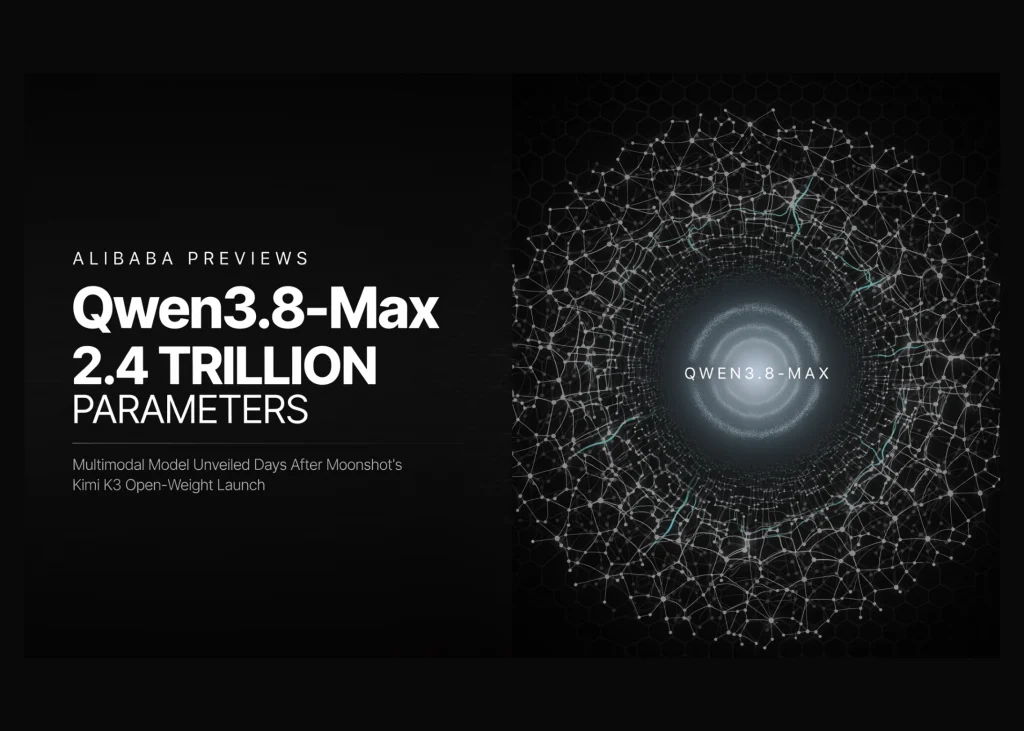
Alibaba’s Qwen research team officially announced the preview release of Qwen3.8-Max-Preview on July 19, 2026, marking a significant milestone in the rapidly accelerating global race for artificial intelligence supremacy. Positioned as the next flagship in the Qwen family, the model is described by its creators as a 2.4 trillion-parameter powerhouse, a scale that places it among the largest and most complex neural networks ever developed. According to internal benchmarking data released by Alibaba, the model currently ranks as the second most capable system in existence, trailing only "Fable 5," the high-end frontier model from Anthropic that has served as the industry standard for much of the year. The announcement, made during the World AI Conference (WAIC) in Shanghai, signals a shift in the AI landscape as Chinese labs increasingly demonstrate the ability to match or exceed the technical specifications of their Western counterparts.
The launch of the Qwen3.8-Max-Preview is not merely a technical update but a strategic move within a highly volatile market. The preview is currently live for select users and enterprise partners, though the research team has noted that the comprehensive benchmark tables, detailed model cards, and official open-weight licenses are still forthcoming. By releasing the preview build through Alibaba’s Token Plan subscription at a 10% introductory discount, the company is effectively inviting the global developer community to stress-test the architecture before the full-scale deployment of the final version.
The Strategic Context of the Shanghai Announcement
The timing of Alibaba’s announcement is widely viewed by industry analysts as a direct response to the escalating "parameter war" among Chinese AI laboratories. Only 48 hours prior to the Qwen3.8 reveal, Moonshot AI, another major player in the domestic Chinese sector, released Kimi K3, a 2.8 trillion-parameter open-weight model. The proximity of these two releases suggests a highly coordinated or intensely competitive environment where leading firms are vying for dominance in the "open-weight" category—models where the underlying weights are accessible to the public, allowing for local hosting and fine-tuning.
The World AI Conference in Shanghai provided the ideal stage for this demonstration of technical prowess. As an event focused on "AI for Good" and industrial integration, WAIC has become the premier venue for Chinese tech giants to showcase their self-reliance in the face of ongoing international trade restrictions and hardware limitations. Alibaba’s decision to highlight a 2.4 trillion-parameter model underscores its commitment to the "Scaling Laws," the hypothesis that increasing a model’s parameters and training data leads to proportional increases in intelligence and reasoning capabilities.
Technical Specifications and the MoE Architecture
While the 2.4 trillion-parameter figure is the headline-grabbing statistic, technical experts have been quick to point out that total parameter count is often a misleading metric for actual performance or operational efficiency. Like its predecessors, Qwen3.8 utilizes a Mixture of Experts (MoE) architecture. In a traditional "dense" model, every parameter is activated for every single query, which is computationally expensive and slow. In contrast, an MoE model like Qwen3.8 is "sparse," meaning only a fraction of its 2.4 trillion parameters are activated to process a specific token.
Historical data from the Qwen3 lineage provides a roadmap for understanding this distinction. For example, the Qwen3-235B-A22B model carries 235 billion total parameters but only activates 22 billion per token. Similarly, the Qwen3-30B-A3B variant activates roughly 3 billion parameters. For Qwen3.8-Max, Alibaba has not yet disclosed the "active-parameter" count. This missing data point is critical for developers and enterprise architects, as it determines the inference speed and the actual "compute cost" of running the model.
The physical requirements for running a model of this magnitude are staggering. Independent calculations suggest that a 2.4 trillion-parameter model, even when compressed to 4-bit precision, would require approximately 1.2 terabytes of Video RAM (VRAM) just to load the weights into memory. To put this in perspective, a top-tier Nvidia H200 GPU possesses 141GB of VRAM. A standard high-density server rack containing eight such cards would still fall short of the memory required to host the full model without sophisticated sharding or offloading techniques. This logistical hurdle has led to speculation that Alibaba may eventually release distilled or quantized versions of the model for broader industrial use.
Multimodality and Workflow Integration
One of the most significant advancements in Qwen3.8, as highlighted by lead developer Shuai Bai, is its native multimodality. This is the first model in the Qwen family exceeding the 1 trillion-parameter threshold that is capable of processing and generating content across text, images, video, and complex documents simultaneously.
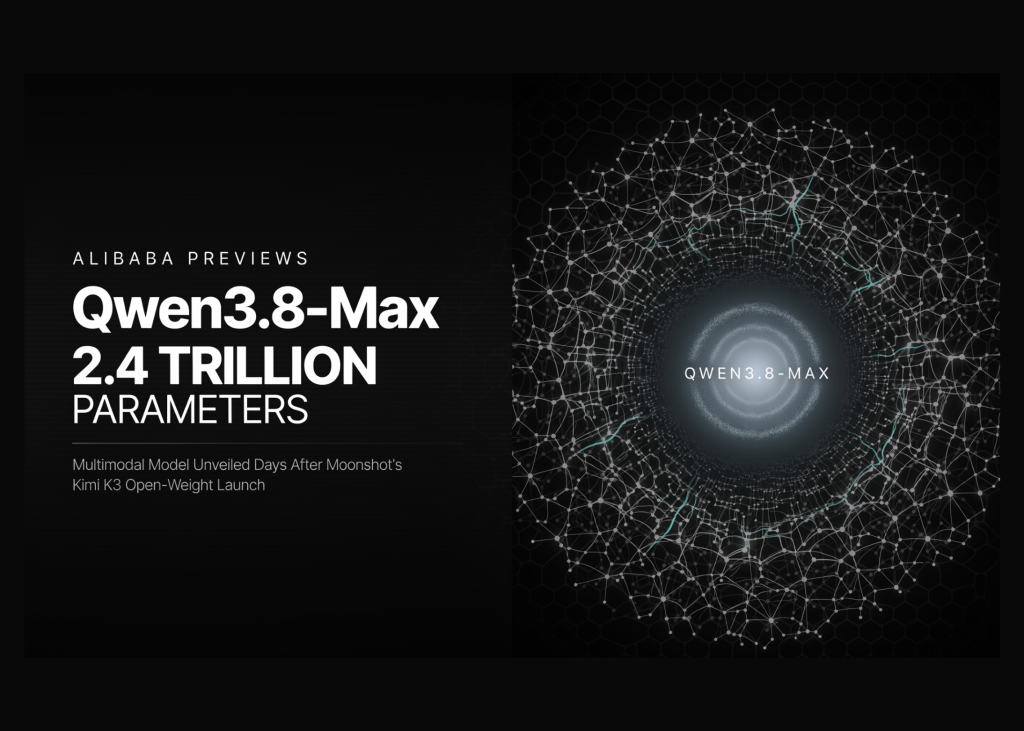
The Alibaba development team claims that Qwen3.8-Max-Preview represents a substantial leap over the previous Qwen3.7-Max, particularly in high-stakes technical domains. These include:
- Advanced Coding and Full-Stack Development: The model is designed to manage entire codebases, suggesting improvements in long-context window management and logical consistency across multiple files.
- Data Analysis: Enhanced mathematical reasoning allows the model to interpret large datasets and generate visualization code with higher accuracy.
- Office Workflows: The model’s ability to parse "messy" documents—such as hand-annotated PDFs or complex spreadsheets—is a core focus of the new release.
By integrating these capabilities into a single architecture, Alibaba is positioning Qwen3.8 not just as a chatbot, but as a foundational operating system for autonomous agents and enterprise automation.
Market and Community Reaction
The reaction from the global developer community has been a mixture of professional excitement and healthy skepticism. On platforms like Hacker News, the discussion has centered on the geopolitical implications of the release. Many contributors noted that an "open-weight race" between Chinese labs like Alibaba and Moonshot AI serves as a massive benefit to the global ecosystem, providing high-quality alternatives to the "closed" models offered by Western companies like OpenAI.
However, a recurring theme in the feedback is "benchmark fatigue." Some developers on Reddit’s r/LocalLLaMA community have characterized Qwen as a "benchmark specialist," suggesting that the models are often optimized to perform well on standardized tests (such as MMLU or HumanEval) but may struggle with the nuances of real-world, creative, or multi-turn conversational tasks. The claim that the model is "second only to Fable 5" is being treated with caution until third-party organizations like Artificial Analysis or the LMSYS Chatbot Arena can provide independent verification.
On social media platform X, the announcement trended under various AI-related hashtags. While large-scale influencers amplified the news of the 2.4T parameter count, the practical conversation among engineers remained focused on the "serving math." The consensus among local-hosting enthusiasts is that unless a distilled or highly quantized version is released, Qwen3.8-Max will remain a tool primarily for well-funded research institutions and massive cloud providers rather than individual developers.
Implications for the AI Industry
The release of Qwen3.8-Max-Preview carries several long-term implications for the AI industry:
- Pressure on Western Labs: With Alibaba and Moonshot AI pushing the boundaries of open-weight models, Western firms that favor closed-source models (like OpenAI and Google) may face increased pressure to justify their "black box" approach, especially as open models begin to close the performance gap.
- Hardware Optimization: The sheer size of Qwen3.8 highlights the ongoing bottleneck in AI hardware. As models reach the multi-trillion parameter scale, the industry must innovate in memory compression and interconnect speeds to make these systems viable for anything other than the largest data centers.
- The Rise of Chinese Frontier Models: The 2026 AI landscape is increasingly defined by a bipolar distribution of power. Alibaba’s ability to release a model comparable to Anthropic’s flagship suggests that the gap between Silicon Valley and Chinese research hubs has narrowed significantly, despite export controls on advanced semiconductors.
Conclusion and Recommendations for Users
As of July 19, 2026, the Qwen3.8-Max-Preview is an impressive technical demonstration, but it remains in a "preview" state. For organizations considering a migration of their production workloads to this new architecture, caution is advised. The lack of a final model card and independent benchmarks means that the model’s reliability in edge cases is still unknown.
Industry experts recommend that developers monitor five key indicators over the coming weeks:
- The publication of the official Qwen blog post with comprehensive benchmark tables.
- The disclosure of the active-parameter count to calculate true inference costs.
- The release of the Hugging Face repository containing the weights and a clear license file.
- The finalization of API pricing for the non-preview version.
- The results of independent evaluations from the broader AI research community.
Until these data points are available, the most prudent course of action is to test the model on non-critical, internal workloads via the Alibaba Cloud console. While the 2.4 trillion parameters represent a monumental achievement in engineering, the true value of Qwen3.8 will be determined by its performance in the field, not its position on a leaderboard.