


The landscape of Large Language Model (LLM) development has shifted from a focus on sheer parameter count to a rigorous optimization of the fine-tuning process, where efficiency, memory management, and scaling are the primary metrics of success. Currently, four open-source projects dominate this sector: Unsloth, Axolotl, TRL, and LLaMA-Factory. While these frameworks all utilize the foundational PyTorch and Hugging Face ecosystem, they represent distinct engineering philosophies. Unsloth focuses on low-level kernel rewrites to maximize single-GPU performance; Axolotl prioritizes complex parallelism strategies for multi-GPU clusters; TRL (Transformer Reinforcement Learning) serves as the standardized API layer for the broader community; and LLaMA-Factory emphasizes accessibility through a zero-code interface and extensive model support.
The Evolution of LLM Fine-Tuning Frameworks
The rapid development of these tools has been dictated by the release cycles of foundational models such as Meta’s Llama series, Mistral, and Alibaba’s Qwen. In the early stages of the LLM boom, fine-tuning was often a manual, error-prone process requiring custom training scripts. The emergence of Hugging Face’s TRL provided the first major standardization, offering a unified Trainer API that simplified the implementation of Reward Modeling and Proximal Policy Optimization (PPO).
By 2024, the demand for more hardware-efficient training led to the rise of specialized wrappers. Unsloth emerged as a disruptive force by identifying bottlenecks in the standard PyTorch autograd functions, replacing them with hand-written Triton kernels. Simultaneously, Axolotl gained traction among researchers requiring sophisticated distributed training setups, such as Fully Sharded Data Parallelism (FSDP). By early 2025, the ecosystem reached a state of maturity where these frameworks began cross-pollinating; for instance, Axolotl integrated custom kernels inspired by Unsloth, and LLaMA-Factory added a Megatron-core backend to support industrial-scale pre-training.
Unsloth: Optimizing the Single-GPU Frontier
Unsloth has positioned itself as the leader in raw throughput for developers working with limited hardware resources. The project’s core value proposition lies in its rewrite of the mathematical kernels used during the backward pass of training. By optimizing how gradients are calculated and stored, Unsloth significantly reduces the overhead typically associated with the standard Transformers library.
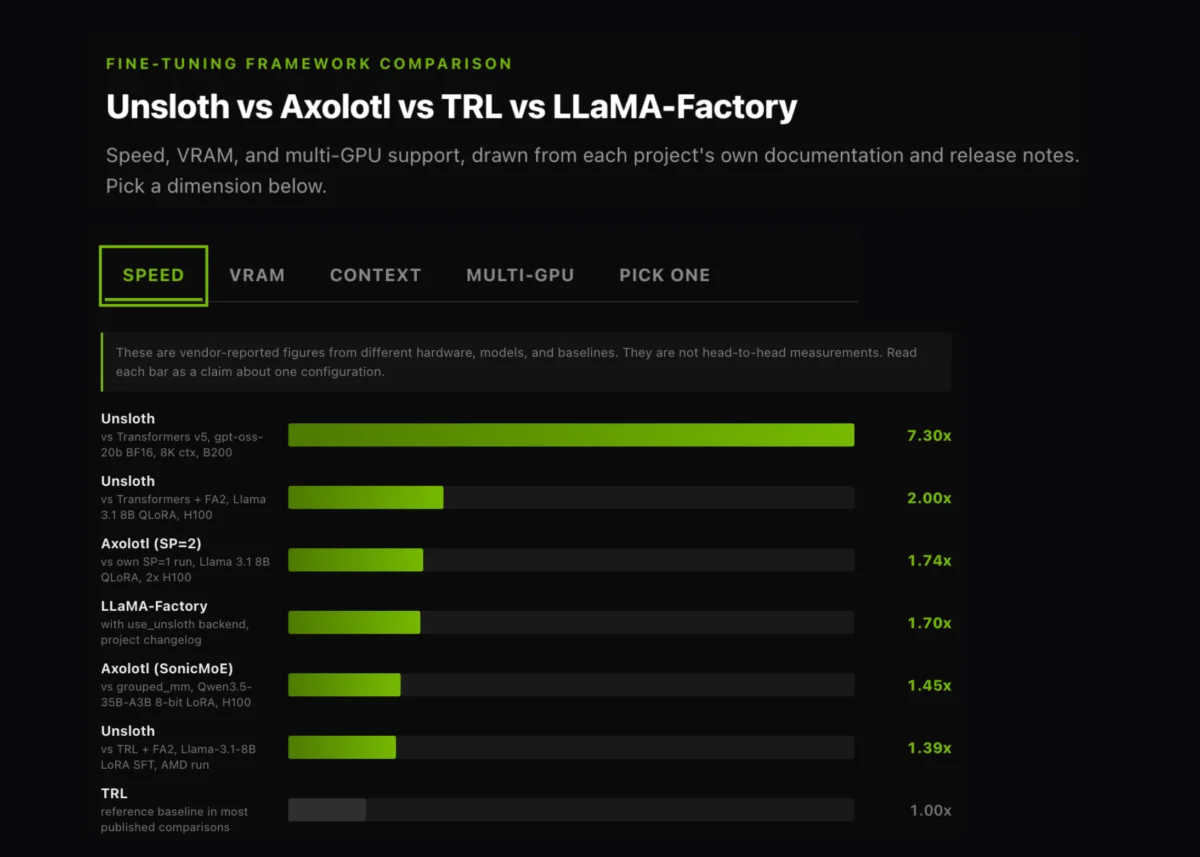
Published benchmarks indicate that Unsloth can achieve a 2x increase in training speed for Llama 3.1 8B and Llama 3.3 70B models. In a controlled test environment using the Alpaca dataset with a batch size of 2 and a gradient accumulation of 4, Unsloth maintained consistent loss curves while doubling the processing speed of standard QLoRA (Quantized Low-Rank Adaptation).
The performance gains are even more pronounced in Mixture of Experts (MoE) architectures. When fine-tuning a 20-billion parameter MoE model on an NVIDIA B200, Unsloth recorded a step time of 712.33 ms at an 8K context length. In comparison, the standard Transformers v5 baseline required 5,226.86 ms, representing a 7.3x performance gap. These gains are largely attributed to the framework’s use of "Flex Attention" and specialized MoE kernels that prevent the redundant materialization of weights across experts. However, data suggests these gains are context-dependent; as sequence lengths increase, the speedup can fluctuate based on the specific GPU architecture, with H100 and B200 systems showing the most significant benefits.
Axolotl: Advanced Parallelism and Distributed Scaling
While Unsloth focuses on the "how" of kernel execution, Axolotl focuses on the "where" of data distribution. Axolotl is designed for engineers who need to scale training across multiple GPUs or nodes. In February 2025, the project introduced custom Triton kernels for LoRA layers, citing Unsloth as a direct inspiration, but its primary strength remains its native support for complex parallelism.
Axolotl’s architecture supports a "deep parallelism matrix," allowing users to compose different sharding strategies through PyTorch’s DeviceMesh. This includes:
- FSDP2 (Fully Sharded Data Parallelism): The current recommended path for sharding model states across GPUs.
- N-D Parallelism: The ability to combine Data, Tensor, Context, and Expert parallelism.
- Sequence Parallelism: Utilizing the
ring-flash-attentionlibrary to handle massive context lengths that exceed the memory of a single GPU.
In recent benchmarks involving the Qwen 3.5-35B-A3B model, Axolotl’s "SonicMoE" support delivered a 1.45x speedup and a 30% reduction in VRAM usage compared to standard grouped matrix multiplication. Furthermore, Axolotl provides a modular approach to attention mechanisms, supporting FlashAttention 2, 3, and 4, as well as SageAttention and Liger Kernels, making it the most versatile tool for experimental hardware configurations.
TRL and LLaMA-Factory: Standardization and Accessibility
Hugging Face’s TRL remains the baseline against which all other frameworks are measured. Rather than competing solely on speed, TRL focuses on feature breadth and stability. It serves as the primary integration point for new training methodologies like GRPO (Group Relative Policy Optimization), which is essential for modern reasoning models. TRL’s documentation provides a comprehensive roadmap for reducing memory usage through packing, padding-free batching, and vLLM integration for faster inference during the training loop.

LLaMA-Factory, conversely, targets the "prosumer" and enterprise segments where ease of use is paramount. It does not typically write its own kernels but acts as a sophisticated orchestrator. Through its LlamaBoard UI, users can activate Unsloth’s patches or Liger kernels via simple toggle switches. A significant milestone for LLaMA-Factory in 2025 was the addition of the mcore_adapter, which allows the framework to utilize NVIDIA’s Megatron-core. This transition moves LLaMA-Factory from a purely fine-tuning tool into a viable option for large-scale model pre-training.
Comparative VRAM Efficiency and Context Length
One of the most critical bottlenecks in LLM training is Video Random Access Memory (VRAM). The ability to train longer sequences on cheaper hardware is a primary driver of framework adoption. Unsloth has demonstrated a significant advantage in this area through its improved gradient checkpointing algorithms.
For a Llama 3.1 8B model using QLoRA on a 24 GB GPU (such as an NVIDIA RTX 3090 or 4090), the differences in maximum context length are substantial:
- Standard Transformers + FlashAttention-2: Approximately 5,789 tokens.
- Unsloth: Approximately 78,475 tokens.
On higher-end hardware like the 80 GB A100, Unsloth reports the ability to handle up to 342,733 tokens, whereas the standard baseline fails to exceed 30,000 tokens. This disparity is caused by how memory is allocated during the cross-entropy calculation. Unsloth’s use of "Cut Cross Entropy" prevents the system from storing massive intermediate tensors, which typically cause Out-of-Memory (OOM) errors during the backward pass.
In the realm of MoE models, memory management has shifted toward expert quantization. Axolotl’s quantize_moe_experts feature allows for the loading of expert weights directly into 4-bit or 8-bit formats, bypassing the need to briefly hold the full BF16 tensor in memory. This technique allowed the GLM-4.7-Flash model to drop from 127 GiB of reserved memory to just 23 GiB, effectively enabling the training of large MoE models on consumer-grade hardware.
Multi-GPU Scaling and Distributed Performance
The hierarchy of these frameworks often inverts when moving from a single GPU to a multi-GPU cluster. Unsloth’s specialized kernels are currently most effective on single-device setups. While it supports multi-GPU training via Accelerate and DeepSpeed, the process requires more manual configuration and lacks the seamless "plug-and-play" parallelism found in Axolotl.
Axolotl and TRL offer more robust solutions for distributed environments. Axolotl’s support for "Ring Attention" allows for linear scaling of context length across GPUs. However, benchmarks show a trade-off: while context length scales linearly with the number of GPUs, throughput efficiency often drops. For example, at a sequence parallelism degree of 8, throughput efficiency can fall to approximately 15% of the single-GPU rate, meaning that while the model can "see" more tokens, it processes them much slower per device.
TRL provides a clear distinction between Context Parallelism (Ring Attention on FSDP2) and Sequence Parallelism (DeepSpeed Ulysses). TRL’s guidance suggests that Ulysses is superior for high-speed interconnects like NVLink, supporting sequences up to 500,000 tokens, while Ring Attention is better suited for extreme lengths (1M+ tokens) on networks with limited bandwidth.
Broader Industry Implications and Future Outlook
The competition between these four frameworks highlights a broader trend in the AI industry: the democratization of high-performance computing. Techniques that were once the exclusive domain of major labs—such as custom CUDA kernels and complex sharding—are now accessible to any developer with a GitHub account.
The ongoing collaboration between software developers and hardware manufacturers is also evident. Unsloth’s partnership with AMD to optimize Llama-3.1 on ROCm architectures suggests a future where fine-tuning frameworks are hardware-agnostic. Meanwhile, the integration of Megatron-core into LLaMA-Factory signals a convergence between "hobbyist" tools and enterprise-grade infrastructure.
As we move further into 2025, the primary differentiator will likely be how these frameworks handle "Reasoning Models" and Reinforcement Learning from Human Feedback (RLHF). The framework that can most efficiently implement techniques like GRPO while maintaining the kernel-level speed of Unsloth and the scaling of Axolotl will likely emerge as the definitive tool for the next generation of AI development. For now, the choice remains specialized: Unsloth for speed and single-GPU efficiency, Axolotl for massive multi-GPU scaling, TRL for ecosystem compatibility, and LLaMA-Factory for ease of use and broad model support.