

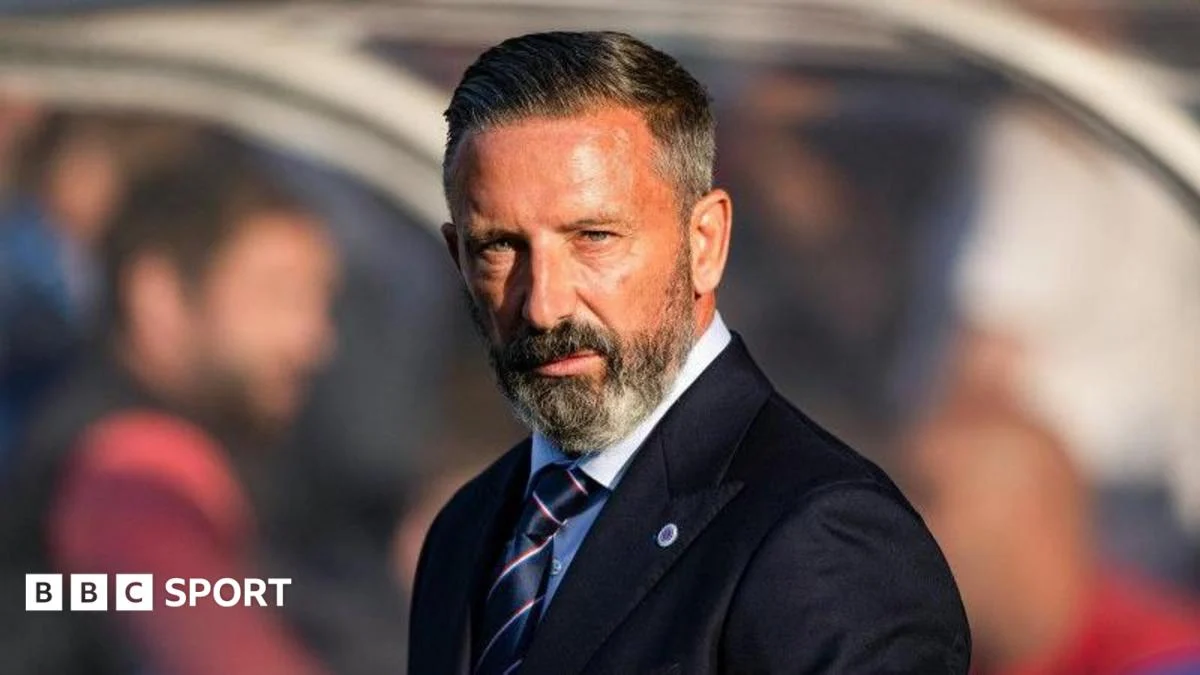
Rangers Football Club has firmly stated its intention to contest the four-match touchline ban imposed on Derek McInnes, their recently appointed manager, for comments made regarding a contentious late penalty awarded to Celtic against Motherwell in May. The club asserts that McInnes’s remarks, which he described as "disgusting," were directed at the specific officiating decision and not a broader indictment of match officials. The ban, comprising three immediate games and one suspended until the end of the season, stems from McInnes’s role as Hearts manager at the time of the incident.
Background to the Controversy: A Title Race Turning Point
The incident occurred during a crucial Scottish Premiership fixture on May 13th at Fir Park, where Celtic secured a dramatic 3-2 victory over Motherwell. The decisive moment arrived in the 96th minute when a penalty was awarded for a handball offence. This late spot-kick, converted by Kelechi Iheanacho, proved pivotal, leaving Celtic just one point behind then-leaders Hearts in the title race. Ultimately, Celtic went on to clinch the championship on the final day of the season, narrowly edging out Hearts.
At the time, McInnes, then in charge of Hearts, was outspoken in his criticism of the penalty decision. Speaking to broadcasters following his team’s own match that evening, he expressed his strong disapproval. "When you heard Celtic got a 96th-minute penalty that was going to VAR and they were checking it, you just assume what’s happened is they get the penalty," McInnes stated. "Having seen it again, it’s disgusting. It is. I don’t think it’s a penalty kick. But we’re up against it. We’re up against everybody." His comments, particularly the use of the word "disgusting," triggered a disciplinary investigation by the Scottish Football Association (SFA).
Rangers’ Stance: Defending Managerial Expression
Rangers, now representing McInnes, have outlined their defence, emphasizing that the manager’s criticism was focused solely on the officiating decision itself. A club statement articulated their position: "The remarks were directed at the decision, rather than representing any broader criticism of officials." This distinction is central to their appeal, suggesting that McInnes’s commentary was a professional reaction to a perceived error in judgment during a high-stakes match.
Following a friendly victory over St. Etienne at Ibrox, McInnes elaborated on the club’s decision to appeal. "I don’t agree with it and the club don’t agree with it. I’m glad that we’re going to appeal against that," he stated. He further defended his right to comment on contentious decisions, drawing on his extensive 19-year managerial career. "I’ve been a manager for 19 years and you know you’re going to be asked about contentious decisions and all the rest of it," McInnes explained. "I’ve never wanted to make it personal. For me, the decision was wrong. I feel as though I made my points at the hearing."
McInnes also highlighted the role of media in football, suggesting that managers should be afforded the space to offer their professional opinions. "Broadcasters pay a lot of money to hear managers’ reactions. We’ve got to be careful that we don’t have managers and players who have to be really sure of themselves and check themselves before answering a question," he argued. He maintained that his intention was not to provoke or inflame the situation, asserting that his comments were "controlled" and that the discussion around the penalty was already widespread.
Chronology of Events and SFA Proceedings
The controversy unfolded in stages, beginning with the match on May 13th. McInnes’s post-match interviews immediately drew attention. Subsequently, the SFA’s compliance officer issued a complaint under disciplinary rule 72, which prohibits criticism of match officials that indicates bias or incompetence, or remarks that impinge on their character. This rule applies to various forms of communication, including interviews and online posts.
The SFA’s decision to sanction McInnes came after consideration of his remarks. The ban, a standard three-game immediate suspension with one game deferred, is a common penalty for breaches of rule 72. The suspended game is contingent on the individual not committing further disciplinary offences of a similar nature before the end of the season.
Broader Context and Supporting Data
The penalty awarded to Celtic at Fir Park was not an isolated incident that drew criticism. The SFA’s head of referees, Willie Collum, later publicly supported the referee’s decision, citing "clear evidence" that Sam Nicholson’s hand and arm were in an "unnatural position" and that the subsequent contact constituted a "punishable handball." This official backing from the SFA’s refereeing department highlights the complexity and differing interpretations that can arise from such incidents, particularly when VAR is involved.
Rangers have further bolstered their defence by suggesting that McInnes’s concerns were not unique. Their statement noted that "concerns were widely shared by other commentators across the UK" and that "similar language has previously been used in Scottish football by others with lesser disciplinary action or without any action at all." This points to a perceived inconsistency in the application of disciplinary rules within Scottish football, a sentiment that resonates with many clubs and observers.
Repercussions and Wider Impact
The implications of the ban, if upheld, are significant for Rangers. McInnes would be absent from the touchline for crucial early-season fixtures. This includes the Scottish Premiership opener away to Dundee United on July 31st, the subsequent home match against Hibernian, and a League Cup tie scheduled for the weekend of August 15th. In an era where managerial presence and communication are vital, such a ban can disrupt team dynamics and strategic implementation.
The incident also brought unwanted attention to the referee, John Beaton. Following the match, his contact details were reportedly leaked online, leading to a police investigation and the surveillance of his home. A teenager was subsequently charged in connection with a data protection offence. This serves as a stark reminder of the potential consequences of public outcry and online vigilantism directed at match officials.
Precedents and Related Sanctions
The disciplinary action taken against McInnes is not unprecedented in Scottish football. Both Motherwell Football Club and their former midfielder, Elliott Watt, have also faced sanctions related to the same incident. Watt, who has since moved to Turkish club Samsunspor, received a four-match suspension for describing the penalty as "the worst VAR decision in history." This suggests a pattern of strict enforcement of rules concerning public criticism of officiating.
Motherwell themselves were fined £5,000 for releasing a video with a caption that read: "As the world of football mocks our game, we simply have to draw a line in the sand and shift the focus." This action by the club was interpreted as a public statement of their dissatisfaction with the decision and its broader implications for the integrity of the game.
The Principle of Scrutiny and Accountability
Rangers’ final statement underscored a broader principle concerning the relationship between officials, clubs, and the media. "Respect for officials and legitimate scrutiny are not competing principles," the club declared. They argued that for Scottish football to improve its standards and maintain trust, managers, players, and clubs must be able to speak honestly about significant decisions.
The club’s position is that "Scrutiny, transparency and accountability should be seen as part of improving standards, not as a threat to them." This advocacy for open dialogue and critical analysis, within reasonable bounds, suggests a desire for a more mature and professional approach to officiating and its evaluation within the sport. Rangers believe that stifling honest feedback could hinder progress and perpetuate a culture of silence, ultimately detrimental to the game’s evolution. The appeal by Rangers and the defence mounted by McInnes suggest a commitment to testing the boundaries of acceptable managerial commentary and advocating for greater freedom of expression in the analysis of officiating in Scottish football. The outcome of this appeal will likely set a precedent for how such controversies are handled in the future.