

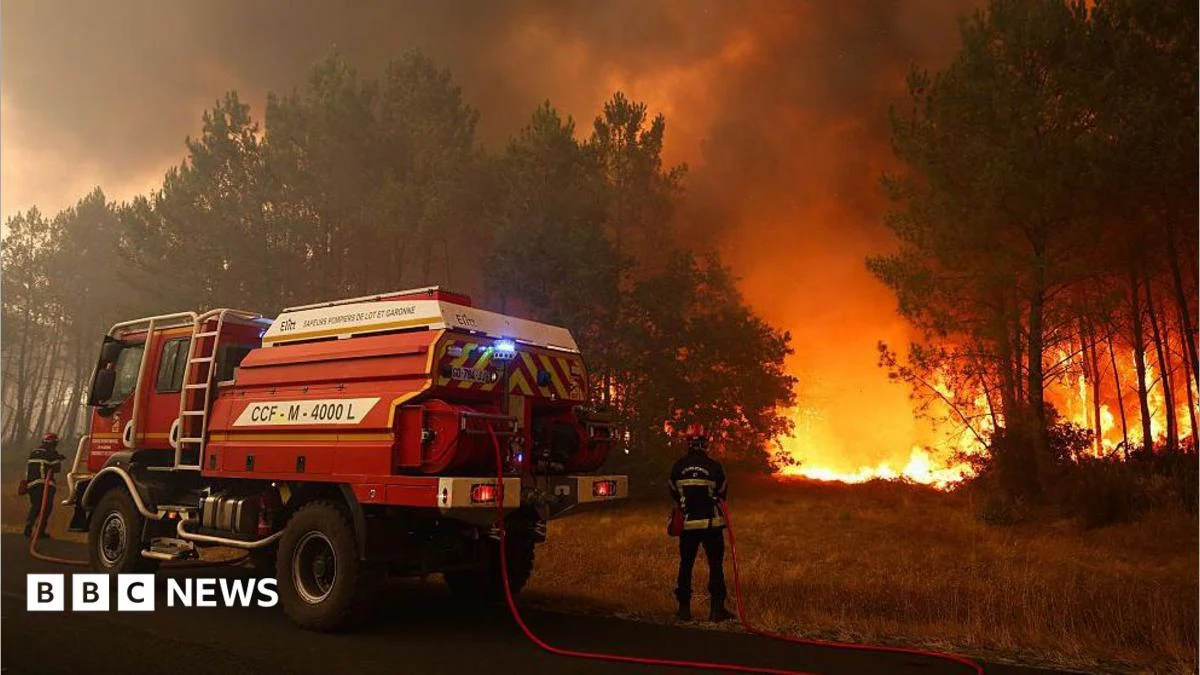
An escalating wildfire crisis has gripped large swathes of Southern Europe, compelling the evacuation of tens of thousands of residents and tourists from threatened areas in France, Spain, and Italy. The Gironde region in south-west France has emerged as a critical hotspot, where approximately 12,000 people have already been displaced, with authorities orchestrating the movement of an additional 8,800 individuals as infernos rapidly consume vast tracts of land. These relentless blazes, fueled by a series of unusual and prolonged heatwaves that have pushed temperatures to record highs, are stretching emergency services to their limits and exacting a tragic human toll, including the deaths of multiple firefighters.
The French Front: Gironde Under Siege
The picturesque landscapes of the Gironde department, particularly around the popular Bay of Arcachon and the Lège-Cap-Ferret peninsula, have been transformed into a battleground against rapidly spreading wildfires. Sophie Brocas, the local prefect, confirmed the destruction of at least 2,400 hectares (approximately 5,900 acres) of land in the area, a figure that continues to climb as firefighters struggle to contain the highly volatile blazes. The initial wave of evacuations predominantly involved visitors to local campsites, many of whom were enjoying summer holidays. Overnight, around 10,000 campers were forced to abandon their sites, a testament to the sudden and intense nature of the threat. The subsequent evacuation operations, including those in the village of Claouey on the shores of Arcachon Bay, were reportedly conducted "calmly," reflecting the efficiency and preparedness of local emergency responders despite the immense pressure.
The operational challenges faced by firefighters are formidable. Marc Vermeulen, chief of the Gironde fire service, described the work as "relentless all night," underscoring the continuous efforts required to combat the fires. He warned of worsening conditions, with temperatures expected to rise further and winds strengthening, predicting a peak around 20:00 local time. The shifting wind patterns were highlighted as a critical concern, making the fires "difficult to predict" and necessitating an unwavering state of alert from the firefighting crews. This unpredictable behavior underscores the complex dynamics of these climate-driven wildfires, where even minor changes in meteorological conditions can drastically alter a fire’s trajectory and intensity.
The human cost of this battle has been tragically high in France. Earlier in the week, two local firefighters lost their lives while combating another blaze in close proximity to Bordeaux airport. French Interior Minister Laurent Nuñez paid a poignant tribute to these fallen heroes, expressing his "infinite gratitude" and "unwavering support" to their grieving families, acknowledging the immense sacrifices made by those on the front lines. Fortunately, Ms. Brocas confirmed that no civilian injuries had been reported amidst the large-scale evacuations, a testament to the efficacy of the early warning and evacuation protocols. However, several sites and roads in exposed forest areas have been prudently closed to ensure public safety and facilitate emergency operations.
An Eyewitness Account from the Evacuation Zone
The unfolding crisis has touched countless lives, including that of BBC South presenter Jo Kent, who was on holiday with her family at the Lesley Pastourelles campsite in Claouey, near Lège. Her firsthand account provides a vivid snapshot of the anxiety and disruption experienced by those caught in the path of the fires. She noted that many anxious campers had already departed the site, while those remaining were explicitly warned to be prepared for imminent evacuation. The usually bustling main road leading to the south of the peninsula, typically characterized by "nose to tail traffic" during the peak summer season, was eerily deserted. Similarly, the local supermarket, a hub of activity in holiday periods, was described as "unnervingly quiet," painting a stark picture of a community preparing for the worst. Such personal testimonies underscore the profound psychological impact of these events on individuals and families, disrupting their lives and instilling a sense of vulnerability.
Widespread Fire Activity Across France
Beyond the immediate crisis in Gironde, other regions across France have also been grappling with significant wildfire activity. In the Var region, located in the south-east of the country, evacuated residents were cautiously permitted to return to their homes on Thursday morning to assess potential damage. However, authorities issued stern warnings, advising people to strictly limit their movements in the area due to the persistent risk of fire re-ignition, particularly as winds were forecast to pick up through the afternoon. This delicate balance between allowing residents to survey their properties and maintaining safety protocols is a common challenge in post-evacuation scenarios.
The recurrent outbreaks across multiple French departments are symptomatic of a broader environmental challenge. France, like many other European nations, has been experiencing a succession of "unusual and prolonged heatwaves" throughout the summer season. These extreme meteorological conditions, characterized by high temperatures, low humidity, and persistent drought, create an exceptionally combustible environment, transforming vast tracts of dry vegetation into potential fuel for devastating fires. The confluence of these factors has made this fire season particularly severe and widespread.
Southern Europe’s Shared Ordeal: Spain and Italy Battle Blazes
The wildfire crisis is by no means confined to France, with Spain and Italy simultaneously confronting their own devastating blazes. These southern European nations, inherently vulnerable to summer fires due to their Mediterranean climates, are experiencing an intensification of these events driven by global climate patterns.
Spain’s Extensive Losses
In Spain, residents near the village of Almorox, south of Madrid in the Toledo region, have begun a tentative return to their homes after being evacuated due to wildfires. While authorities confirmed that the fires were not yet fully under control, ongoing firefighting efforts had successfully prevented the perimeter of the blaze from expanding further, despite approximately 890 hectares (2,200 acres) having already been consumed. The return process is meticulously managed, often involving assessments of structural integrity and ensuring the absence of lingering hazards.
Further north, the Guadalajara region has witnessed Spain’s largest wildfire of the year so far, which has ravaged over 35,000 hectares of land. The aftermath has left behind "bleak images of destroyed landscapes," a stark visual reminder of nature’s destructive power when exacerbated by extreme weather. Despite the extensive damage, authorities in Guadalajara have also permitted residents to return to their homes, signaling a degree of containment, though the psychological and material recovery for these communities will be a long and arduous process. Spain has been experiencing some of the most intense heat of the current European heatwave, with temperatures soaring to at least 42°C in many areas, creating tinderbox conditions across the country.
Italy’s Tragic Struggle
Italy, particularly its southern regions and islands, has likewise been engulfed in a severe wildfire season. Sicily, in particular, has been hit hard. Salvo Cocina, head of the Sicilian Civil Protection, provided an update revealing that the island had contended with over 350 fires, including 10 major blazes that necessitated precautionary evacuations. Tragically, a firefighter, Alessandro Marchi, died while bravely tackling a wildfire in San Cataldo. Italian Interior Minister Matteo Piantedosi paid tribute to Marchi, praising his ultimate sacrifice "in service to the community." Renato Schifani, Sicily’s regional leader, extended wishes for a "speedy recovery" to another firefighter injured during the same operation, highlighting the immense risks inherent in these life-saving efforts.
Mr. Cocina’s statement regarding the fires’ origins in Sicily is particularly noteworthy: he attributed them to "human causes," adding that firefighting has evolved into "a social and public order problem." This assessment points to a critical dimension of the wildfire crisis, where deliberate or negligent human actions often initiate fires that subsequently spiral out of control due to environmental conditions. Addressing this aspect requires not only emergency response but also public awareness campaigns, stricter enforcement, and community engagement in prevention strategies.
The Broader Climate Context: Europe’s Warming Reality
The widespread and intensifying wildfire activity across Europe is not an isolated phenomenon but rather a stark manifestation of a rapidly changing climate. Countries across the continent have been experiencing record temperatures in recent months and years, fundamentally altering weather patterns and increasing the frequency and severity of extreme weather events.
A comprehensive report released in April by the Copernicus Climate Change Service, which draws on extensive climate data, unequivocally identified Europe as the fastest-warming continent on Earth. The report indicated that in recent years (referring to data from 2022 and 2023), at least 95% of Europe recorded "above average" annual temperatures. This warming trend directly contributes to longer and more intense heatwaves, prolonged periods of drought, and the desiccation of vegetation, all of which create ideal conditions for wildfires to ignite, spread rapidly, and become exceedingly difficult to control.
The Copernicus report further underscored the gravity of the situation, stating that wildfire-burnt area and associated fire emissions both reached record levels in the preceding year. This grim statistic points to a dangerous feedback loop: as temperatures rise, more land burns; as more land burns, significant quantities of stored carbon are released into the atmosphere, further contributing to global warming. This cycle exacerbates the conditions that make future fires more likely and more destructive, creating a profound environmental and climatic challenge. The Mediterranean basin, in particular, is recognized as a wildfire hotspot, a region where climate change projections predict even hotter and drier summers, thus increasing its vulnerability exponentially.
Impacts and Implications: A Multifaceted Crisis
The current wildfire crisis carries profound and multifaceted implications, extending far beyond the immediate damage to land and property.
Environmental Catastrophe:
The ecological toll is immense. Wildfires obliterate vast swathes of forests, grasslands, and other natural habitats, leading to irreversible biodiversity loss. Animal populations are decimated, and delicate ecosystems, some of which have taken centuries to develop, are destroyed in a matter of hours or days. The destruction of vegetation also leads to significant soil degradation, increasing the risk of erosion and landslides, especially in the aftermath of heavy rains following a fire. Furthermore, the massive carbon emissions released during large-scale fires contribute directly to atmospheric greenhouse gas concentrations, accelerating climate change and perpetuating the cycle of extreme weather events.
Economic Strain:
The economic repercussions are substantial. For regions heavily reliant on tourism, such as the Bay of Arcachon and the Lège-Cap-Ferret peninsula, the forced evacuation of visitors and the destruction of campsites and other tourist infrastructure deal a severe blow to local economies. Businesses suffer losses, employment opportunities diminish, and the region’s appeal can be negatively impacted for years. The agricultural and forestry sectors also face devastating losses, with crops destroyed and valuable timber resources incinerated. The direct costs of firefighting operations, including personnel, equipment, and aerial support, run into millions of euros, placing a significant burden on national and regional budgets. Moreover, property damage, including homes, businesses, and critical infrastructure, necessitates costly rebuilding and recovery efforts.
Social and Health Consequences:
On a societal level, the forced displacement of communities, even if temporary, creates significant psychological trauma for affected residents and tourists. The anxiety of uncertainty, the loss of homes or cherished memories, and the disruption of daily life can have lasting impacts. The widespread smoke from these fires also poses a serious public health risk, leading to respiratory problems, particularly for vulnerable populations such as the elderly, children, and those with pre-existing conditions. Emergency services, already stretched thin, face immense pressure, and healthcare systems may become overwhelmed by fire-related injuries and health issues. The long-term recovery for affected communities involves not only rebuilding infrastructure but also providing essential social and psychological support to help people cope with the aftermath.
Official Responses and Future Outlook
In response to the escalating crisis, governments and regional authorities are intensifying their efforts on multiple fronts. This includes not only immediate firefighting and evacuation operations but also a focus on long-term prevention and adaptation strategies. There is a growing recognition of the need for improved forest management practices, including controlled burns, creating firebreaks, and promoting fire-resistant vegetation. Early warning systems are being enhanced to provide timely alerts, and public awareness campaigns are being launched to educate citizens about fire risks, particularly those linked to human activity.
International cooperation also plays a crucial role, with countries often providing mutual aid in terms of firefighting aircraft, ground crews, and expertise. This collective response underscores the transnational nature of climate change challenges. Looking ahead, adaptation measures will become increasingly critical, encompassing changes in building codes in fire-prone areas, developing resilient infrastructure, and implementing urban planning strategies that minimize risk. Ultimately, while immediate response remains paramount, the long-term solution lies in a concerted global effort to mitigate climate change by drastically reducing greenhouse gas emissions, thereby addressing the root causes that are making Europe’s summers increasingly volatile and destructive. The unwavering dedication of firefighters and emergency personnel across Europe, who put their lives on the line, continues to be a source of profound gratitude and admiration amidst this ongoing environmental catastrophe.