


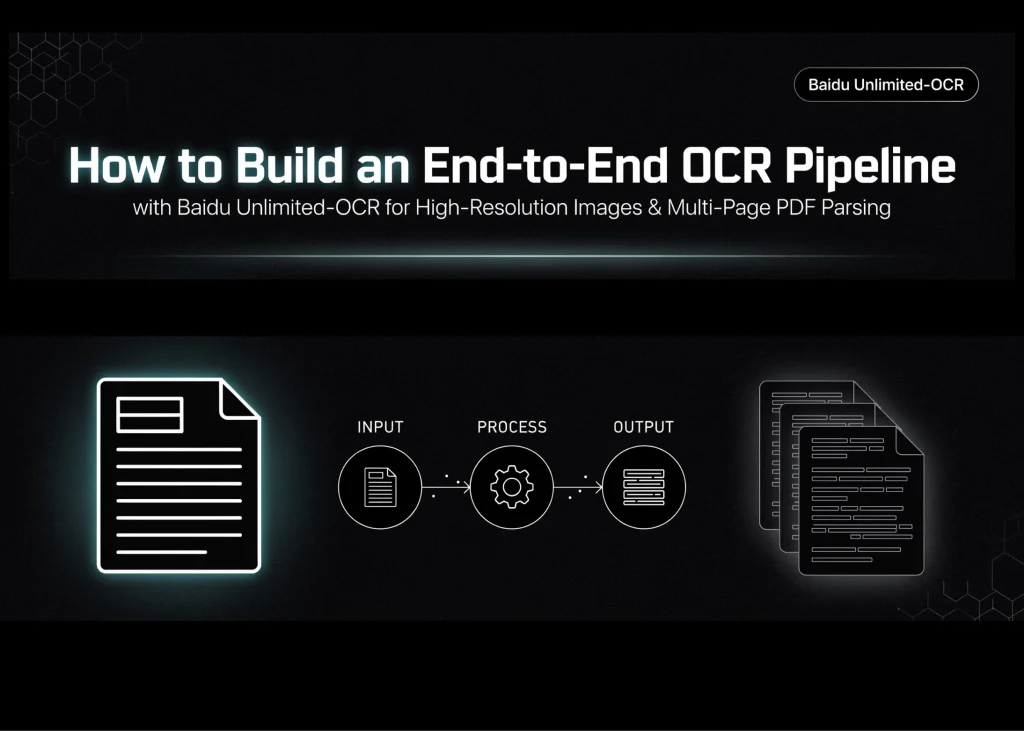
The landscape of Optical Character Recognition (OCR) is undergoing a fundamental shift as traditional modular pipelines are replaced by unified vision-language models (VLMs). Baidu’s recent release of the Unlimited-OCR model represents a significant milestone in this evolution. Moving beyond the limitations of legacy systems that require separate stages for text detection, layout analysis, and character recognition, Unlimited-OCR leverages a 3-billion-parameter architecture to perform end-to-end document parsing. This system is designed to handle the intricate complexities of modern documents, including dense tables, varied font sizes, and multi-page structures, all within a single inference framework.
The Evolution of Document Intelligence
For decades, OCR technology relied on a "divide and conquer" approach. Developers would first deploy a layout analysis model to identify regions of interest, then a text detection model to locate lines of text, and finally a recognition model to transcribe those lines into strings. While effective for simple documents, this approach often failed when faced with complex layouts, such as overlapping tables or multi-column academic papers.
The advent of vision-language models has simplified this process. By treating a document image as a visual prompt and the desired text as a linguistic sequence, models like Unlimited-OCR can "read" a document in a way that mimics human cognition. Baidu’s Unlimited-OCR specifically addresses the "long-horizon" challenge—the ability to maintain context and structural integrity across many pages of a single document without losing track of the narrative or data flow.
Technical Specifications and Environment Configuration
The Unlimited-OCR model is built on a 3B-parameter backbone, a size optimized for the balance between computational efficiency and reasoning capability. In professional environments, deploying such a model requires a robust hardware setup, typically involving NVIDIA GPUs with support for high-precision data types.
The model is designed to be versatile, supporting both bfloat16 and float16 data types. The use of bfloat16 is particularly advantageous for modern hardware like the NVIDIA A100 or H100 series, as it provides a wider dynamic range, reducing the likelihood of numerical overflow during long-sequence generation. The software stack relies heavily on the transformers library by Hugging Face, alongside einops for tensor manipulation and Pillow for image processing.
To facilitate reproducible results, the workflow begins with the installation of specific library versions, such as transformers==4.57.1, and the integration of PyMuPDF (also known as fitz). The latter is critical for handling PDF inputs, as it allows for high-fidelity rasterization of document pages into images that the vision-language model can process.
Strategic Inference Modes: Gundam vs. Base
A standout feature of the Unlimited-OCR framework is its dual-mode inference strategy, which allows users to choose between speed and granular detail based on the specific requirements of the document at hand.
The Gundam Mode: High-Detail Tiling
The "Gundam" mode is an advanced inference setting designed for dense or high-resolution documents. In this mode, the model does not merely look at a downsampled version of the page. Instead, it employs a tiling mechanism where the document is broken into smaller crops (typically 640×640 pixels). These crops are processed alongside a global view of the page. This approach ensures that fine text—such as footnotes or small cells in a financial table—is preserved and recognized with high accuracy. By enabling crop_mode=True, the model can maintain a high level of detail that would otherwise be lost in a single-pass resize.
The Base Mode: Efficiency and Speed
Conversely, the "Base" mode is optimized for clean, clearly printed documents where speed is a priority. This mode utilizes a single 1024-pixel view of the image. By disabling the cropping mechanism, the model reduces the number of visual tokens it must process, leading to significantly faster inference times. This is ideal for digitizing standard business letters, simple reports, or high-quality digital-born PDFs where the text size is uniform and legible at lower resolutions.
Overcoming the Multi-Page Barrier with infer_multi()
One of the most persistent hurdles in document AI is the transition from single-page images to multi-page PDF documents. Traditional VLMs often treat each page as an isolated event, which can lead to fragmented data and lost context (e.g., a table that starts on page four and ends on page five).
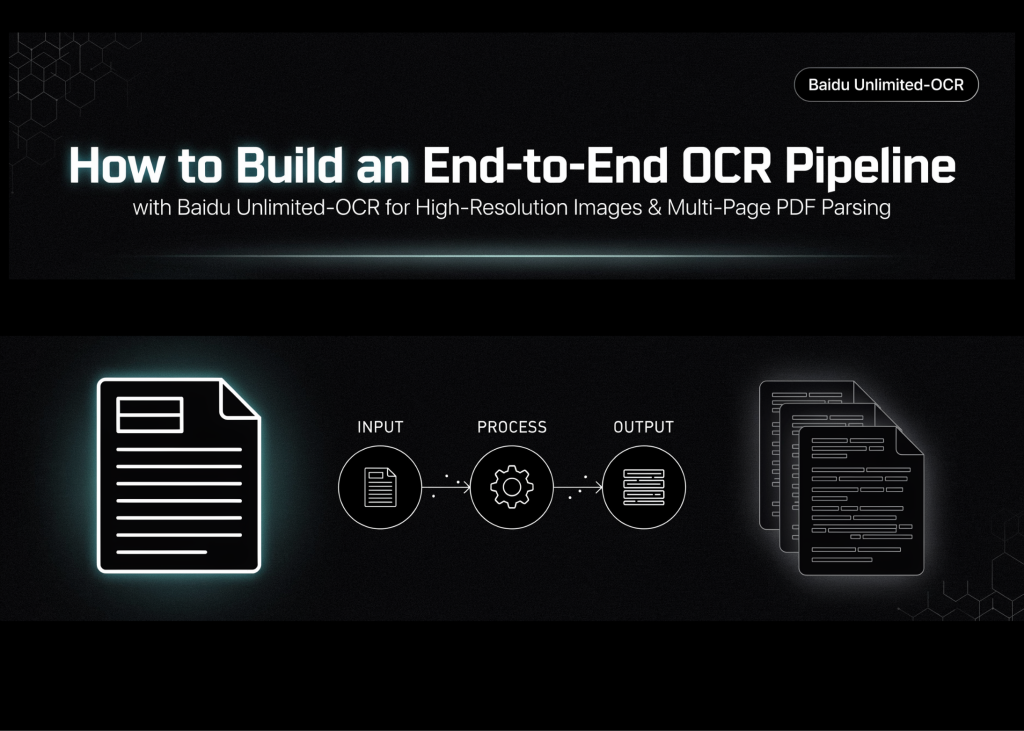
Unlimited-OCR addresses this through the infer_multi() function. This pipeline involves a sophisticated pre-processing stage where a PDF is rasterized at a high DPI (dots per inch), usually 300 DPI, to ensure clarity. These images are then passed as a sequence to the model. By utilizing a massive 32,768-token context window, the model can "remember" what it read on previous pages, ensuring that the resulting Markdown or JSON output remains coherent.
To prevent the model from entering a "repetition loop"—a common failure mode in long-context generation—the framework implements strict repetition controls. Parameters such as no_repeat_ngram_size and ngram_window are tuned to ensure the model continues to generate fresh, accurate content even when processing documents that exceed ten or twenty pages.
Benchmarking and Performance Data
While specific benchmarks against proprietary models like GPT-4o are ongoing, preliminary technical analysis suggests that Baidu’s Unlimited-OCR excels in "long-horizon" tasks. In testing environments, the model has demonstrated the ability to:
- Preserve Table Structure: Unlike standard OCR which often flattens tables into unstructured strings, Unlimited-OCR can output valid Markdown or JSON representations of complex grids.
- Handle Diverse Layouts: The model effectively identifies headers, footers, and sidebars, distinguishing them from the main body text without the need for an external layout engine.
- Accuracy in Low-Resource Settings: By offering a 3B parameter version, Baidu provides a solution that can run on mid-range professional GPUs (16GB-24GB VRAM), making high-tier document intelligence accessible to a wider range of enterprises.
Industry Implications and Broader Impact
The release of a high-performing, open-weights OCR model has significant implications across several sectors. In the legal and financial industries, where documents are notoriously long and structurally complex, the ability to automate the extraction of data into structured formats like JSON can reduce manual data entry costs by over 80%.
In the healthcare sector, Unlimited-OCR can be used to digitize historical patient records and handwritten forms, converting them into searchable, interoperable data that can be integrated into Electronic Health Record (EHR) systems. Furthermore, the model’s ability to run locally or in a private cloud environment is a critical factor for organizations dealing with sensitive PII (Personally Identifiable Information) or HIPAA-regulated data, where sending documents to a third-party API is often prohibited.
The academic and research community also stands to benefit. The ability to parse technical papers, complete with mathematical formulas and multi-column layouts, into structured Markdown allows for better indexing and training of specialized Large Language Models (LLMs) on scientific corpora.
Implementation Chronology and Reproducibility
The implementation of the Unlimited-OCR workflow follows a logical progression designed for enterprise-grade reliability:
- Environment Preparation: Setting up the CUDA-enabled environment and verifying hardware compatibility (BF16/FP16).
- Model Acquisition: Downloading the 3B-parameter weights and tokenizer from the Hugging Face repository.
- Data Pre-processing: Utilizing PyMuPDF to convert PDF assets into a sequence of high-resolution PNG files.
- Inference Execution: Selecting the appropriate mode (Gundam for detail, Base for speed) and executing the
infer()orinfer_multi()functions. - Post-processing and Validation: Inspecting the output artifacts (Markdown, JSON, or Text) to ensure the structural integrity of the extracted data.
Conclusion and Future Outlook
Baidu’s Unlimited-OCR is more than just a tool for text extraction; it is a specialized vision-language engine that understands the "language" of documents. By integrating advanced tiling techniques and long-context handling, it effectively bridges the gap between raw pixels and structured knowledge.
As the industry moves toward more "agentic" AI systems—where AI agents are expected to read, understand, and act upon complex documentation—models like Unlimited-OCR will serve as the essential visual front-end. The transition from traditional OCR to VLM-based parsing is no longer a theoretical preference but a practical necessity for organizations looking to scale their document processing capabilities in the age of generative AI. The availability of the full code and model weights ensures that this technology will continue to be refined by the global AI community, further pushing the boundaries of what is possible in automated document understanding.