


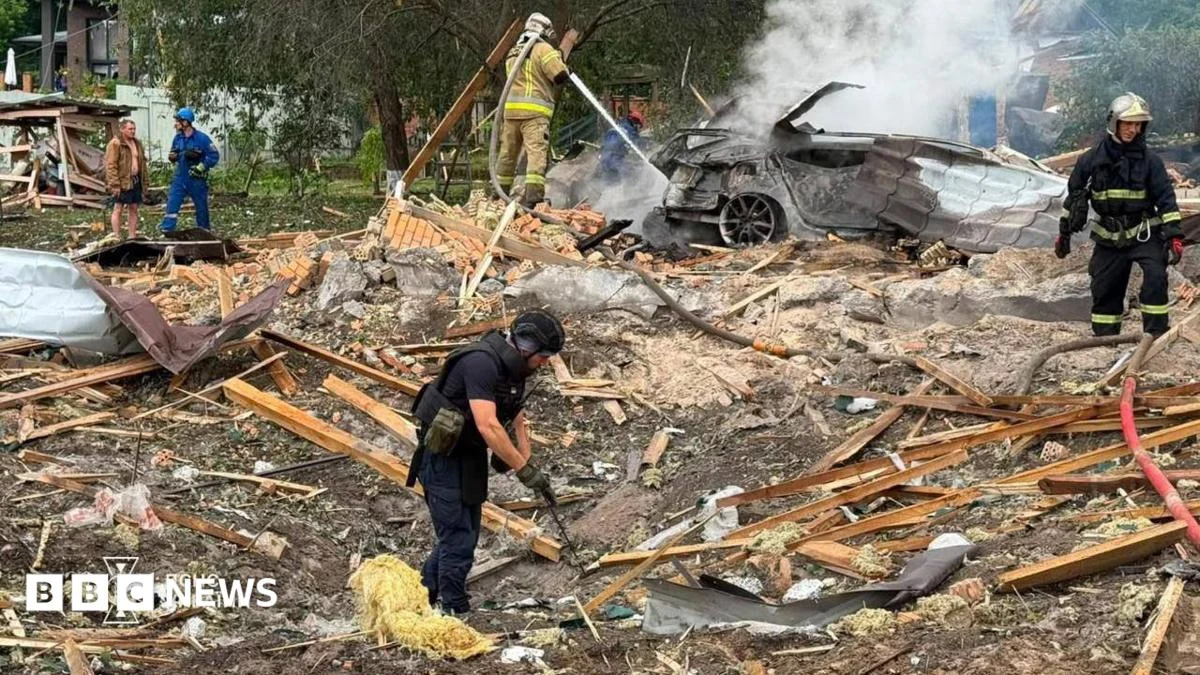
At least 15 individuals have been confirmed dead following a wave of Russian attacks across Ukraine, with a particularly devastating ballistic missile strike near Kyiv targeting an exhibition showcasing advanced drone technology. This daytime assault resulted in the deaths of 10 people and left approximately 100 injured, including prominent figures within Ukraine’s burgeoning defence sector. The strikes occurred amidst a backdrop of escalating cross-border hostilities, with Ukraine simultaneously launching its own deep strikes against military-industrial and logistics targets within Russian territory.
A Day of Devastation: Russian Ballistic Missile Attack on Kyiv Exhibition
The most significant incident unfolded near the Ukrainian capital, where a specialized exhibition dedicated to drone technology became the target of a precise Russian ballistic missile strike. The event, reportedly attended by numerous specialists, engineers, and officials crucial to Ukraine’s defence innovation, was abruptly shattered by the impact. Ukrainian President Volodymyr Zelensky confirmed the casualty figures, underscoring the severity of the attack on what was intended to be a forum for technological advancement vital to the nation’s wartime efforts.
Initial reports generated widespread concern for several high-profile attendees, including Serhiy Beskrestnov, known as "Flash," a respected advisor to the Defence Ministry, and Lyuba Shypovych, a key figure in developing technology for the Ukrainian armed forces. Both subsequently used social media platforms to reassure the public of their safety, with Beskrestnov stating he had opted to stay away from the event due to pre-existing security concerns, a sentiment that now appears tragically prescient.
According to Yuri Ihnat, spokesperson for the Ukrainian Air Force, the assault involved three ballistic missiles. Only one of these highly destructive projectiles was successfully intercepted by Ukraine’s air defence systems, highlighting the persistent challenge posed by ballistic missile threats, which travel at supersonic speeds and follow steep trajectories, making them exceptionally difficult to counter. The relatively low interception rate for this specific attack raises questions about the efficacy of existing air defence coverage for such gatherings, especially given the known threat landscape.
Russia swiftly confirmed the attack, with its Ministry of Defence issuing a statement asserting that "high-precision long-range weaponry" had been deployed against a site where drones "for use in targeting civil sites in Russia" were being demonstrated. The Russian ministry further claimed that the target included "producers of drones, as well as representatives of Ukraine’s drone forces and security services directly planning and carrying out strikes on Russian territory." This framing aligns with Moscow’s consistent narrative that its actions are aimed at neutralizing threats to its own security and infrastructure.
Broader Russian Offensive Operations
Beyond the Kyiv exhibition, Russian forces executed a series of other deadly attacks across Ukraine. In the eastern city of Sloviansk, a key strategic location in the Donbas region that has witnessed intense fighting since the early days of the full-scale invasion, five civilians were killed by Russian glide bombs. These unguided aerial munitions, often retrofitted with guidance kits to enhance precision, are typically launched from tactical aircraft operating beyond the range of many Ukrainian air defence systems. Their use frequently results in widespread destruction and high civilian casualties due to their immense explosive power. Sloviansk, situated near the front lines, has been a frequent target of such indiscriminate shelling and aerial bombardment, underscoring the relentless pressure on communities in Ukraine’s east.
Furthermore, in the northern city of Sumy, which lies close to the Russian border and has endured persistent shelling, military officials confirmed the deaths of two men early on Saturday. Sumy Oblast has been a hotspot for cross-border incursions and artillery barrages since the initial invasion, with border communities living under constant threat of attack. These incidents collectively paint a grim picture of the ongoing human cost of Russia’s aggression, with civilian lives tragically lost across multiple regions of Ukraine.
Ukrainian Retaliation: Deep Strikes into Russian Territory
The Russian attacks near Kyiv and elsewhere followed a significant wave of Ukrainian retaliatory strikes deep within Russian territory on Friday. These operations signify Ukraine’s evolving strategy of conducting "asymmetric warfare" by targeting Russia’s military-industrial complex and logistics infrastructure far from the front lines, aiming to degrade Moscow’s capacity to wage war.
One such strike hit the Russian city of Kirov, located more than 1,000 kilometres (600 miles) behind the front line. Ukrainian President Zelensky described the target as "one of the most important military facilities" in Kirov, responsible for supplying "components for aircraft and missile equipment" used in strikes against Ukraine. Such a long-range strike on a facility critical to Russia’s military production chain represents a notable escalation and demonstrates Ukraine’s increasing capability to reach strategic targets deep within enemy territory. The attack reportedly killed six people and wounded 26, according to Russian authorities, highlighting the dangerous reciprocal nature of the conflict.
Concurrently, Ukraine also targeted warehouses belonging to Wildberries, Russia’s largest online retailer, in the St. Petersburg area. This marks the latest in a series of attacks on Wildberries facilities over the past week. Kyiv’s stated rationale for targeting logistics hubs like those operated by Wildberries is to disrupt supply chains that it believes can be used to acquire military equipment, thereby impeding the Russian army’s operational capabilities. While Wildberries primarily serves civilian consumers, Ukraine argues that the dual-use nature of many goods and the vast logistical networks of such companies make them legitimate targets in a total war scenario. These strikes have undoubtedly dealt a blow to a large number of small and medium-sized businesses within Russia that rely on Wildberries for distribution, demonstrating the wider economic ramifications of Ukraine’s deep strike strategy. The targeting of civilian logistics, even if justified by military necessity, also carries significant implications for the perception of the conflict and potential accusations of targeting civilian infrastructure.
Background and Chronology of Escalation
The intensified exchanges of fire and deep strikes occur within the broader context of Russia’s full-scale invasion of Ukraine, which commenced in February 2022. The conflict has evolved from an initial attempt at a rapid conquest to a protracted war of attrition, characterized by trench warfare, artillery duels, and increasingly, drone warfare and long-range missile strikes.
The use of drones has become a defining feature of this conflict, with both sides deploying them extensively for reconnaissance, targeting, and direct attack. Ukraine, in particular, has leaned heavily on drone technology, often developed through a blend of domestic innovation and international support, to compensate for numerical disadvantages in traditional military hardware. Exhibitions like the one targeted near Kyiv are crucial for fostering this technological edge, making them high-value targets for Russia. Indeed, this is at least the third time since the 2022 invasion that an exhibition of this kind has been hit, indicating a deliberate and repeated effort by Russia to impede Ukraine’s drone development and deployment capabilities. Each prior strike on such events has also generated internal debate within Ukraine regarding security protocols and the wisdom of holding publicly advertised gatherings of critical defence personnel during active warfare.
Ukraine’s strategy of targeting Russian logistics and military-industrial facilities deep behind the front lines has intensified over recent months. Initially focused on oil depots and refineries, Kyiv has broadened its scope to include manufacturing plants, railway infrastructure, and now, large-scale commercial logistics networks. This shift reflects a strategic effort to put pressure on Russia’s war economy and disrupt its ability to sustain military operations, especially as Western military aid to Ukraine faces political hurdles.
Official Reactions and Investigations
The attack on the drone exhibition near Kyiv has sparked widespread outrage within Ukraine, not only for the tragic loss of life but also for the perceived security lapses. The fact that a public event involving critical defence personnel was widely advertised has drawn sharp criticism. President Zelensky acknowledged the public outcry and announced that the incident was being thoroughly investigated. Ukraine’s prosecutor-general has initiated efforts to establish precisely who authorized the event and what specific safety measures, if any, were implemented to protect attendees from potential Russian attacks. This internal scrutiny underscores the gravity of the incident and the need for accountability in wartime decision-making.
On the Russian side, the Defence Ministry’s statement regarding the Kyiv strike framed the attack as a legitimate military operation against a facility involved in planning and executing strikes on Russian territory. This narrative serves to justify Russia’s actions on the international stage and within its domestic information space, portraying its military as responding to Ukrainian aggression.
Diplomatic Maneuvers and Future Outlook
Amidst the escalating military actions, diplomatic efforts continue to unfold, albeit with limited immediate prospects for a breakthrough in peace. President Zelensky is expected to travel to the United States next week, where he is slated to meet with former President Donald Trump on Tuesday, according to a White House official. This meeting holds significant weight, particularly as Washington seeks to revive peace talks between Ukraine and Russia, and as the future of US military and financial aid to Ukraine remains a contentious issue in American domestic politics. Trump’s past statements on the conflict have often been viewed with apprehension in Kyiv, making this upcoming engagement particularly crucial for understanding the potential trajectory of US support.
Adding an unexpected layer to Zelensky’s prospective US visit, Trump ally Laura Loomer, who recently interviewed the Ukrainian President in Kyiv, quoted him as stating his intention to attend the funeral of US Senator Lindsey Graham on the same day as his scheduled meeting with Trump. While the specific details surrounding this claim are still emerging, Senator Graham has been a vocal proponent of strong US support for Ukraine, and any attendance by Zelensky would carry significant symbolic weight regarding US-Ukrainian solidarity.
Broader Implications and The Path Ahead
The recent surge in cross-border attacks and deep strikes by both Russia and Ukraine signals a dangerous escalation in the conflict, with profound implications for civilian populations and the broader geopolitical landscape. For Ukraine, the ability to strike deep into Russian territory demonstrates an increasing capability to project power and disrupt Russia’s war machine, but it also risks further retaliation and potential accusations of targeting civilian infrastructure. For Russia, the continued use of ballistic missiles and glide bombs against Ukrainian cities underscores its willingness to inflict mass casualties and terrorize civilian populations, while simultaneously facing growing pressure on its own logistical and industrial base.
The controversy surrounding the drone exhibition near Kyiv highlights the immense challenges of operating and innovating in a warzone. It underscores the critical need for robust security protocols, intelligent threat assessments, and perhaps, a rethinking of how such sensitive events are conducted. The ongoing investigations will likely shape future decisions regarding public gatherings of defence personnel.
As the conflict grinds on, the humanitarian cost continues to mount, with civilians on both sides increasingly caught in the crossfire. The simultaneous military and diplomatic maneuvers suggest a complex and uncertain path forward, with no clear end in sight. The upcoming discussions between President Zelensky and Donald Trump will be closely watched for any indications of a shift in the international approach to resolving this devastating war, even as the fighting on the ground, and deep behind the lines, intensifies. The interplay of military pressure, economic disruption, and diplomatic engagement will ultimately determine the future course of this defining conflict of the 21st century.