


China’s vast automobile market is currently navigating its most challenging period since 2021, grappling with a significant downturn in consumer demand for passenger vehicles following a period of unprecedented growth. After achieving record-high sales in 2025, the industry has experienced a sharp contraction, prompting a substantial revision of full-year forecasts and sparking concerns among manufacturers and analysts alike. The first half of 2026 witnessed a stark 20.2% decline in passenger vehicle sales, a sobering indicator that led the China Passenger Car Association (CPCA) to lower its full-year retail sales projection to a 14% year-on-year decrease. This updated forecast anticipates a final delivery volume of 20.4 million units by the end of 2026, a notable drop from the record 23.7 million units sold in the preceding year. Cumulative sales for the initial six months of 2026 currently stand at 8.7 million units, highlighting the severity of the market’s contraction. The 23rd Changchun International Automobile Expo, held on July 11, 2026, in Changchun, Jilin Province, drew participation from 53 Chinese and foreign automobile manufacturers showcasing over a thousand vehicles, yet even such large-scale events reflect an industry in search of renewed vigor amidst prevailing economic headwinds.
A Deep Dive into Demand Erosion
The precipitous fall in consumer demand is attributed to a confluence of factors, ranging from macroeconomic pressures to specific policy adjustments and evolving market dynamics. One of the most significant contributors to the slump has been the surge in transportation energy costs. Data from China’s National Bureau of Statistics reveals a staggering 15.3% year-over-year increase in transportation energy costs in June alone. This sharp rise has had a particularly devastating impact on the demand for internal combustion engine (ICE) vehicles, which saw retail sales plummet by 39% year-on-year in June. Pure gasoline models were hit even harder, experiencing a 42% decline and accounting for a dominant 78% of the total reduction in passenger vehicle sales for that month. Consumers, facing higher operational expenses and tightening household budgets, have become increasingly hesitant to invest in new gasoline-powered cars, exacerbating the market’s woes.
Adding to the demand-side challenges is Beijing’s strategic pullback of subsidies for new energy vehicles (NEVs), including electric and hybrid cars and vans. For years, these government incentives played a crucial role in stimulating consumer appetite and fostering the rapid adoption of NEVs, positioning China as a global leader in electric mobility. Introduced to spur innovation and achieve environmental targets, these subsidies effectively lowered the purchase price of NEVs, making them more attractive to a broad segment of buyers. However, the gradual phasing out of these subsidies, intended to allow the market to mature and stand on its own feet, has inadvertently tempered demand in 2026. Xiao Feng, head of Hong Kong/China Industrials Research at Citic CLSA, observed that "policy only moves demand around," suggesting that the current lackluster sales could be a "paying back the frontloaded demand from last year," where consumers rushed to purchase vehicles before the subsidies expired. This phenomenon of demand pull-forward often creates a subsequent dip as the market adjusts, a scenario now unfolding in China.
Furthermore, the broader economic outlook in China has contributed to a more cautious consumer sentiment. While the nation continues its economic development, a general tightening of household budgets, uncertainties surrounding employment, and a prioritization of essential spending over discretionary purchases like new cars have logically dampened buying enthusiasm. The market, having experienced a boom in 2025 driven by a combination of post-pandemic recovery and sustained policy support, appears to be undergoing a period of correction, compounded by these various pressures. Even for NEVs, a segment that has historically defied broader market trends, sales are projected to decline by 5% to 6% year-on-year, a stark contrast to their previous explosive growth, according to Xiao Feng’s slightly more optimistic but still negative outlook. Sino Auto Insights founder Tu Le succinctly described the current environment as "going to continue to be a brutal year," underscoring the fierce competition among original equipment manufacturers (OEMs) battling for a shrinking pool of consumers.
The Cost Squeeze: Supply-Side Pressures and Shrinking Margins
While demand falters, Chinese automakers are simultaneously grappling with intense pressure on the supply side. Rising raw material and component costs have become a significant headache, squeezing already slim profit margins across the industry. The price of critical battery-related inputs, including lithium – a key component for EV batteries – and memory chips, has continued its upward trajectory. These commodities, subject to global supply chain fluctuations and geopolitical influences, directly impact the manufacturing expenses for both traditional and new energy vehicles, making it harder for companies to maintain profitability without significantly raising prices. However, in a market characterized by intense competition and weakening demand, raising prices is often not a viable option.
The confluence of rising production costs and falling consumer prices has created a particularly challenging environment. Passenger vehicle prices experienced a more than 1% year-on-year decline in June, according to China’s National Bureau of Statistics. This downward pressure on pricing, often a result of aggressive price wars initiated by manufacturers to attract reluctant buyers and clear inventory, further compresses profit margins for automakers. CPCA Secretary General Cui Dongshu highlighted the severity of this squeeze, reporting an industry-wide plunge in sales profit margins to a mere 3.4% for the period between January and May 2026. During the same period, overall industry profits plummeted by 20% year-on-year, painting a stark picture of financial strain across the automotive sector. This situation is unsustainable for many players, particularly smaller ones, and underscores the "brutal year" described by Tu Le, founder of Sino Auto Insights, who cited increased competition as original equipment manufacturers aggressively fight to capture what little demand remains. The delicate balance between cost, pricing, and sales volume has been severely disrupted, forcing companies to re-evaluate their operational strategies.
Navigating a Brutal Landscape: Industry Consolidation on the Horizon
The current economic headwinds and razor-thin margins are widely expected to trigger a significant market shakedown, leading to a period of intense consolidation within China’s fragmented automotive industry, particularly in the burgeoning electric vehicle segment. Xiao Feng of Citic CLSA projects that by 2030, China’s vast EV market, currently home to numerous players, will consolidate into a more streamlined landscape dominated by just seven or eight major players. This consolidation is a natural outcome of the demanding capital requirements, economies of scale, and technological prowess necessary to thrive in the modern auto industry. The EV sector, in particular, requires massive investments in research and development, battery technology, charging infrastructure, and sophisticated manufacturing processes, making it difficult for smaller, less capitalized companies to compete long-term.
Feng elaborates on the critical thresholds for survival and profitability. He estimates that a carmaker in China needs to achieve annual sales of at least 500,000 units merely to break even. To achieve sustainable profits, that figure rises sharply to 1 million units. Furthermore, to attain full economies of scale and truly compete effectively, an automaker must aim for annual sales of 2 million units. These stringent benchmarks mean that smaller players who fail to measure up to these figures will be "largely out of [the] market," unable to absorb the high costs of research and development, manufacturing, and extensive sales networks required in a rapidly evolving technological landscape. This scenario will likely see a wave of mergers, acquisitions, and even bankruptcies among the less competitive players.
This projected consolidation will fundamentally reshape the competitive landscape. Feng specifically predicts that American automakers, despite their global presence and technological advancements, may struggle to survive the fiercely competitive Chinese car market, which demands not only technological prowess but also deep localization, rapid adaptation to local tastes, and aggressive pricing strategies. Instead, he anticipates that domestic giants like BYD, Geely, and Leapmotor, alongside established global players such as Germany’s Volkswagen and Japan’s Toyota, will be among those left standing. These companies, with their significant production capacities, established brands, extensive dealer networks, and ongoing investments in future technologies, are better positioned to weather the storm and emerge stronger as market leaders. Their ability to innovate, control costs, and maintain a strong brand presence will be key determinants of their longevity.

Key Players and Their Stances Amidst the Storm
The first half of 2026 has presented a mixed, though generally challenging, performance for key players in the Chinese auto market. Among the major domestic automakers, BYD, a trailblazer in new energy vehicles and a vertically integrated powerhouse, reported a robust 1.8 million sales in the first half of 2026. This performance underscores its strong market position and relative resilience, likely bolstered by its comprehensive NEV ecosystem, competitive pricing strategies, and growing export footprint. Geely, another prominent Chinese manufacturer with a diverse portfolio of brands, trailed with 1.4 million deliveries during the same period, demonstrating its continued significant presence and strategic partnerships. Leapmotor, a newer entrant focusing on intelligent EVs and known for its cost-effective offerings, recorded 356,000 deliveries, reflecting its growth trajectory but also highlighting the substantial gap between emerging players and established leaders in terms of sheer volume.
For international companies, the picture is equally challenging, underscoring the universal impact of the market contraction. Volkswagen Group, a long-standing dominant foreign player in China and a pioneer in establishing joint ventures, reported 973,000 deliveries in the first half of 2026. This figure, however, represents a significant 25.9% year-on-year drop, illustrating the profound impact of the market downturn even on industry giants with deep roots in the country. Despite Volkswagen’s aggressive pivot into electric cars in China, its sales performance indicates the broader market headwinds affecting all segments, including the rapidly growing EV space. Toyota, another major Japanese automaker renowned for its reliability and hybrid technology, posted 579,000 deliveries between January and May, demonstrating its enduring appeal but also its vulnerability to the overarching market contraction. The pressure on these global players is immense, as maintaining sales at scale is deemed crucial for survival in the accelerating global EV race, demanding continuous innovation, adaptation to local preferences, and rigorous cost-efficiency.
The Silver Lining: Export Growth Paves the Way for Future Recovery
Despite the domestic market’s current struggles, a significant silver lining has emerged in the form of robust export growth. This unexpected surge in overseas demand is increasingly viewed as a crucial catalyst for the industry’s eventual recovery, potentially offsetting some of the domestic downturn. In June 2026, total passenger vehicle exports from China demonstrated remarkable strength, growing by 11.5% month-on-month and surging an astonishing 82.3% year-on-year, reaching 877,000 units, according to CPCA data. This performance highlights China’s growing role as a global automotive manufacturing hub and an increasingly competitive exporter of vehicles, particularly NEVs. The transformation from a market primarily focused on domestic consumption to a significant global supplier marks a strategic shift for the industry.
Several factors are fueling this export boom. A primary driver is the escalating global energy crisis, exacerbated by geopolitical events. The ongoing conflict in the Middle East, for instance, has led to widespread shipping disruptions and a significant increase in global fuel prices. This situation has made traditional gasoline-powered vehicles more expensive to operate in many international markets, prompting overseas consumers to "pivot [to] Chinese-made EVs because of the operation costs," as explained by Fengming Lu, Assistant Professor in the Department of Political and Social Change at The Australian National University. Lu emphasized that the Middle East conflict, and its resultant impact on fuel prices, is "one of the major motivations" driving buyers toward more cost-efficient electric vehicles. This global demand shift plays directly into the strengths of Chinese manufacturers who have invested heavily in EV technology.
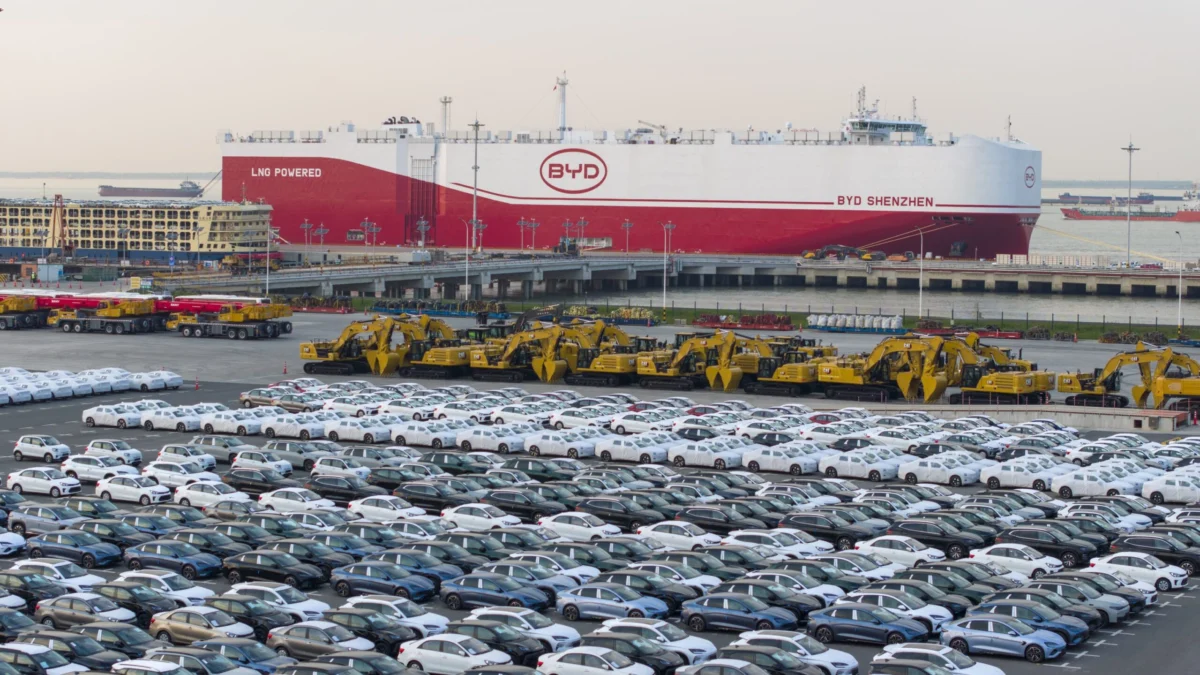
Chinese automakers, having invested heavily in EV technology, scaled up production capabilities, and refined their manufacturing processes, are uniquely positioned to capitalize on this global shift. Their competitive pricing, advanced battery technology, increasingly sophisticated vehicle designs, and rapid product development cycles make them attractive alternatives in markets facing higher energy costs and a growing imperative for decarbonization. The sight of the world’s largest car carrier, BYD "Shenzhen," loading over 7,000 BYD new energy commercial vehicles for Brazil in April 2025 (as depicted in a related image), is a tangible illustration of this burgeoning export strength and strategic global expansion. This ability to diversify revenue streams through exports offers a vital lifeline to Chinese automakers during a challenging domestic period, allowing them to maintain production volumes and continue investing in innovation.
Broader Economic Implications and Global Resonance
The performance of China’s automotive sector carries profound broader economic implications, both domestically and globally. As one of the largest manufacturing industries and a significant contributor to GDP, employment, and technological innovation, a prolonged slump in the auto market could have ripple effects across China’s economy. It could impact employment in manufacturing plants, affect demand for raw materials and components (from steel and plastics to semiconductors and advanced electronics), and dampen consumer spending in related sectors such as automotive finance, insurance, and aftermarket services. The government will likely be monitoring the situation closely for any signs that require policy intervention, perhaps in the form of renewed, targeted stimulus measures to boost domestic demand, adjustments to industrial policy to support struggling manufacturers, or further incentives for innovation.
Globally, China’s automotive trends resonate widely. As the world’s largest car market, its health directly impacts global automakers, many of whom derive a substantial portion of their revenues and profits from their Chinese operations. The struggles faced by Volkswagen, for instance, underscore how deeply integrated global players are with the Chinese market’s fortunes. A downturn in China can significantly affect the global financial performance and strategic planning of multinational automotive corporations. Furthermore, China’s ascendancy as an EV exporter signifies a reshaping of the global automotive landscape. The competitive pressure from Chinese EVs is accelerating the transition to electric vehicles worldwide, pushing established automakers in Europe, North America, and Japan to innovate faster, improve their own EV offerings, and become more cost-efficient to compete effectively. This dynamic will likely intensify, fostering both collaboration and intense competition on an international scale, fundamentally altering the global automotive hierarchy.
Outlook: A Cyclical Rebound on the Horizon
Despite the current pessimism surrounding the industry’s outlook for the second half of 2026, analysts remain cautiously optimistic for a rebound in 2027. Xiao Feng anticipates "much better demand next year," framing China’s auto market as inherently cyclical. He explains that as the existing fleet of vehicles ages, typically after a few years of heavy use, owners will naturally look to replace them, creating a natural recovery in sales. This fundamental replacement cycle, coupled with an anticipated "better economic outlook" for China in 2027, is expected to provide a strong impetus for renewed growth. The government’s potential economic stimulus measures and a general improvement in consumer confidence would further bolster this recovery.
Moreover, the continued robust performance of NEV exports is poised to be a significant driver of this recovery. As global demand for energy-efficient and environmentally friendly transportation solutions continues to rise, Chinese automakers are well-positioned to meet this need. The strategic investments made in battery technology, manufacturing scale, and international distribution networks will bear fruit, allowing these companies to leverage global market opportunities even if domestic consumption remains subdued for a period. This dual-pronged approach – relying on both cyclical domestic recovery and sustained export growth – offers a resilient pathway forward. Feng reaffirms his confidence in a market rebound, suggesting that with an improved economic climate, "even better growth [in the EV market] could be