


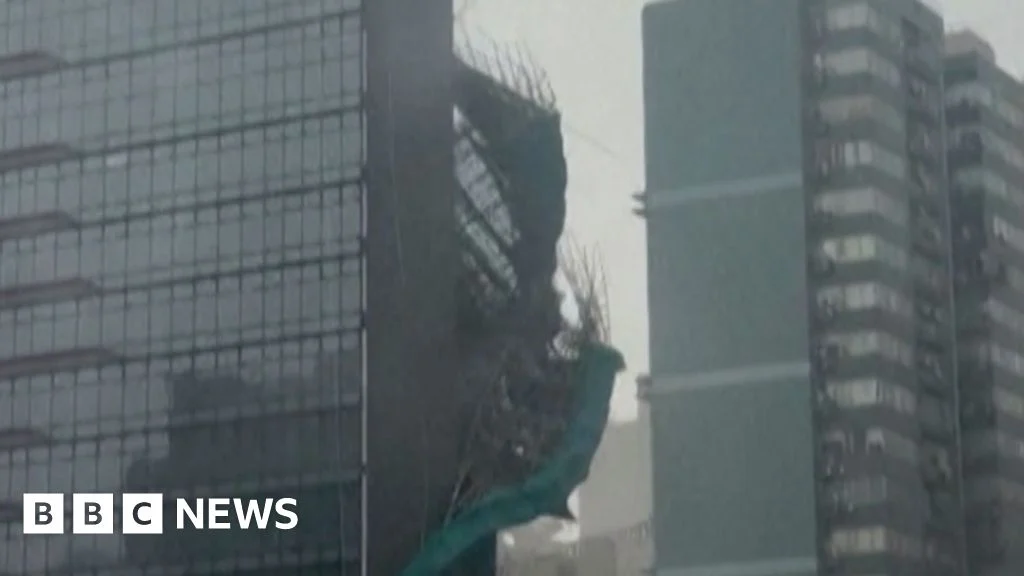
Police confirmed they received numerous emergency calls on Saturday following the dramatic collapse of multi-storey scaffolding along Cheung Sha Wan Road in Hong Kong, a direct consequence of the powerful winds preceding the arrival of Typhoon Noul. Miraculously, no injuries have been reported from the incident, despite the significant structural failure in a densely populated urban area. The typhoon, designated as the strongest to make landfall in China in 2026 to date by state media, subsequently struck southern China on Sunday morning, bringing with it not only destructive winds and torrential rain but also forcing the cancellation of approximately 360 passenger flights at Hong Kong International Airport, throwing regional travel into disarray.
Typhoon Noul’s Trajectory and Escalating Intensity
Typhoon Noul began its formation as a tropical depression in the western Pacific, rapidly intensifying over the warm ocean waters. Over the course of several days, meteorological agencies tracked its westward trajectory, observing a swift progression through categories, eventually reaching Super Typhoon status with sustained winds estimated at over 200 kilometers per hour near its center, and gusts exceeding 250 km/h. The Hong Kong Observatory (HKO) began issuing initial warnings, known as Standby Signal No. 1, as early as Thursday, escalating its alerts incrementally as Noul drew closer. By Friday evening, the Strong Wind Signal No. 3 was in effect, preparing the city for significant wind conditions. However, it was during the early hours of Saturday, as Noul’s outer bands began to sweep across the Pearl River Delta, that the weather conditions deteriorated sharply, prompting the HKO to hoist the Gale or Storm Signal No. 8. This signal, indicating sustained winds of 63-117 km/h or higher, with gusts potentially exceeding 180 km/h, underscored the severity of the approaching storm and the immediate threat it posed to infrastructure and public safety. The "powerful winds" that led to the Cheung Sha Wan scaffolding collapse occurred precisely during this critical period, highlighting the immediate and tangible impact of Noul’s peripheral forces even before its official landfall.
The Cheung Sha Wan Scaffolding Collapse: A Miraculous Escape
The incident on Cheung Sha Wan Road, a bustling artery in Hong Kong’s Kowloon district, unfolded on Saturday afternoon, plunging a section of the thoroughfare into chaos. The multi-storey scaffolding, an integral part of a building renovation project, succumbed to the immense lateral forces exerted by Noul’s gale-force winds. Eyewitness accounts described a terrifying scene as sections of bamboo and metal poles, along with safety netting, detached from the building façade, cascading onto the street below. The sheer volume of debris covered a considerable stretch of the road and pavement, narrowly missing pedestrians and vehicles.
Emergency services, including police and fire departments, were immediately dispatched to the scene after numerous calls from alarmed citizens. Upon arrival, responders secured the area, established cordons, and began a meticulous search through the wreckage to ensure no individuals were trapped or injured. Despite the scale of the collapse, which could have easily resulted in severe casualties given the high foot traffic typical of Cheung Sha Wan, preliminary assessments confirmed the absence of any reported injuries. This outcome has been widely described as fortuitous, with authorities attributing it to a combination of early public warnings, which may have reduced pedestrian presence, and sheer luck. The incident has, however, prompted an immediate investigation by the Labour Department and relevant construction safety bodies into the structural integrity of the scaffolding and adherence to safety protocols under extreme weather conditions. Hong Kong’s unique reliance on traditional bamboo scaffolding, alongside modern metal structures, necessitates stringent safety checks, especially in a typhoon-prone environment.
Widespread Disruption at Hong Kong International Airport
The full force of Typhoon Noul’s disruption was keenly felt at Hong Kong International Airport (HKIA), one of the world’s busiest air hubs. As Noul intensified and its path converged on southern China, the Airport Authority Hong Kong (AAHK) commenced a phased shutdown of operations. On Sunday morning, coinciding with the typhoon’s landfall, approximately 360 passenger flights, encompassing both arrivals and departures, were cancelled or significantly delayed. This widespread disruption affected tens of thousands of travelers, stranding them at the airport or at their points of origin.
Airport staff worked tirelessly to manage the ensuing chaos, providing assistance to passengers, distributing essential supplies, and arranging for temporary accommodation where possible. Information screens throughout the terminals displayed a sea of red "cancelled" or "delayed" notifications, leading to long queues at airline service counters as passengers attempted to rebook flights or seek alternative travel arrangements. Airlines issued travel advisories, urging passengers to check flight statuses before heading to the airport. The economic impact of such a large-scale cancellation event is substantial, affecting airline revenues, cargo operations, and the broader tourism and business sectors reliant on HKIA’s connectivity. Recovery efforts are expected to take several days as airlines work to clear the backlog of passengers and aircraft, contending with slot restrictions and crew availability.
Broader Impact Across Southern China
Typhoon Noul made its official landfall in coastal regions of southern China on Sunday morning, unleashing a torrent of destructive weather conditions. While specific landfall locations are yet to be fully detailed by state media, preliminary reports indicate significant impact across Guangdong province and parts of Fujian and Hainan. Wind speeds at landfall were recorded to be consistent with a severe typhoon, causing extensive damage to infrastructure. Power outages affected millions of households as transmission lines buckled under the wind’s force and falling trees. Coastal communities experienced widespread flooding due to storm surges, with waves reportedly reaching several meters high, inundating low-lying areas and forcing mass evacuations.
Local authorities in affected provinces had initiated comprehensive preparedness measures in the days leading up to Noul’s arrival. This included the deployment of emergency response teams, the activation of flood control mechanisms, and the mandatory evacuation of residents from vulnerable coastal zones, offshore oil platforms, and fishing vessels. State media reported that hundreds of thousands of people were moved to temporary shelters, a testament to China’s robust disaster management protocols. Despite these efforts, initial assessments suggest substantial agricultural losses and damage to industrial facilities, particularly in coastal economic zones. The true extent of the damage and the full human toll, though expected to be mitigated by early warnings, will only become clear in the days and weeks following the typhoon’s passage.
Historical Context: Typhoons and Hong Kong’s Resilience
Hong Kong and southern China are no strangers to the destructive power of tropical cyclones. The region lies within the primary typhoon belt of the western Pacific, experiencing an average of several typhoon-strength storms each year. Historically, the city has developed sophisticated early warning systems and robust infrastructure designed to withstand these annual meteorological challenges. The Hong Kong Observatory (HKO), established in 1883, is renowned globally for its accuracy in typhoon forecasting and its clear public warning system, which utilizes numbered signals (T1 to T10) to communicate threat levels.
Past typhoons such as Mangkhut in 2018, Hato in 2017, and the infamous Wanda in 1962 have left indelible marks on the city, demonstrating the potential for widespread damage, power outages, and even fatalities. Mangkhut, for instance, caused extensive damage to trees and buildings, and resulted in significant flooding, particularly in low-lying coastal areas. The fact that Typhoon Noul has been classified as the "strongest to make landfall in China in 2026 to date" immediately places it in a category of high concern, drawing parallels to these powerful historical events and testing the limits of contemporary urban resilience. The no-injury report from the Cheung Sha Wan scaffolding collapse, while fortunate, serves as a stark reminder of the ever-present dangers posed by such powerful natural phenomena.
Official Responses and Investigative Actions
In the wake of the scaffolding collapse, Hong Kong’s government moved swiftly to address public concerns. A spokesperson for the Labour Department stated that an immediate investigation would be launched into the incident, focusing on compliance with construction safety regulations, the materials used, and the methods of installation. They emphasized the importance of ensuring that all temporary structures, especially those in high-rise environments, are built to withstand expected weather conditions, including typhoon-force winds. The Buildings Department is also expected to conduct an assessment of the structural integrity of the affected building and surrounding structures.
The Airport Authority Hong Kong issued a statement expressing regret for the inconvenience caused to travelers and reaffirmed its commitment to restoring normal flight operations as quickly and safely as possible. They advised passengers to consult airline websites and the HKIA flight information display system for the latest updates. In mainland China, provincial disaster relief agencies and the China Meteorological Administration are providing continuous updates on Noul’s path and impact. The central government has pledged full support to affected regions, mobilizing resources for search and rescue operations, relief efforts, and the eventual reconstruction phase.
Implications for Urban Resilience and Construction Safety
The Cheung Sha Wan scaffolding collapse, while devoid of casualties, serves as a critical case study for urban resilience and construction safety in typhoon-prone regions. Hong Kong’s dense urban environment, characterized by high-rise buildings and extensive construction activity, presents unique challenges when faced with extreme weather. The incident prompts a review of existing regulations regarding temporary structures, particularly scaffolding systems, to ensure they are robust enough to withstand increasingly severe weather patterns. Experts in civil engineering and urban planning are likely to examine whether current standards adequately account for the projected increase in intensity of tropical cyclones, potentially linked to climate change.
Beyond the immediate damage, the economic implications of Typhoon Noul are significant. The disruption to air travel, supply chains, and local commerce will have a measurable, albeit short-term, impact on regional economies. Businesses in affected areas face direct losses from property damage, operational shutdowns, and reduced consumer activity. The recovery and rebuilding efforts will require substantial investment and coordinated action from both government and private sectors. This event underscores the perpetual need for proactive disaster preparedness, investment in resilient infrastructure, and continuous adaptation to the evolving challenges of a changing climate. As southern China begins the arduous task of recovery, the lessons learned from Typhoon Noul will undoubtedly shape future strategies for mitigating the impact of severe weather events in one of the world’s most economically vital and densely populated regions.