


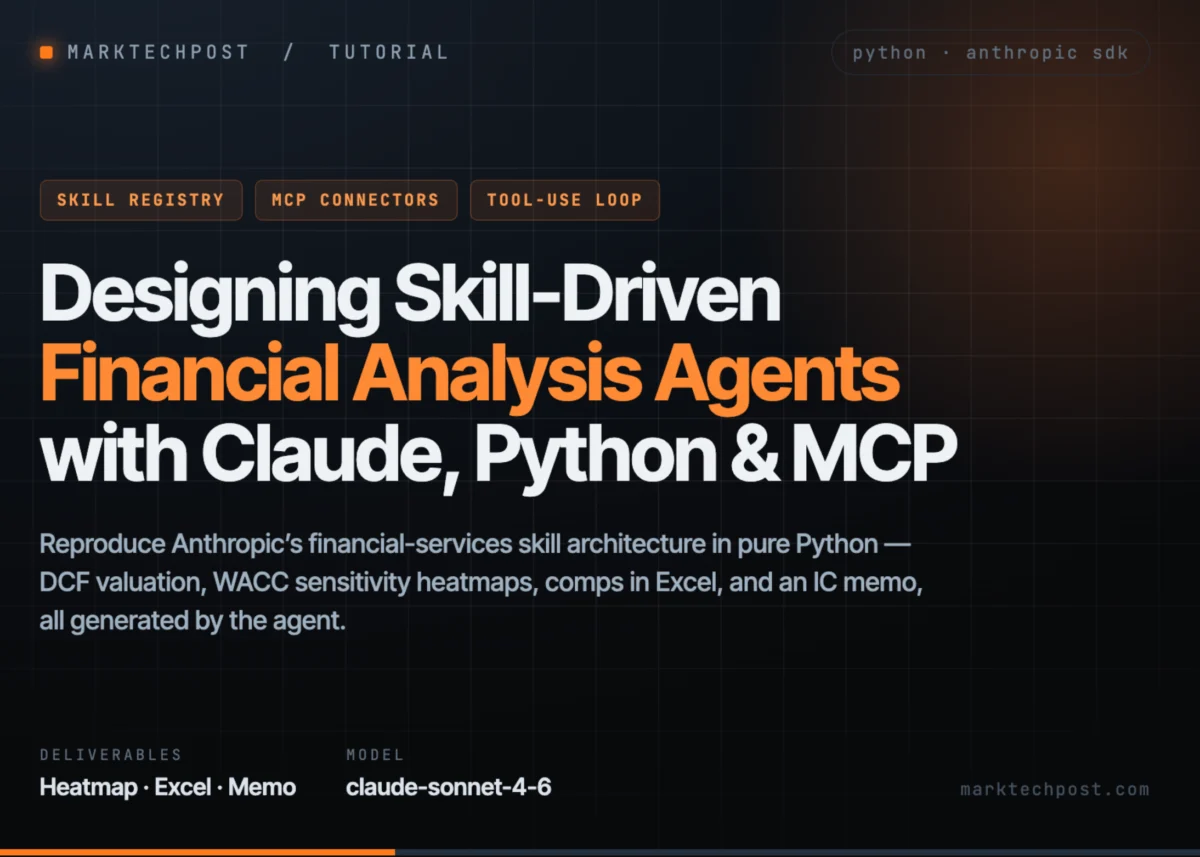
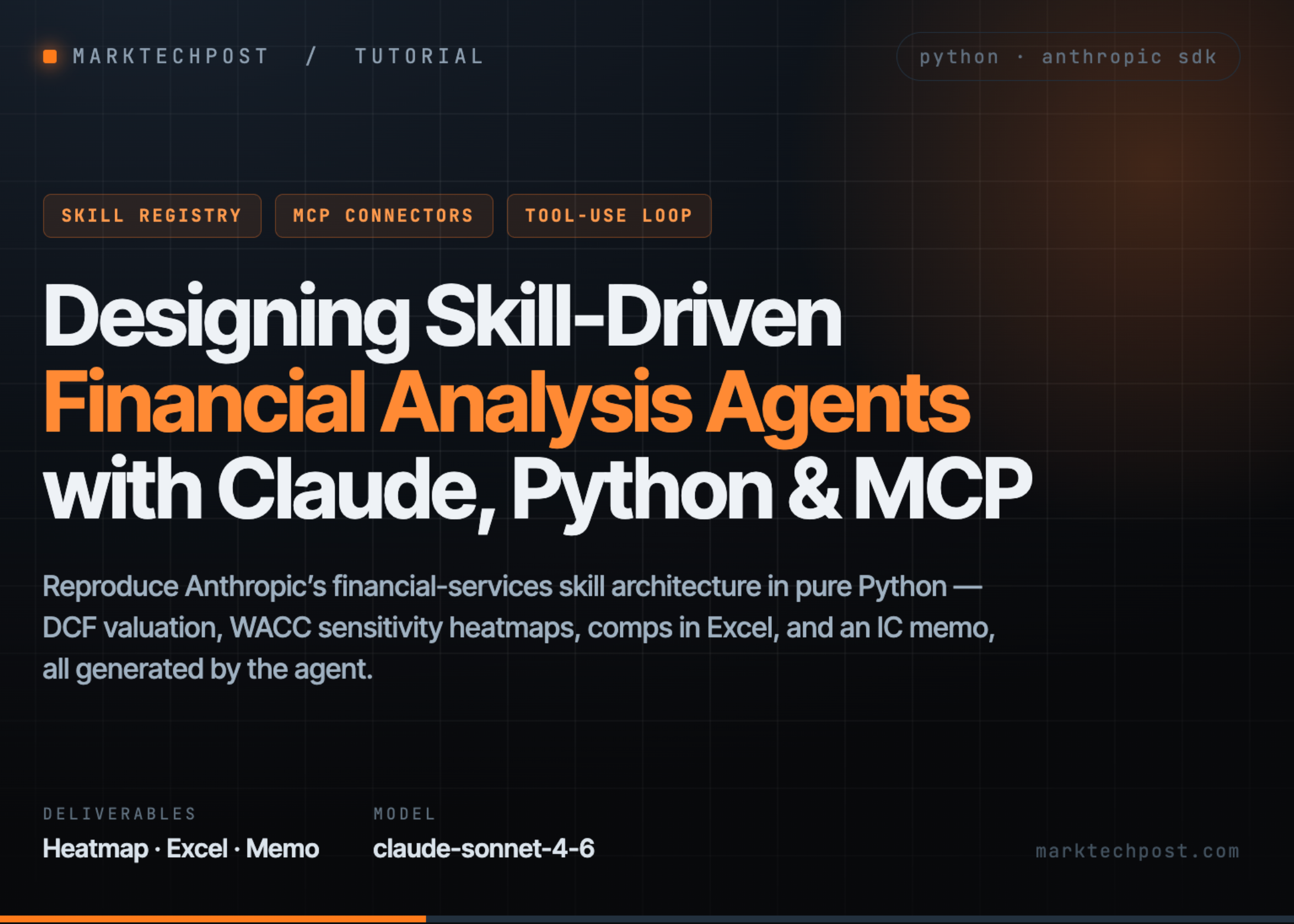
The integration of Large Language Models into high-stakes financial environments has reached a significant milestone with the release and subsequent implementation of Anthropic’s specialized financial-services framework. By leveraging a skill-driven architecture, developers are now able to reproduce complex financial workflows—ranging from discounted cash flow (DCF) valuations to investment committee memo drafting—using pure Python environments and the Anthropic Messages API. This development represents a shift from general-purpose generative AI toward "agentic" systems that follow specific, codified methodologies designed for the rigors of investment banking, private equity, and corporate finance.
The Evolution of Skill-Driven AI in Finance
The traditional approach to using AI in finance often relied on simple prompt engineering, which frequently struggled with the precision required for numerical modeling and the structured formatting of professional deliverables. The current architecture, built around Anthropic’s financial-services repository, addresses these limitations by introducing a modular "skill" system. In this context, a skill is a predefined playbook—often stored as a Markdown file with YAML metadata—that instructs the AI on specific financial methodologies, such as Weighted Average Cost of Capital (WACC) calculations or Comparable Company Analysis (Comps).
This shift toward skill-based agents allows for a "human-in-the-loop" workflow where the AI does not merely generate text but executes a series of logical steps. By programmatically mapping these skills into a searchable registry, financial institutions can ensure that their AI agents adhere to internal compliance standards and industry-standard valuation techniques. The use of a persistent Python namespace further ensures that calculations are not performed through "mental arithmetic" by the model—a common source of hallucination—but are instead executed via code, providing a verifiable audit trail for every figure produced.
Chronology of the Implementation Framework
The deployment of an advanced financial agent typically follows a structured six-stage progression. The process begins with the environment setup, where essential libraries such as Pandas, OpenPyxl, and Matplotlib are installed to handle data manipulation and visualization. Following this, the Anthropic financial-services repository is cloned to serve as the foundational knowledge base.
In the second stage, the system performs a comprehensive repository mapping. It scans for agent plugins, vertical plugins, and partner integrations, identifying the specific "SKILL.md" files that contain the logic for various financial tasks. This stage is critical for establishing a registry that the agent can query to find the most relevant methodology for a given user request.
The third stage involves the configuration of the Model Context Protocol (MCP). MCP connectors allow the agent to interface with external data providers, such as FactSet, S&P Global, or PitchBook. By defining these connectors in a structured JSON format, the agent gains the ability to pull real-time market data, which is essential for accurate valuation and peer analysis.
In the fourth stage, a "SkillAgent" class is constructed. This class acts as the orchestrator, injecting selected financial playbooks into the system prompt of the Claude model. This stage also defines the "tools" available to the agent, specifically a Python execution environment and a file-saving mechanism.
The fifth stage is the execution phase, where the agent performs specific tasks such as a 5-year unlevered DCF valuation or a Comps analysis. The final stage involves the generation of professional-grade artifacts, including Excel workbooks with automated formatting and Markdown-based investment memos, which are then stored for human review.
Technical Architecture and Tool Orchestration
The core of this agentic workflow is the interaction between the Claude model (specifically versions like Claude 3.5 Sonnet) and a sandboxed Python environment. Unlike standard chatbots, this agent operates within a "tool-use loop." When a user requests a valuation, the agent does not immediately provide a number. Instead, it generates Python code to perform the necessary arithmetic, executes that code, and then incorporates the output into its final response.
This architecture solves the "black box" problem of AI in finance. Because the agent saves its calculations in a persistent namespace, a human analyst can inspect the Python code to verify the assumptions used in a WACC calculation or the formulas applied to an EBITDA margin expansion. Furthermore, the integration of the save_file tool allows the agent to produce deliverables that are ready for corporate use, such as formatted Excel sheets that include bolded headers, specific color schemes, and calculated summary statistics like medians and quartiles.
Case Study A: Automated Discounted Cash Flow and Sensitivity Analysis
In a recent demonstration of the framework’s capabilities, a synthetic valuation was performed on "Meridian Software," a hypothetical firm with $850 million in revenue. The agent was tasked with executing a 5-year unlevered DCF valuation based on specific operating assumptions, including a 24% tax rate and a WACC of 9.5%.
The agent successfully utilized the run_python tool to project free cash flows, calculate the terminal value using the perpetuity growth method, and discount these flows back to the present value. Beyond the baseline valuation, the agent generated a two-dimensional sensitivity matrix. This matrix explored the impact of varying WACC (from 8.5% to 10.5%) and terminal growth rates (from 1.5% to 3.5%) on the implied share price. The resulting data was not just presented as text but was visualized through a Matplotlib-generated heatmap, providing an immediate graphical representation of valuation risk—a standard requirement for high-level investment briefings.
Case Study B: Comparable Company Analysis and Professional Reporting
The framework also streamlines the process of Comparable Company Analysis, a task that typically consumes hours of a junior analyst’s time. By supplying a peer set with tickers, prices, and NTM (Next Twelve Months) estimates, the agent can automatically calculate enterprise value (EV) multiples and price-to-earnings (P/E) ratios.
During the testing phase, the agent processed a synthetic peer set and produced a comprehensive "Comps" table. It then utilized the openpyxl library to export this data into a multi-sheet Excel workbook. Notably, the agent applied professional formatting, including "solid fill" headers and adjusted column widths, demonstrating an understanding of the aesthetic and functional standards required in financial reporting. This capability suggests a significant potential for reducing the "manual labor" aspect of investment banking, allowing analysts to focus more on qualitative synthesis and less on data entry.
Strategic Implications for the Financial Sector
The adoption of agentic workflows in finance carries profound implications for productivity and accuracy. According to industry data, financial analysts spend upwards of 50% of their time on data gathering and basic modeling. The automation of these tasks via skill-driven agents could theoretically double the capacity of deal teams.
Furthermore, the use of the Model Context Protocol (MCP) addresses one of the primary hurdles to AI adoption in finance: data freshness. By allowing models to "reach out" to licensed data providers, the risk of using stale information is mitigated. This creates a "governed runtime" where the AI operates within the boundaries of both professional methodology (the skills) and verified data (the MCP connectors).
However, the implementation of such systems also raises questions regarding regulatory compliance and accountability. The current framework emphasizes that all outputs are "drafts for human review" and not formal investment advice. As these systems become more autonomous, the role of the "Human-in-the-loop" will likely evolve from a creator of models to an auditor of AI-generated workflows.
Official Context and Industry Response
While Anthropic has not released a formal statement on every individual implementation of their repository, the design of the financial-services GitHub repo itself signals a clear intent to capture the enterprise finance market. The repository’s inclusion of "Managed-Agent Cookbooks" suggests that Anthropic is positioning its models not just as conversational partners, but as the engine for specialized, deployable workers that can be integrated into existing corporate infrastructures.
Market analysts observe that this move puts Anthropic in direct competition with specialized FinTech AI startups. By providing the "plumbing" for financial agents—registry patterns, skill playbooks, and tool-use loops—Anthropic is enabling firms to build proprietary AI tools in-house rather than relying on third-party SaaS platforms that may not offer the same level of transparency or customization.
Future Outlook and Conclusion
The transition from experimental AI to production-ready financial agents is accelerating. The ability to reproduce Anthropic’s advanced workflows in a pure Python environment like Google Colab or a local IDE democratizes access to sophisticated financial modeling tools. Looking forward, the integration of more complex skills—such as Leveraged Buyout (LBO) modeling, merger consequence analysis, and automated KYC (Know Your Customer) workflows—is expected to expand the utility of these agents.
As financial institutions continue to refine these workflows, the focus will likely shift toward "stacked skills," where an agent can perform a "football field" valuation by combining DCF, Comps, and Precedent Transaction methodologies into a single, cohesive report. The ultimate goal is a seamless pipeline where raw data enters the system and a formatted, professional, and mathematically sound investment memo emerges, ready for the final scrutiny of a human partner. This technological trajectory suggests that the future of finance lies not in replacing the analyst, but in equipping them with an "agentic" workforce capable of executing the mechanical aspects of the profession with unprecedented speed and precision.