

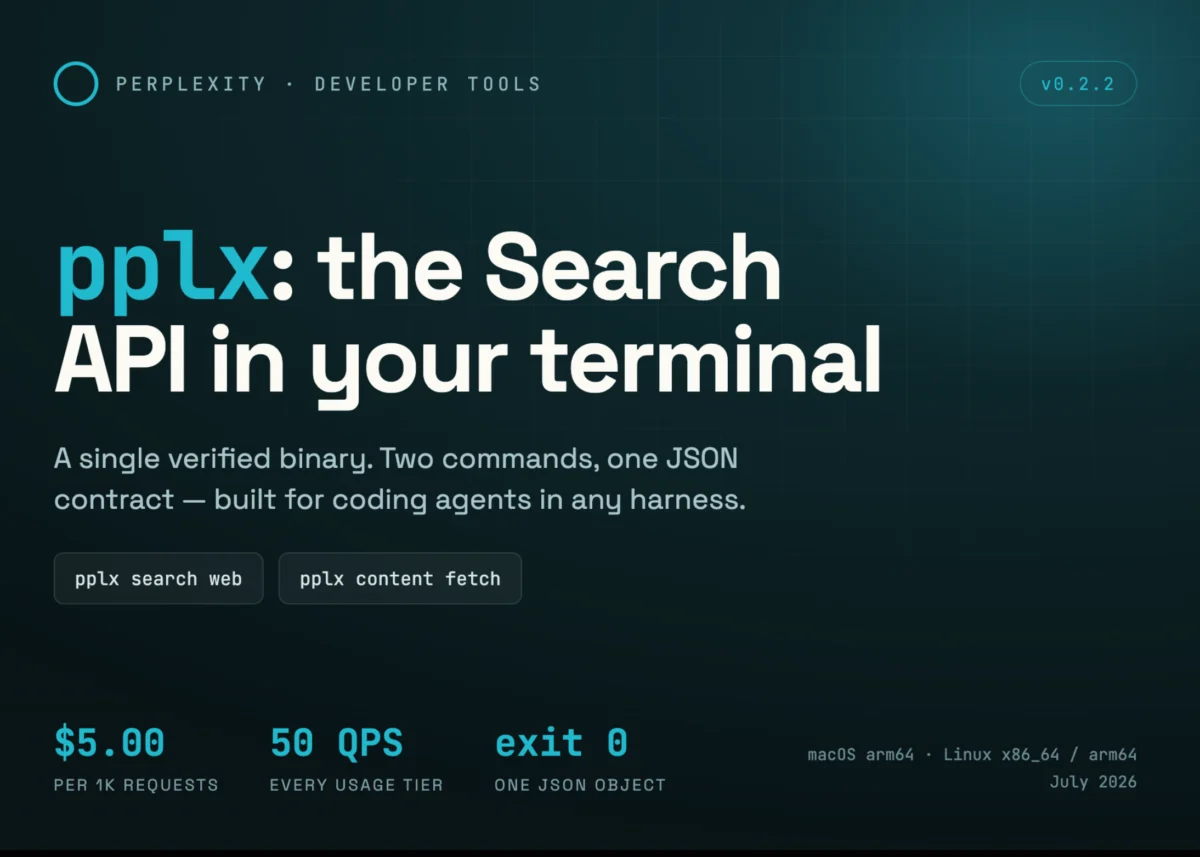
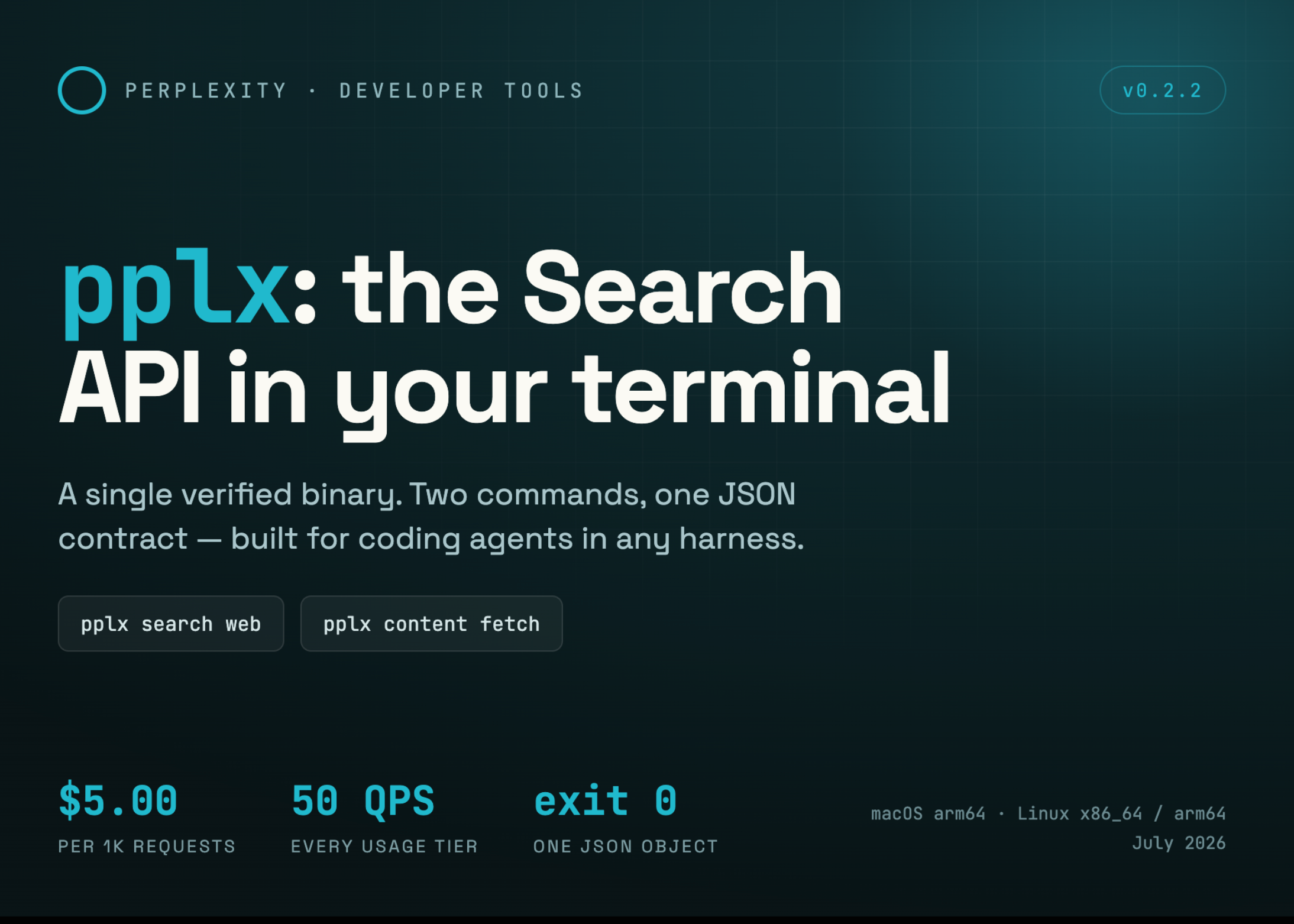
Perplexity, the artificial intelligence-driven search engine that has rapidly emerged as a primary competitor to traditional search giants, has officially released its command line client, known as pplx. This new tool represents a significant strategic pivot toward the developer and automation market, providing a dedicated interface for the company’s Search API. Unlike the consumer-facing Perplexity Pro or the standard web interface, pplx is not a chat client; it offers no conversational mode, no model selection, and no synthesized natural language answers. Instead, it is designed as a high-performance utility that returns grounded search results and extracted page text in structured JSON format, specifically engineered to serve both human developers and autonomous coding agents.
The release of the pplx CLI marks a maturation of Perplexity’s developer ecosystem. By stripping away the conversational layer, the company is positioning itself as a foundational data provider for the next generation of AI "agents"—programs designed to perform complex tasks with minimal human intervention. As the industry moves toward agentic workflows, the demand for "grounded" data—information verified by external sources—has skyrocketed. The pplx tool addresses this by providing a programmatic bridge between the live web and the local development environment.
Functional Overview: Two Surfaces and a Unified Output Contract
The pplx CLI is built around a philosophy of simplicity and predictability, exposing exactly two working surfaces for users. The first command, pplx search web, executes a live web search across Perplexity’s index. This command does not return a summarized paragraph as the web interface would; instead, it yields a JSON object containing an array of "hits." Each hit includes the source URL, the page title, the domain, and a relevant snippet of text. This allows developers to programmatically parse search results without the overhead of natural language processing.
The second surface, pplx content fetch, is designed for deep data extraction. By providing a specific URL to this command, the tool pulls the page and returns a "cleaned" version of the text. This feature is particularly valuable for developers building Retrieval-Augmented Generation (RAG) pipelines, where the quality of the input data directly dictates the quality of the AI’s output. By removing navigation menus, advertisements, and extraneous HTML boilerplate, Perplexity provides a streamlined data stream for LLM consumption.
The "contract" of the CLI is its most distinguishing feature for automation. According to the official pplx-cli Agent Skill documentation, the tool follows a strict execution protocol. A successful operation always results in an exit code of 0 and exactly one JSON object sent to standard output (stdout). Conversely, any failure results in an exit code of 1, an empty stdout, and a single JSON error object sent to standard error (stderr). This binary success-failure state, paired with structured error codes such as AUTHENTICATION, UNKNOWN_ARGUMENT, and BAD_REQUEST, makes the tool exceptionally easy to integrate into larger software systems and automated scripts.
Strategic Design for the Agentic Economy
One of the most innovative aspects of the pplx CLI is its explicit focus on "context-window economics." In the current AI landscape, the cost and performance of large language models (LLMs) are heavily influenced by the number of tokens processed. Large, unoptimized web pages can easily overwhelm an agent’s context window, leading to increased costs and decreased reasoning accuracy.
Perplexity has addressed this by integrating token budgeting as a first-class design concern. The CLI includes a --stdout-preview flag, which truncates long string fields in the output and appends <truncated> markers. Crucially, this feature is designed to work in tandem with the --output-dir flag. When both are used, the tool saves the full, high-resolution data to a local JSON file while providing a lightweight preview to the console or the calling agent. This allows an AI agent to "glance" at the search results to determine relevance before committing to the computational expense of processing the full-text content.
The tool also introduces sophisticated handling for web-specific hurdles. For content fetching, the CLI includes an is_paywall flag in its output, allowing agents to identify and bypass or flag restricted content. Furthermore, the --html flag allows users to fetch raw HTML via a live crawler, while --no-cache ensures that the data is not pulled from a previous index but is instead a "fresh" look at the target URL. These features suggest that Perplexity is moving toward a more transparent and granular "Search-as-a-Service" model.
Installation Architecture and Platform Constraints
The installation process for pplx reflects a modern, "zero-dependency" approach, though it currently features notable platform limitations. Users can install the tool via a single shell command that pipes a script from GitHub into the shell. While such installation methods are common in the developer community, Perplexity has implemented several safety and stability measures within the script.
An analysis of the install.sh script reveals that it does not simply pull the latest binary. Instead, it downloads a manifest.json file from the latest release to extract specific tags and version numbers. It then pins all subsequent downloads to that specific tag to prevent "race conditions" where a new version might be published mid-installation. The script also fetches SHA256 checksums to verify the integrity of the binary before it is moved to the user’s local directory.
Significantly, the tool does not require administrative (sudo) privileges, as it installs to ~/.local/bin/pplx. However, the current release is highly targeted in its hardware support. The CLI is available only for macOS on Apple Silicon (M-series chips), Linux x86_64, and Linux arm64. There is currently no support for Windows environments or older Intel-based Mac hardware. This focus on ARM architecture and Linux suggests that Perplexity is prioritizing the environments most commonly used by AI researchers, cloud infrastructure, and modern software engineers.
Chronology and Context: The Evolution of Perplexity’s API
The release of the pplx CLI is the latest step in a rapid expansion of Perplexity’s enterprise and developer offerings. Founded in 2022, Perplexity initially focused on a "conversational answer engine" to disrupt the traditional search market. However, as the demand for enterprise-grade AI tools grew, the company began diversifying its product line.
In late 2023 and early 2024, Perplexity launched its API platform, allowing third-party developers to integrate Perplexity’s search-augmented LLMs into their own applications. The API pricing model—ranging from free tiers for Pro subscribers to usage-based billing for enterprise clients—created a foundation for this ecosystem. The introduction of the CLI is a response to developer feedback calling for more "primitive" tools that provide raw data rather than processed answers.
By providing a CLI, Perplexity is essentially unbundling its search technology. Developers who may not want to use Perplexity’s specific LLM fine-tuning can now use Perplexity’s superior web-indexing and "cleaning" capabilities to feed data into other models, such as OpenAI’s GPT-4, Anthropic’s Claude, or locally hosted Llama models.
Broader Implications for the AI Industry
The launch of pplx carries several significant implications for the broader technology industry. First, it signals a shift in how search companies view their "product." While Google and Bing have long offered Search APIs, those tools were often seen as secondary to their primary ad-driven web interfaces. Perplexity, by contrast, is treating its API and CLI as primary products, recognizing that in an AI-driven world, the "user" of a search engine is increasingly likely to be a machine rather than a human.
Second, the tool highlights the growing importance of "grounding" in AI. As concerns over LLM hallucinations persist, the ability to quickly and reliably pull verified web data into a model’s context window is a critical competitive advantage. Perplexity’s decision to focus on JSON output and strict error handling makes it a more attractive option for developers building mission-critical applications where "synthesized answers" might be too risky or imprecise.
Finally, the focus on "coding agents" suggests that Perplexity is positioning itself as a core component of the automated software engineering stack. Tools like Devin, the world’s first AI software engineer, require the ability to search the web for documentation, debug errors by looking up stack traces, and fetch the latest library specifications. The pplx CLI provides these agents with a standardized, high-speed way to perform these tasks without the overhead of a web browser or a chat interface.
As Perplexity continues to iterate on its developer platform, the industry will likely see a move toward more "modular" AI tools. The pplx CLI is a testament to the idea that sometimes, the most powerful AI tool is the one that does less—by providing the raw, structured data that allows other systems to do more. With its robust JSON contract and focus on token efficiency, pplx is set to become a staple in the toolkit of developers building the next generation of autonomous systems.