


The Structural Realities of the $10 Trillion Travel Economy
The $10 trillion figure often cited in travel industry pitch decks is frequently misinterpreted as a measure of opportunity. In reality, this spending is distributed across a highly fragmented landscape governed by local regulations, disparate payment systems, and complex operational requirements. For a startup to succeed, it must move beyond aesthetic improvements—such as user experience (UX) enhancements—and address the structural dependencies that define the industry.

A critical metric for any new company is the "Permission to Exist" framework. This evaluation consists of five fundamental questions regarding a company’s structural right to operate. First, discoverability: can third-party agents see and read the inventory? Second, accountability: who is held responsible when a trip is disrupted? In this context, "blame" is viewed as proof of market relevance. Third, brand preference: do consumers ask for the service by name? Fourth, transaction ownership: who controls the checkout process and the customer record? Finally, structural dependency: can other companies transact without this specific entity?
Historical data suggests that even well-loved interfaces, such as the travel search platform Hipmunk, failed because they lacked these structural moats. Hipmunk was eventually acquired by SAP Concur and shuttered, demonstrating that superior UX is not a substitute for a robust answer to these five questions.

The Hierarchy of the Travel Stack and the Fight for Tolls
The travel industry operates as a layered system, where each "floor" possesses distinct economics and profit margins. At the top of the stack is consumer inspiration, a layer Ali describes as "free," while the actual revenue is often captured several floors down. Below inspiration lies search and planning—a domain dominated by Google for two decades—followed by booking and payments, distribution rails, operations, capital allocation, and government systems.
A significant portion of industry conflict centers on "The Toll." When a consumer pays $500 for a hotel room, the actual amount retained by the hotel varies significantly based on the distribution channel. A direct booking may leave the hotel with $475, whereas an Online Travel Agency (OTA) booking might reduce that figure to between $375 and $425. Wholesale resellers, or "bedbanks," often leave the hotel with $350 or less. The "hatched zone"—the difference between the consumer price and the hotel’s take—is the toll collected by intermediaries. The current industry struggle involves who will collect these tolls as artificial intelligence (AI) begins to automate the booking process.

Capital Allocation and the "Say-Do Gap"
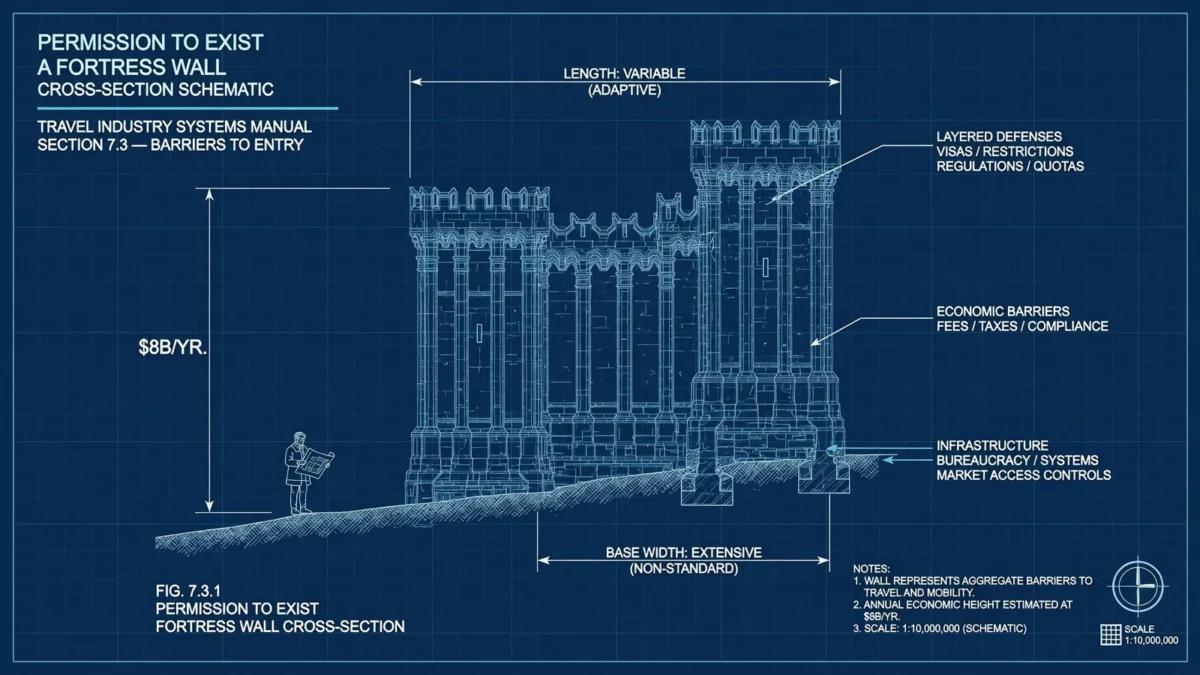
One of the most revealing indicators of industry direction is the gap between what incumbents say and where they allocate capital. Major hotel brands like Marriott and Hilton often frame themselves as technology platforms during earnings calls. However, data shows they typically spend only 2% to 2.3% of revenue on technology. In contrast, Booking Holdings allocates approximately 3.4% of revenue to IT, while spending a staggering 30%—roughly $8 billion annually—on marketing.
Furthermore, the largest travel companies return 60% to 75% of their free cash flow to shareholders through buybacks. This suggests that incumbents are betting on the permanence of current models rather than investing in radical disruption. This "Say-Do Gap" creates an opening for startups to build in areas where incumbents are structurally conflicted. For instance, an OTA cannot easily help a hotel increase direct bookings without undermining its own commission-based business model.

The Evolution of the Consumer Travel Market
The consensus among industry analysts is that the consumer travel startup is largely dead as a venture capital thesis. The cost of customer acquisition is prohibitively high because Google controls the top of the funnel, while OTAs like Expedia and Booking.com dominate the middle. The graveyard of travel startups is filled with "itinerary builders" that failed to move beyond the inspiration phase.
The more viable path for modern startups lies in addressing "business pain" rather than "traveler pain." While travelers frequently complain about friction, they are often unwilling to pay for its removal. Conversely, businesses are willing to pay to fix margin leakage, distribution inefficiencies, and failed retailing strategies. In this B2B context, the user, the payer, the supplier, and the beneficiary are often different entities, requiring a sophisticated sales approach targeted at specific executive budgets.

The Friction Framework and Demand Corridors
The industry often treats "friction" as a negative attribute, but the "Friction Framework" suggests that some forms of complexity are beneficial. There are four distinct types:
- Barrier Friction: Structural obstacles like visas or broken payments that stop purchases; these must be removed.
- Legacy Friction: Manual processes and fragmented supply; these should be automated.
- Discovery Friction: The pleasure of research and anticipation; this should be preserved.
- Competitive Friction: Operational complexity that a company handles better than others; this serves as a moat and should be kept.
Additionally, startups must recognize that demand moves in "corridors" rather than broad markets. These corridors are shaped by flight routes, visa policies, diaspora populations, and trade ties. For example, when Ryanair introduced flights to Tirana, Albania, traffic surged not because the destination’s appeal changed, but because a corridor was opened. Founders are advised to "win a specific world" first—such as boutique hotels in a specific region or a particular travel niche—before attempting global expansion.

Emerging Hubs and New Funding Paradigms
The geographic landscape of travel technology is shifting away from traditional hubs like San Francisco and London. Significant innovation is emerging from "mispriced" markets:
- Turkey: Home to Hitit, one of the world’s largest airline reservation technology providers, and a tech sector forged in currency volatility.
- Montreal: A hub with 80 years of aviation expertise dating back to the establishment of the International Civil Aviation Organization (ICAO).
- India: Companies like TBO and RateGain are engaging in "Reverse Gravity," using their scale in Eastern markets to acquire established Western firms.
These companies often utilize funding models that differ from traditional venture capital. They may be bootstrapped for decades, backed by pension capital (such as Canada’s CDPQ), or owned by strategic airline parents. These models prioritize patience and infrastructure building over the rapid exit timelines required by venture firms.

AI and the Future of Customer Ownership
The current wave of AI integration has created a divide between "Builders," "Reorganizers," and "Renamers." Builders create entirely new capabilities, while Renamers simply add an AI label to existing products. A simple test for any AI startup is to strip the AI language from their pitch deck; if the business model no longer makes sense, it is likely a technology demo rather than a viable company.
The long-term impact of AI will be a shift in who owns the customer relationship. The concept of "booking on any digital surface," first proposed in 2015, is becoming a reality through AI agents. For example, SiteMinder has already enabled 53,000 hotels to be bookable via ChatGPT and Claude.

The ultimate prize in this transition is the "AI memory"—the record of a traveler’s preferences, dislikes, and experiences across an entire trip. Currently, this data is fragmented. Banks know what travelers spend, and airlines know where they fly, but no single entity holds a complete, portable memory of the traveler. The infrastructure that stores and manages this memory is described as the most valuable unclaimed job in the travel industry.
Conclusion and Implications
After fourteen years of observing the industry’s evolution, the primary lesson for founders is to avoid building "beside" the power struggle. The most durable companies are those that embed themselves within the industry’s complex plumbing and solve problems that incumbents are structurally unable to address. By matching the right capital to the business, focusing on business-side pain points, and preparing for a future where AI agents mediate the customer relationship, new entrants can find a foothold in the $10 trillion experiential economy. Success in travel tech is less about the "logo" and more about the "layer"—understanding where the next dollar goes and who holds the power to decide its destination.