


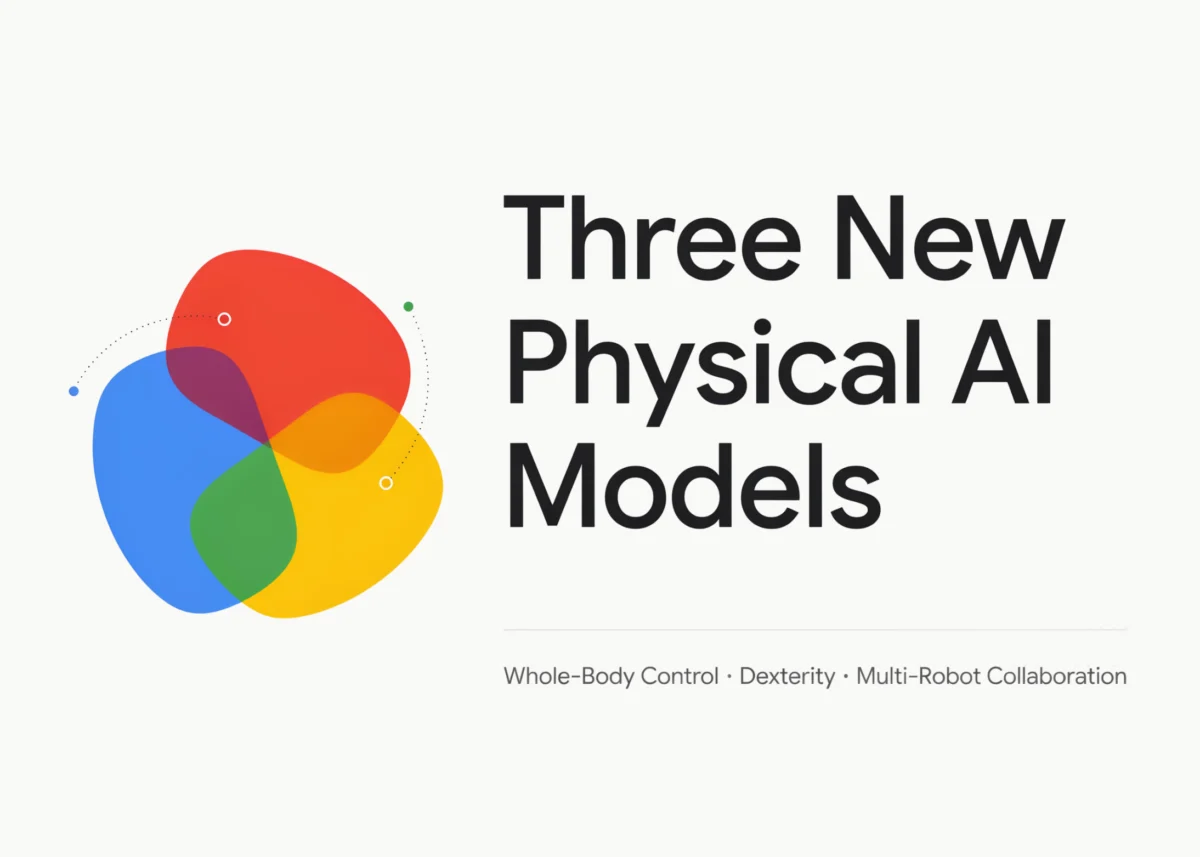
Google DeepMind has officially announced the launch of Gemini Robotics 2, a sophisticated intelligence layer designed to serve as the foundational architecture for the next generation of autonomous machines. This release represents a significant technological leap, moving beyond the limitations of stationary, table-top manipulation and introducing a comprehensive suite of capabilities including whole-body control, five-finger dexterity, and seamless multi-robot teamwork. By shipping as a tripartite system of models with tiered access, Google aims to provide developers and industrial partners with the tools necessary to transition robots from narrow, repetitive task sequences to versatile, adaptive agents capable of operating in unpredictable real-world environments.
For years, the robotics industry has been constrained by three primary bottlenecks: the need for rigid pre-programming or tele-operation, an inability to adapt to environmental changes, and the lack of skill transferability between different robot architectures. Gemini Robotics 2 is engineered to address these challenges simultaneously, leveraging Google’s latest advancements in multimodal large language models to create a "brain" that understands physical nuances as effectively as it processes digital information.
The Evolution of Embodied AI: A Brief Chronology
The journey to Gemini Robotics 2 is rooted in a series of rapid advancements within Google’s AI research divisions. In late 2022, the introduction of RT-1 (Robotics Transformer 1) demonstrated that transformers could be used to manage robotic tasks with high efficiency. This was followed by RT-2 in 2023, the first Vision-Language-Action (VLA) model, which proved that a model trained on both web-scale data and robotic trajectories could exhibit emergent reasoning and basic generalization.
In early 2024, Google DeepMind introduced Gemini Robotics 1.5, which integrated the Gemini family’s long-context capabilities into the robotic stack, allowing machines to follow complex, multi-step instructions. The current release of Gemini Robotics 2 marks the culmination of these efforts, shifting the focus from "manipulation" to "embodiment." This means the AI is no longer just controlling a gripper on a desk; it is managing the balance, navigation, and fine motor skills of a mobile, humanoid, or multi-armed system in a holistic manner.
Architectural Framework: Three Specialized Models
The Gemini Robotics 2 ecosystem is divided into three distinct models, each optimized for a specific layer of the robotic stack. This modular approach allows for better system design, enabling developers to balance high-level reasoning with low-latency motor execution.
Gemini Robotics ER 2: The Reasoning Engine
The "ER" in Gemini Robotics ER 2 stands for Embodied Reasoning. This model serves as the high-level cognitive center of the robot. Based on the Gemini 3.5 Flash architecture, ER 2 is a vision-language model (VLM) designed to communicate with humans, interpret the physical world, and plan complex, multi-step tasks that may span several minutes.
Technically, ER 2 boasts a context window of up to 128,000 tokens, allowing it to process massive amounts of interleaved text, image, video, and audio data. It can emit up to 64,000 tokens of text, which it uses to formulate strategies and delegate specific motor tasks to other models. One of its most significant features is its ability to treat lower-level control interfaces—such as VLA models or navigation APIs—as "callable tools," much like a software agent calls an API to check the weather.
Gemini Robotics 2: The VLA Motor Controller
While ER 2 handles the "why" and "what," Gemini Robotics 2 (the VLA model) handles the "how." This model converts vision and language inputs directly into motor control signals. It is the engine behind "whole-body intelligence," capable of driving full humanoids from their stabilizing feet to their delicate fingertips. It is designed to be embodiment-agnostic, meaning it can operate various hardware configurations, from standard industrial parallel grippers to complex five-fingered hands with high degrees of freedom (DOF).
Gemini Robotics On-Device 2: The Edge Specialist
For applications where network latency is unacceptable or connectivity is intermittent, Google has provided Gemini Robotics On-Device 2. This model is built on the foundation of Gemini Robotics 1.5 and Google’s Gemma on-device models. It is optimized to run locally on the robot’s hardware. By processing proprioception—the robot’s internal sense of its own position and movement—as numerical values, On-Device 2 ensures rapid response times and enables the robot to adapt to new physical bodies within hours rather than weeks.
Breakthroughs in Whole-Body Control and Dexterity
A primary highlight of this release is the demonstration of whole-body motion on the Apptronik Apollo 2 humanoid. In previous iterations, Gemini models were largely confined to upper-body movements while the robot remained stationary. With Gemini Robotics 2, the AI manages the transition between walking, reaching, and placing.
In a benchmark scenario, a robot was instructed to "put the watering can into the green bin on the bottom shelf." The system successfully coordinated the walk to the table, the pick-up maneuver, the navigation to the shelving unit, and the precise placement of the object. While Google DeepMind acknowledged that movement speeds still require advancement to match human efficiency, the fluidity of the coordination marks a new milestone for the industry.
Furthermore, the system has demonstrated unprecedented dexterity using the 22-degree-of-freedom SharpaWave hand. Tasks that were once considered nearly impossible for general-purpose AI—such as tying knots in a trash bag, sealing a ziplock bag, and unscrewing lightbulbs—have been successfully executed.
Performance Data and Success Rates
The efficacy of Gemini Robotics 2 was tested across various embodiments, including the Apptronik Apollo 2 and the Franka Duo platform. The following data highlights the current success rates for specific tasks:
- General Manipulation (Apollo 2 + Inspire Hands):
- Pick up from shelf: 76.3%
- Pick up from table: 68.4%
- Pick up from floor: 45.7%
- Multi-finger Dexterity (Apollo 2 + Sharpa Hands):
- Unscrew lightbulb: 92%
- Tie trash bag: 44%
- Ziplock bag sealing: 40%
- Screw in lightbulb: 36%
- Gripper Dexterity (Franka Duo):
- Precise insertion tasks: 89.6%
- Diverse tool kitting: 78.9%
These figures suggest that while the models are highly capable of understanding tasks, the physical execution of high-precision tasks like threading a screw remains a frontier for further refinement.
Advanced Spatial Reasoning and Tool Orchestration
Beyond physical movement, Gemini Robotics 2 introduces sophisticated "progress classification" and "moment finding" capabilities. These features solve a perennial problem in robotics: knowing exactly when a task is finished or when an error has occurred.
ER 2 can assign every frame of a video feed to a progress level (0-100%). This allows the robot to understand if it is stuck or if a task has been successfully completed. In "moment finding" tests—such as identifying the exact millisecond to stop pouring liquid to avoid an overflow—ER 2 achieved 91.3% accuracy. This level of temporal precision is achieved at four times the execution speed of previous models.
The system also features upgraded spatial capabilities, including the ability to read a wide array of instruments. Testing showed the model could accurately interpret digital displays, linear scales, rulers, and liquid thermometers across ten different instrument types. This allows robots to interact with legacy human environments without requiring specialized digital sensors for every piece of equipment.
Multi-Robot Collaboration and The Live API
One of the most forward-looking aspects of Gemini Robotics 2 is its support for heterogeneous robot teams. Recognizing that no single robot design is optimal for every environment, Google DeepMind has enabled robots to communicate through a shared semantic understanding.
In one demonstration, a wheeled Franka F3 Duo and a humanoid Apptronik Apollo 2 collaborated to hand off subtasks, with the wheeled unit handling indoor transport and the humanoid managing tasks requiring vertical reach. This orchestration is facilitated by the Gemini Live API, which provides a bidirectional streaming endpoint. This eliminates the "stop-and-think" pauses typical of older AI robots, allowing for a continuous flow of action and reaction.
Industry Implications and Future Outlook
The release of Gemini Robotics 2 has significant implications for the global robotics market. By providing a standardized, high-level intelligence layer, Google is essentially attempting to do for robotics what Android did for smartphones: providing a common platform that hardware manufacturers can build upon.
Industry analysts suggest that this move will accelerate the deployment of robots in logistics, domestic assistance, and complex manufacturing. The ability of Gemini Robotics On-Device 2 to adapt to new robot bodies with fewer than 200 examples is particularly disruptive, as it drastically reduces the cost and time of "training" a robot for a specific factory floor or warehouse.
However, challenges remain. Google DeepMind’s own safety technical reports and model cards highlight limitations in generalizing to completely out-of-distribution tasks and managing extremely high-DOF systems. Furthermore, the energy consumption of running such massive models, even in "Flash" versions, remains a consideration for battery-powered mobile units.
Availability
Gemini Robotics 2 is being rolled out through a tiered access program:
- Gemini Robotics ER 2: Currently available in public preview via the Gemini API and Google AI Studio. It is also available in private preview for enterprise customers on the Gemini Enterprise Agent Platform.
- Gemini Robotics 2 (VLA): Restricted to early-access partners for industrial testing.
- Gemini Robotics On-Device 2: Available to "Trusted Testers" to ensure safety and stability before a wider release.
As these models move from the laboratory to the real world, the focus will likely shift toward optimizing speed and safety. For now, Gemini Robotics 2 stands as a testament to the power of multimodal AI in bridging the gap between digital reasoning and physical action.