


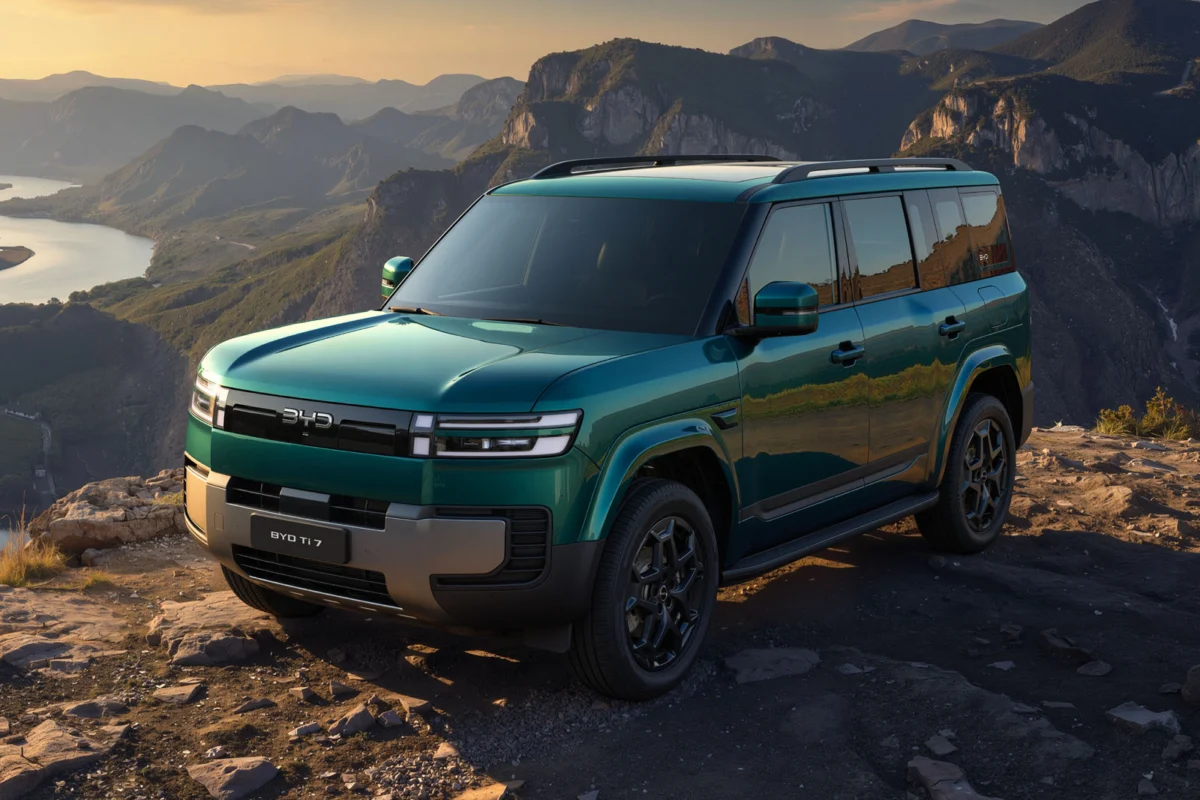
The arrival of the BYD Ti7 in the United Kingdom marks a significant expansion for the Chinese automotive giant, introducing its largest and most ruggedly styled model to the British market to date. Positioned as a direct competitor to established premium off-roaders and luxury crossovers, the Ti7 enters the fray with a starting price of £47,995. This pricing strategy places the vehicle in a highly competitive niche, undercutting the Land Rover Defender—which sits as a primary stylistic rival—as well as petrol-powered premium staples such as the Mercedes-Benz GLC and the BMW X3. By offering a blend of aggressive, traditional 4×4 aesthetics with a highly advanced plug-in hybrid (PHEV) powertrain, BYD aims to capture a segment of the market that prioritizes both presence and environmental efficiency.
Technical Specifications and the DM-p Powertrain
Central to the Ti7’s appeal is the debut of BYD’s performance-oriented ‘DM-p’ (Dual Mode performance) powertrain in the UK. Unlike the ‘DM-i’ systems found in other BYD models, which prioritize fuel efficiency and range extension, the DM-p architecture is engineered for high power output and dynamic capability.
The system is built around a 1.5-litre turbocharged four-cylinder petrol engine. This internal combustion unit works in tandem with two high-output electric motors, one situated on each axle to provide permanent all-wheel-drive capability. The combined system produces a total output of 402bhp. This power allows the Ti7, despite its significant physical footprint and rugged construction, to accelerate from 0-62mph in just 4.8 seconds. This performance figure places the Ti7 in direct competition with performance-tuned variants of European luxury SUVs.
Powering the electric motors is a 35.6kWh lithium-iron-phosphate (LFP) battery pack. This battery utilizes BYD’s proprietary "Blade Battery" technology, which is designed to offer enhanced thermal stability and safety compared to traditional NCM (nickel-cobalt-manganese) chemistries. According to official figures, the Ti7 achieves an electric-only range of 74 miles, a figure that is significantly higher than many current PHEV rivals. This range allows for most daily commuting to be handled without engaging the petrol engine, potentially offering substantial savings in running costs and Benefit-in-Kind (BiK) tax for company car users.
Design Philosophy and Engineering Architecture
The Ti7 adopts a "boxy" design language that pays homage to classical 4×4 icons like the Land Rover Defender and the Toyota Land Cruiser. Its exterior features include bluff vertical edges, a high beltline, and a prominent spare wheel carrier mounted externally on the rear tailgate. These design cues are intended to project an image of durability and off-road readiness.
However, the engineering beneath the skin reveals a specific market positioning. While its sibling, the Denza Bao 5 (known as the Fangchengbao Leopard 5 in China), utilizes a body-on-frame "ladder" chassis for heavy-duty off-roading, the Ti7 is built on a monocoque platform. This structural choice is deliberate; a monocoque chassis generally provides superior on-road refinement, better handling characteristics, and improved crash safety compared to traditional body-on-frame designs.
A spokesperson for BYD UK clarified the reasoning behind this distinction, noting that the Ti7 is aimed at consumers who desire the "rugged styling and commanding road presence" of a traditional off-roader but primarily use their vehicles for on-road family duties and urban commuting. By opting for a monocoque structure, BYD has prioritized ride comfort and cabin space, ensuring the Ti7 competes effectively with the BMW X3 and Mercedes-Benz GLC in terms of daily drivability.
Brand Strategy and Market Context
In the Chinese domestic market, the Ti7 is sold under the Fangchengbao sub-brand, which BYD launched to target a younger, "lifestyle-oriented" demographic interested in high-performance and outdoor-capable vehicles. For the UK market, the decision was made to fold the Ti7 under the core BYD brand name. This move leverages the growing brand recognition BYD has established in Britain through models like the Atto 3, Dolphin, and Seal.
The Ti7 is also closely related to the Denza Bao 5, which is scheduled for a UK release later this year. By offering both models, BYD is effectively covering two distinct segments of the premium SUV market: the Ti7 for the lifestyle/performance buyer and the Bao 5 for the dedicated off-road enthusiast.
Infrastructure and Future Powertrain Options
While the UK launch focuses on the DM-p plug-in hybrid, the Ti7 is produced in China with a fully battery-electric (BEV) powertrain as well. This BEV version is compatible with BYD’s ultra-rapid ‘Flash’ charging technology. In domestic applications, these chargers are reported to be capable of delivering up to 1500kW of power—a figure that far exceeds current European public charging standards.
To support the introduction of more advanced Chinese EV technology, a network of 300 high-power charging stations is slated for construction across the UK within the next year. This infrastructure project is primarily intended to coincide with the launch of the Denza Z9 GT, a high-performance luxury estate. However, the presence of this network raises the possibility that the fully electric version of the Ti7 could be introduced to the British market at a later date, should consumer demand for large electric SUVs continue to grow.
Chronology of BYD’s UK Expansion
The launch of the Ti7 represents the latest step in an aggressive multi-year expansion plan for BYD in the British Isles.
- Early 2023: BYD officially entered the UK passenger car market with the Atto 3, a mid-sized electric crossover.
- Summer 2023: The launch of the Dolphin, a competitive C-segment electric hatchback, expanded the brand’s reach into more affordable price brackets.
- Late 2023: The Seal executive saloon was introduced, targeting the Tesla Model 3 and establishing BYD’s credentials in the performance and luxury sectors.
- Mid 2024: The introduction of the Seal U brought BYD’s first plug-in hybrid technology to the UK, testing the waters for the DM-i powertrain.
- Late 2024: The Ti7 is officially priced and goes on sale, with the order books opening for the brand’s most ambitious model yet.
- January 2025: First customer deliveries of the Ti7 are scheduled to commence.
Comparative Market Analysis
The Ti7’s entry at £47,995 is a disruptive move in the UK’s large SUV segment. For comparison, the Land Rover Defender 110 typically starts well above £60,000, and even the smaller Defender 90 commands a premium over the Ti7’s base price. While the Land Rover offers superior off-road hardware (such as low-range transfer cases and air suspension), the Ti7 counters with a significantly higher standard specification and a much more powerful hybrid system at a lower price point.
When measured against the Mercedes-Benz GLC and BMW X3, the Ti7 offers more horsepower and a longer electric-only range for a lower initial investment. The BMW X3 xDrive30e (PHEV), for example, offers an electric range of approximately 30-40 miles, roughly half of what the Ti7 claims. This disparity in battery capacity and electric range is a key pillar of BYD’s strategy to win over European buyers who are increasingly wary of "compliance" hybrids with limited EV utility.
Industry Implications and Implications for the UK
The introduction of the Ti7 highlights the shifting dynamics of the UK automotive industry. As Chinese manufacturers move from budget-oriented models to premium, high-performance vehicles, established European marques face increasing pressure to justify their higher price points.
The Ti7 also reflects a broader trend in the UK market: the resurgence of the PHEV. As the 2035 ban on internal combustion engines approaches (with intermediate ZEV mandate targets for manufacturers), many consumers are viewing high-range PHEVs as the ideal transitionary vehicle. By providing a 74-mile electric range, the Ti7 effectively functions as an EV for daily use while eliminating the "range anxiety" associated with long-distance travel, a combination that has proven popular in the current British economic climate.
Furthermore, the rollout of the "Flash" charging network indicates that Chinese manufacturers are not just exporting vehicles, but are also looking to influence the charging infrastructure landscape. If successful, this could accelerate the adoption of ultra-rapid charging across the UK, benefiting the wider EV ecosystem.
As customer deliveries begin in January, the automotive industry will be watching closely to see how British buyers respond to a Chinese-branded vehicle that challenges the prestige of the Land Rover Defender. The success of the Ti7 could pave the way for more "Fangchengbao" derived models, further diversifying the UK’s automotive offerings and intensifying the competition in the luxury 4×4 sector.