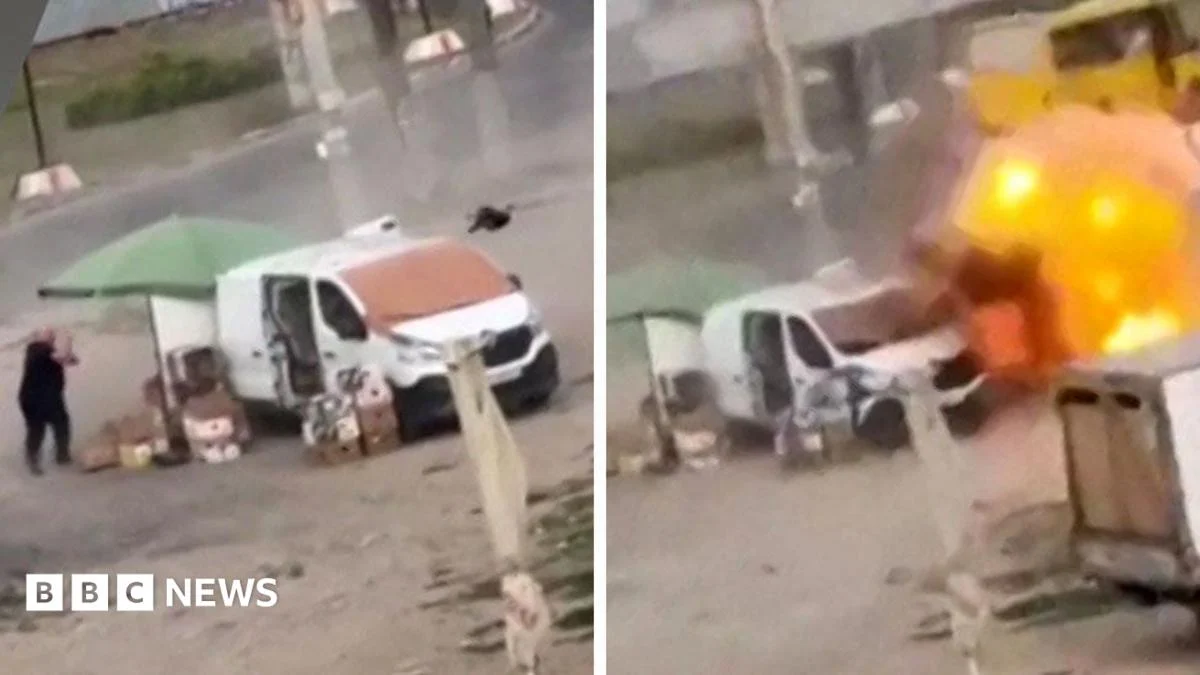
Ukrainian President Volodymyr Zelensky has vehemently condemned a drone attack in southern Ukraine, sharing a video on social media that depicted a remotely operated unmanned aerial vehicle (UAV) hunting down and exploding on a civilian in the Kherson region. Zelensky described the incident as a "safari" attack, a term used by Ukrainian authorities to denote the deliberate targeting of non-combatants by Russian forces using drones, often with the apparent aim of terrorizing the local population and filming their final moments. The harrowing footage, which quickly garnered international attention, showed the drone relentlessly pursuing a 52-year-old street vendor named Yuriy, before striking him with explosive force. This incident underscores the brutal reality faced by civilians in frontline Ukrainian territories, where such tactics are increasingly employed, constituting what international legal experts and human rights organizations classify as potential war crimes.
The attack unfolded in a market space beside a roundabout in the Tavriiskyi district in northern Kherson, a location geolocated by BBC Verify. Yuriy, a street vendor selling vegetables, was reportedly setting up his stall with his wife when the distinctive buzzing sound of a drone overhead signaled impending danger. As the UAV descended, his wife instinctively fled for safety. The drone, however, turned its attention squarely on Yuriy. In a desperate attempt to signal his civilian status and non-threat, Yuriy held up heads of garlic towards the drone’s camera, hoping the operator would recognize him as an ordinary merchant. Despite his clear demonstration of peaceful intent, the drone persisted, chasing him around a white van as he frantically sought cover. The video graphically shows the drone swooping down and detonating upon impact with the vendor.
Miraculously, Yuriy survived the direct assault. Medical personnel later reported that he sustained multiple shrapnel wounds, a concussion, and significant trauma. He was subsequently filmed speaking from a hospital bed, recounting his terrifying ordeal. His testimony, detailing how the drone seemed to deliberately track him, even "ducking under the umbrella" as he ran, paints a grim picture of a calculated and personal attack. The earliest public copy of the video, which captured the drone’s perspective, was reportedly shared by a pro-Ukrainian Instagram account on a Tuesday morning, bringing the incident to global awareness. The precise method of filming and public dissemination of such events raises further questions about the intent behind these "safari" attacks.
Kherson’s Enduring Vulnerability and Strategic Context
The Kherson region, particularly its northern parts, remains a highly volatile area, situated only a few miles from the active front lines of the conflict. Following its liberation from Russian occupation in November 2022, the city of Kherson and its surrounding territories have been subjected to relentless shelling, missile strikes, and, increasingly, drone attacks. The strategic importance of Kherson, a port city on the Dnipro River, makes it a continuous target for Russian forces, who seemingly seek to exert pressure and sow fear among the populace. The proximity to the front allows for the frequent deployment of various types of drones, ranging from surveillance UAVs to weaponized commercial drones and dedicated military models, creating an environment of constant peril for residents.
The concept of "human safari" attacks, as termed by Ukrainian authorities, refers to the deliberate deployment of remotely operated drones to target and harass individual civilians or small groups in open areas. This tactic often involves FPV (First Person View) drones, which provide the operator with a real-time, immersive view, allowing for precise tracking and engagement of moving targets. While the specific model of drone used in Yuriy’s attack was not identified, FPV drones, often adapted from commercial models and equipped with explosives, have become a common feature of the war, utilized by both sides for reconnaissance and direct engagement. However, their use against unarmed civilians, as documented in this instance, represents a grave escalation and a clear violation of the laws of armed conflict. The objective extends beyond military gain, aiming to terrorize, demoralize, and disrupt civilian life, forcing displacement and fostering an atmosphere of pervasive fear.
International Humanitarian Law and War Crimes Allegations
The targeting of civilians in armed conflict is explicitly prohibited under international humanitarian law (IHL), specifically the Geneva Conventions and their Additional Protocols. The principle of distinction, a cornerstone of IHL, mandates that parties to a conflict must at all times distinguish between civilians and combatants, and between civilian objects and military objectives, directing attacks only against military objectives. The incident involving Yuriy, a street vendor with no discernible military connection, represents a prima facie violation of this fundamental principle.
Ukrainian Foreign Minister Andrii Sybiha unequivocally labeled the attack a "barbaric war crime," emphasizing that it was part of a "deliberate and systemic Russian strategy." Sybiha highlighted that "the sadist operating this drone knows full well that he is targeting a civilian," underscoring the premeditated nature of such acts. Furthermore, the practice of filming these attacks and subsequently posting the videos online, as observed in numerous similar incidents, constitutes an additional layer of violation. A United Nations report, findings of which are expected to be formally published in 2025, has previously documented that Russian armed forces have "recurrently killed and injured civilians" in the Kherson area by using drones to target them. This report explicitly states that "posting videos of civilians being killed and injured amounts to the war crime of outrages upon personal dignity," a grave breach of international law designed to protect human dignity, even in death. Such acts are not merely collateral damage but deliberate attempts to humiliate, terrorize, and dehumanize victims, with widespread psychological repercussions for communities.
Official Reactions and Calls for Accountability
President Zelensky’s direct appeal on Telegram, stating "The world must see this. It must see every piece of evidence that Russia has gone mad, and every fact that Russian soldiers are enjoying killings and tormenting people," serves as a powerful call for global attention and condemnation. This statement aligns with Ukraine’s broader strategy of meticulously documenting alleged Russian war crimes to build a comprehensive case for international justice and accountability. Ukrainian officials have consistently urged the international community to recognize and respond to these systemic violations.
Conversely, Russia has consistently denied targeting civilians since its full-scale invasion of Ukraine in February 2022. These denials stand in stark contrast to the growing body of evidence, including eyewitness testimonies, satellite imagery, forensic analyses, and the numerous videos such as the one depicting the attack on Yuriy, which are being collected by Ukrainian authorities and international investigative bodies. The persistent denial despite overwhelming evidence further complicates efforts towards de-escalation and peaceful resolution, highlighting a fundamental disagreement over the conduct of the war.
Beyond direct state actors, human rights organizations like Amnesty International and Human Rights Watch have repeatedly condemned attacks on civilians in Ukraine, calling for thorough investigations and accountability for those responsible. Such organizations emphasize that intentional attacks on civilians are war crimes, and those who plan, order, or carry out such acts must be held criminally responsible. The International Criminal Court (ICC) has already issued arrest warrants for senior Russian officials, including President Vladimir Putin, for alleged war crimes in Ukraine, specifically related to the unlawful deportation of Ukrainian children. Incidents like the drone attack in Kherson add further weight to the growing dossier of potential war crimes that may eventually be prosecuted in international tribunals.
Broader Implications: Psychological Warfare and Global Response
The "human safari" attacks carry profound broader implications, extending beyond the immediate physical harm inflicted upon victims. They represent a potent form of psychological warfare, designed to instill pervasive fear and break the morale of the civilian population. The public dissemination of such videos amplifies this psychological impact, turning every resident of frontline areas into a potential target and fostering a sense of helplessness and vulnerability. This strategy aims to make daily life unbearable, potentially coercing residents to flee, thereby contributing to the ongoing humanitarian crisis and internal displacement within Ukraine.
From a technological standpoint, these incidents highlight the evolving nature of modern warfare, where readily available and relatively inexpensive drone technology can be weaponized with devastating effect against individuals. The accessibility of such technology lowers the barrier to entry for perpetrating acts of violence, complicating efforts to regulate and control its use in conflict zones.
Globally, the drone attack on Yuriy, like countless other documented atrocities, reinforces the urgent need for sustained international pressure on Russia. It fuels calls for increased military and humanitarian aid to Ukraine, stricter sanctions against Russia, and continued support for international mechanisms investigating war crimes. The incident serves as a stark reminder to the international community of the brutal realities of the conflict and the imperative to uphold international law and protect civilian lives. The continued documentation and condemnation of such acts are critical not only for future justice but also for shaping global public opinion and galvanizing a unified response against actions that undermine fundamental principles of humanity and international conduct. The harrowing footage of a drone hunting a vegetable vendor will undoubtedly remain a potent symbol of the human cost of the conflict and the barbarity witnessed in Ukraine.