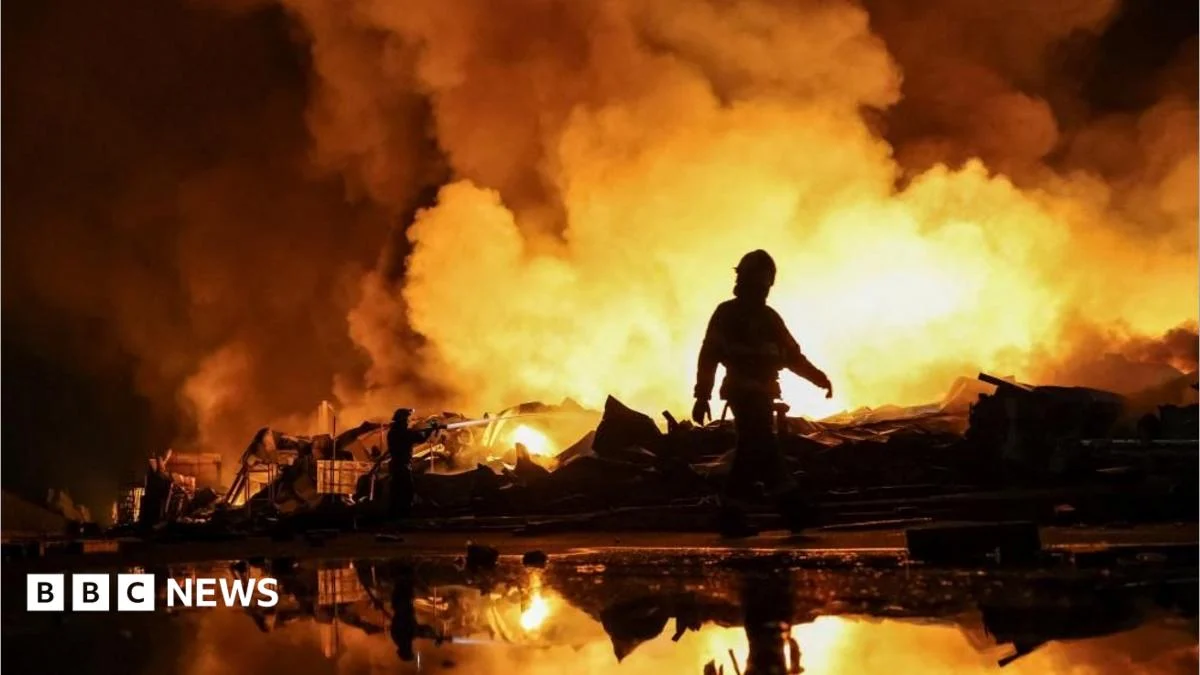
Kyiv, Ukraine – In a brutal pre-dawn assault on Wednesday, Russia launched a devastating barrage of ballistic missiles and drones against Ukraine, resulting in the deaths of at least 14 people and leaving at least 22 injured in what has been described as one of the deadliest strikes across the capital region this year. The coordinated attack, which commenced shortly after midnight, plunged residents into terror and reignited urgent calls from Kyiv for enhanced air defense capabilities from its Western allies.
The head of Kyiv’s military administration, Timur Tkachenko, confirmed the widespread nature of the assault, stating that the "enemy is once again massively attacking the Kyiv region." Air raid alerts, a grimly familiar sound for Ukrainians, blared for over an hour as successive waves of sophisticated ballistic missiles and unmanned aerial vehicles (UAVs) targeted the city and its surrounding areas. Preliminary assessments by Kyiv’s military administration indicated significant damage to both residential buildings and various industrial and commercial warehouses, underscoring the indiscriminate nature of the bombardment.
The Night of the Attack: A Detailed Chronology
The silence of the early hours of Wednesday was shattered by the distinct sounds of incoming projectiles and the ensuing explosions. Starting around 1:00 AM local time, Ukrainian air defense systems engaged multiple targets as the first wave of drones and missiles approached. Eyewitness accounts spoke of bright flashes in the night sky as interceptors engaged incoming threats, followed by powerful blasts as others bypassed defenses. The extensive duration of the air raid alerts, stretching beyond 60 minutes, signified the complexity and persistence of the attack, forcing millions into shelters or to seek refuge in metro stations.
The casualty figures paint a stark picture of the human cost. Tkachenko provided a district-by-district breakdown of the fatalities: nine people were killed in the Boryspil district, four in the Bucha district, and one in the Fastiv district. These areas, particularly Bucha, carry profound historical weight from the initial stages of the 2022 invasion, where evidence of atrocities against civilians emerged. The renewed targeting of these suburban areas intensifies the psychological impact on a population already scarred by conflict.
Emergency services were rapidly deployed to multiple sites across the capital region. Responders worked tirelessly through the night and into the morning, sifting through rubble, extinguishing fires, and providing first aid to the wounded. Kyiv Mayor Vitali Klitschko, utilizing his Telegram channel to communicate with the public, expressed grave concerns that individuals could be trapped beneath the debris of collapsed structures. He further noted the critical condition of four of the injured, highlighting the severity of their wounds and the immense pressure on medical facilities. Rescue operations continued for hours, a testament to the scale of destruction and the potential for further casualties.
Ukrainian Response and Air Defense Imperatives
The immediate aftermath saw strong condemnation from Ukrainian officials, who unequivocally denounced the attack as a deliberate assault on civilian populations and infrastructure. "The enemy is once again deliberately striking civilians and civilian infrastructure," declared Kyiv’s military administration, reiterating a consistent message throughout the conflict that Russia’s actions frequently violate international humanitarian law by failing to distinguish between military and civilian targets.
The attack served as a renewed and urgent catalyst for Ukraine’s persistent pleas to its international allies for more advanced air defense systems, particularly the US-made Patriot missile interceptors. These highly effective systems have proven crucial in protecting Ukrainian cities from ballistic missile threats, capable of intercepting sophisticated projectiles that other systems struggle to counter. However, Ukraine possesses a limited number of these systems, and their deployment across the vast expanse of the country remains a significant challenge, leaving many areas vulnerable. Each successful interception of a ballistic missile by a Patriot system represents not only a technological victory but also potentially hundreds of lives saved and critical infrastructure preserved. The request for more Patriots is not merely for increased defensive capability but is a matter of immediate survival and the ability to safeguard economic stability and civilian life.
The scarcity of such advanced systems forces Ukraine to make difficult strategic choices about where to deploy them, often leaving less protected areas exposed to devastating attacks. The repeated targeting of population centers, including residential buildings and non-military warehouses, underscores the strategic necessity for a more robust, multi-layered air defense network capable of covering a larger geographical area.
Russia’s Stated Objectives and Broader Strategy
In response to the accusations and the widespread condemnation, the Russian Ministry of Defence issued its own statement, asserting that its forces had successfully struck "logistics hubs and supply centres in Kyiv and the surrounding region." The ministry claimed that "These centres were involved in the storage, delivery of various weapons and military supplies, as well as in the production and distribution of unmanned aerial vehicles." This assertion aligns with Russia’s long-standing narrative of targeting military-related infrastructure, even when evidence on the ground points to extensive civilian casualties and damage to non-military sites.
Furthermore, the Russian defence ministry also claimed to have struck three cargo vessels "which were transporting weapons and military equipment" near the Black Sea port of Odesa. This claim, if substantiated, would indicate an expansion of Russia’s targeting strategy beyond land-based facilities to maritime supply routes, potentially impacting vital shipping lanes and further complicating international efforts to ensure the safe passage of goods, including agricultural exports from Ukraine.
Russia’s broader strategy in the conflict appears to involve a multi-pronged approach: degrading Ukraine’s military capabilities, disrupting its supply chains, and exerting immense psychological pressure on the civilian population through persistent attacks. The use of both ballistic missiles, which travel at hypersonic speeds and are difficult to intercept, and slower-moving drones, often used to overwhelm air defenses or strike less critical targets, reflects a deliberate effort to maximize impact and strain Ukrainian resources. This strategy is also seen as an attempt to undermine civilian morale and create internal pressure on the Ukrainian government to negotiate on terms favorable to Moscow.
Escalating Tit-for-Tat: The Cycle of Strikes
The latest assault on Kyiv occurs within a broader context of escalating cross-border attacks, a dangerous cycle where both sides have intensified strikes on infrastructure that often results in civilian casualties. While Russia has ramped up its attacks on Kyiv in recent weeks, Ukraine has simultaneously increased its targeting of Russian civilian infrastructure, including power facilities and commercial warehouses.
Recent weeks have seen several significant incidents illustrating this escalating pattern. Just days prior to the Kyiv attack, five people were killed and ten wounded in the Moscow region on Tuesday morning in what were reported as the most recent strikes on warehouses, including those of the Russian e-commerce giant Wildberries. The day before, Russian officials reported that seven people were killed and 58 injured after a drone hit a busy beach in the southern Krasnodar region, an incident that drew international scrutiny due to the high number of civilian casualties in a recreational area.
Ukraine, for its part, has expressed profound outrage over specific incidents, such as a video circulating online showing a man being chased by a drone in Kherson. Kyiv unequivocally condemned this act, labelling it a deliberate "hunt" and "safari" targeting civilians, a stark illustration of the brutal realities of drone warfare and its ethical implications.
Both Russia and Ukraine consistently deny deliberately targeting civilians, yet the evidence from the ground, including the casualty counts and damage assessments from incidents like the Kyiv barrage, the Krasnodar beach attack, and the Kherson drone footage, frequently contradicts these official denials. This persistent discrepancy fuels international concern and complicates efforts to hold perpetrators accountable under international law. The United Nations and various human rights organizations have repeatedly called for all parties to adhere strictly to international humanitarian law, which mandates the protection of civilians and civilian objects during armed conflict.
Humanitarian Impact and International Reactions
The humanitarian impact of such large-scale attacks is profound and multi-faceted. Beyond the immediate casualties, survivors often grapple with physical injuries, psychological trauma, and the loss of their homes and livelihoods. The repeated exposure to missile and drone attacks creates a pervasive sense of fear and insecurity, disrupting daily life, education, and economic activity. Children, particularly vulnerable, often suffer from long-term mental health issues, including PTSD. Infrastructure damage further strains public services, including healthcare, transportation, and utilities, exacerbating the challenges faced by an already war-weary population.
While specific international reactions to this particular strike were not detailed in the initial reports, similar large-scale attacks on Ukrainian cities have consistently drawn condemnation from international bodies and allied nations. The United Nations typically reiterates its call for an immediate cessation of hostilities and respect for international humanitarian law. Western allies, including the United States and European Union member states, typically reaffirm their support for Ukraine’s sovereignty and territorial integrity, often accompanied by pledges of continued military and financial aid. These statements underscore the global recognition of the severity of the conflict and the imperative to protect civilian lives.
Strategic Implications and Future Outlook
The latest devastating attack on Kyiv carries significant strategic implications for the ongoing conflict. Firstly, it underscores the persistent and critical need for advanced air defense systems for Ukraine. Without a comprehensive and impenetrable air shield, Ukrainian cities and critical infrastructure remain vulnerable to Russia’s vast arsenal of missiles and drones. This vulnerability places immense pressure on Western allies to expedite the delivery of promised systems and explore new avenues for enhancing Ukraine’s defensive capabilities.
Secondly, the sustained attacks on urban centers serve to test the resilience and morale of the Ukrainian population. While Ukrainians have demonstrated remarkable fortitude throughout the conflict, repeated assaults undoubtedly take a toll. The long-term consequences for reconstruction and recovery will be immense, with billions of dollars already required to rebuild damaged cities and infrastructure.
Thirdly, the tit-for-tat nature of strikes on civilian infrastructure highlights a dangerous escalation dynamic. While Ukraine asserts its right to defend itself and target legitimate military objectives within Russia, the blurring lines between military and civilian targets on both sides raise serious ethical and legal questions. This cycle risks deepening the entrenchment of the conflict and making any future peace negotiations even more challenging.
The evolving nature of aerial warfare, with its reliance on drones and advanced missiles, presents a continuous challenge for military strategists and policymakers. The protection of urban centers in a protracted conflict remains a central, unresolved issue. As the conflict grinds on, the international community continues to grapple with how best to support Ukraine while preventing a broader regional conflagration. The latest attack on Kyiv serves as a stark reminder of the brutal realities of modern warfare and the urgent need for a lasting, just peace.