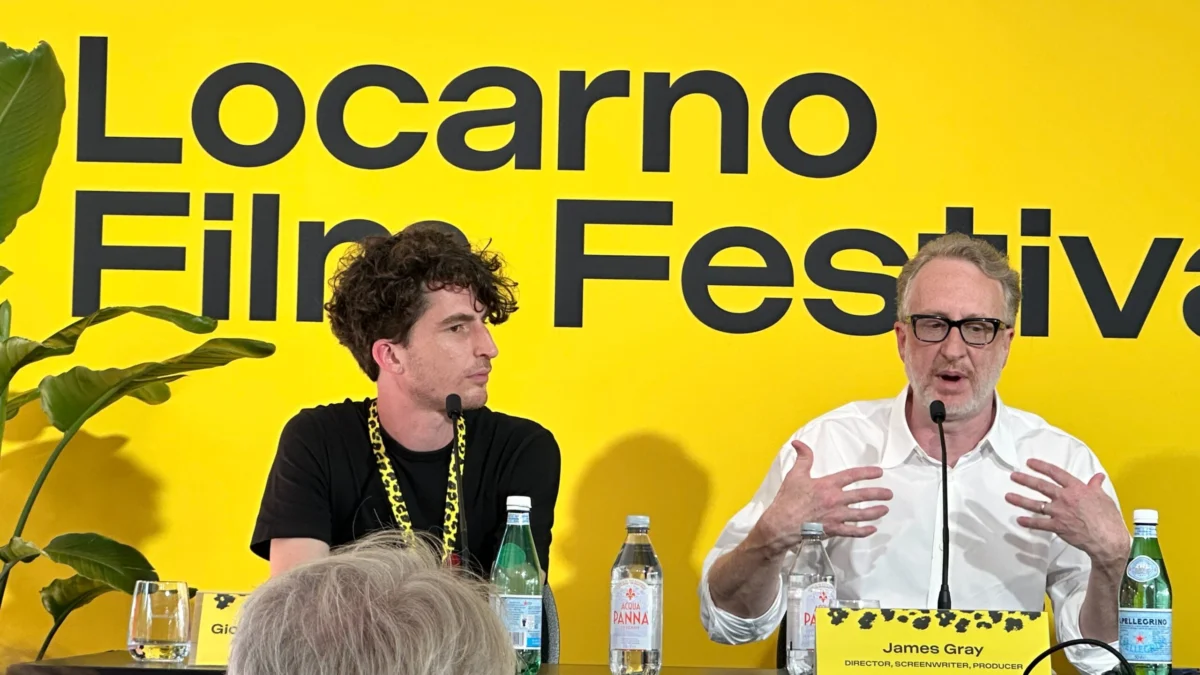
James Gray, the acclaimed American filmmaker known for his intensely personal and critically lauded cinematic works, accepted the prestigious Career Leopard honor at the 79th edition of the Locarno Film Festival on Sunday. During a press conference held in the picturesque Swiss town, Gray expressed a recurring sense of surprise, bordering on disbelief, when esteemed actors express a desire to collaborate with him. This sentiment resonated with the assembled press, as the director has cultivated a reputation for eliciting profound performances from his cast, making his humility all the more striking.
The Locarno Film Festival, a cornerstone of the international cinematic calendar, has a rich history dating back to 1946. It has consistently championed auteur cinema, providing a vital platform for emerging talent and celebrating the established masters of the craft. This year’s festival, running from August 6th to August 16th, 2026, has drawn filmmakers, critics, and industry professionals from across the globe, all converging to discuss the future of cinema and honor its significant contributors. Gray’s Career Leopard award recognizes a lifetime of dedicated filmmaking and a consistent commitment to artistic integrity.
Gray’s reflections on the actor-director dynamic offered a rare glimpse into his creative process. He articulated a belief that actors, far more than is commonly acknowledged, shape the very fabric of a film’s style and emotional resonance. "Actors dictate the style of the film much more than I think is talked about," Gray stated, his words echoing with a characteristic candor. He further elaborated on his directorial approach, emphasizing a philosophy centered on fostering an environment where performers feel empowered to deliver their best work. "I just try to make sure that they are totally comfortable to be excellent," he explained. "I have no acting talent. I’m not a good director of actors. It is all about how good they are and letting them have the freedom to be themselves in the scene and to listen to each other." This perspective underscores a directorial style that prioritizes enabling and supporting talent rather than imposing a rigid vision.
When questioned about the practice of writing scripts with specific actors in mind, Gray firmly rejected the notion, citing past disappointments as a primary motivator. "I try to write the movie not with actors in mind because you’re always going to be disappointed," he admitted. He painted a vivid picture of the logistical hurdles that can arise: "You write it for some actor, and then you find out that guy is not available for two years, and then they can’t do it. And then, instead of the 6’2” guy, you have to cast the 5’1” guy and rethink it. So I’ve learned never to do that." This pragmatic approach to pre-production highlights his commitment to the script’s integrity and his adaptability in the face of casting challenges.
Gray’s engagement with cinematic history, particularly his profound admiration for Italian cinema, provided another compelling dimension to his remarks. When asked to identify pivotal cinematic eras, he declared, "If I had to pick cinema 1945 to 1980, I would say Italian cinema is everything to me, and I’m not just saying this to play for your sense of self, but it’s absolutely true." He further lauded the period, stating, "The number of Italian directors in that period is an ocean of brilliance – it’s unparalleled." This statement speaks to the immense influence of neorealism and the subsequent golden age of Italian filmmaking, encompassing directors like Federico Fellini, Roberto Rossellini, Michelangelo Antonioni, and Luchino Visconti, whose works have left an indelible mark on global cinema. The period between 1945 and 1980 witnessed a remarkable outpouring of artistic innovation and social commentary from Italian filmmakers, exploring profound human experiences with unparalleled depth and stylistic flair.
This deep-seated appreciation for the art of filmmaking also informs Gray’s own creative output. He posited that "movies are the most beautiful art form because it’s the closest thing we have to a dream." This evocative analogy underscores the immersive and transformative power of cinema, its ability to transport audiences to other worlds and tap into their subconscious. He elaborated on how this perspective shapes his directorial choices: "I try to show you a version of my own dream, my intimacy. It’s why people say, ‘I hate that movie’ or ‘I love that movie.’… That’s why when somebody talks behind you in the movie theater, you want to kill them. It’s something interrupting your dream." This sentiment captures the visceral connection audiences can forge with films, experiencing them as intensely personal journeys, and the frustration that arises when that immersive experience is disrupted.
The context of the Locarno Film Festival provides a backdrop against which Gray’s statements gain further significance. The festival, renowned for its intimate atmosphere and focus on artistic exploration, is an ideal setting for a filmmaker to engage in such introspective dialogue. The Career Leopard award itself is a testament to Gray’s enduring impact on independent and art-house cinema. Previous recipients have included luminaries such as Bernardo Bertolucci, Agnes Varda, and Jia Zhangke, placing Gray in esteemed company. The festival’s programming often highlights retrospectives and tributes, allowing audiences to delve deeper into the filmographies of honorees, further contextualizing Gray’s contributions.
The implications of Gray’s remarks extend beyond his personal philosophy. His emphasis on actor-driven performances and his humility regarding directorial control offer a counterpoint to more auteur-centric views of filmmaking. It suggests a collaborative spirit and a deep respect for the inherent talents of the actors he works with. This approach can be seen in his filmography, which often features nuanced and deeply felt character studies, such as those in "The Yards" (2000), "We Own the Night" (2007), "Two Lovers" (2008), and "The Lost City of Z" (2016). These films, while bearing Gray’s distinct directorial signature, are equally defined by the powerful performances of actors like Joaquin Phoenix, Mark Wahlberg, Gwyneth Paltrow, and Charlie Hunnam.
Furthermore, his enduring admiration for Italian cinema serves as a reminder of the foundational pillars upon which much of modern filmmaking is built. In an era often dominated by commercial considerations and genre formulas, Gray’s commitment to personal storytelling and his deep appreciation for cinematic heritage offer a valuable perspective. The 79th edition of the Locarno Film Festival, by honoring James Gray, not only celebrates his individual achievements but also reaffirms the festival’s commitment to nurturing and recognizing filmmakers who strive for artistic excellence and engage with the rich tapestry of cinematic history. The ongoing discussions and screenings at Locarno are expected to continue to illuminate the evolving landscape of international cinema and the enduring power of visionary filmmakers like James Gray.