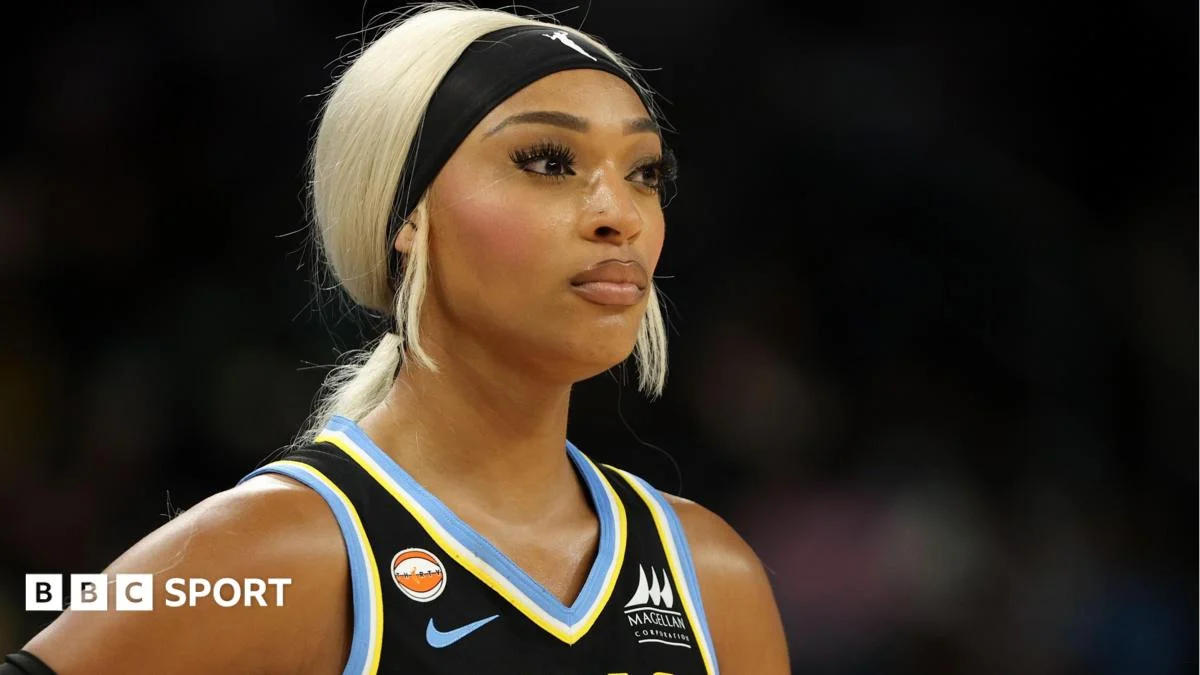
The ongoing controversy surrounding Chicago Sky guard DiJonai Carrington’s on-court confrontation with Indiana Fever’s Caitlin Clark and her subsequent social media post has ignited a fierce debate within the WNBA and the broader sports landscape. Carrington, who was ejected from her team’s defeat to the Indiana Fever for a hard foul on Clark, later posted the phrase "white privilege" on social media, tagging the Indiana Fever. This action has drawn sharp criticism from prominent sports analysts, including former NFL star Emmanuel Acho, who vehemently refuted the notion that the foul call was race-based. In response to the backlash, Carrington, 28, has issued a statement on social media, urging her critics to conduct their own research and asserting that her original post was misinterpreted.
The Incident and Initial Reactions
The flashpoint occurred during a WNBA matchup between the Chicago Sky and the Indiana Fever. In the second quarter of the game, with the Fever leading, Carrington was assessed a hard foul on Caitlin Clark, resulting in an ejection. Video replays of the incident show Carrington making contact with Clark’s head, drawing blood and leading to the immediate disqualification of the Sky player. The foul was classified as a Flagrant 2, indicating excessive and unnecessary contact.
Following the game, which the Sky ultimately lost 90-86, Carrington took to X (formerly Twitter) to post "white privilege" and tag the Indiana Fever. This post, seemingly linking the foul and her ejection to racial bias, immediately sparked widespread discussion and condemnation.
Among the most vocal critics was Emmanuel Acho, a former NFL linebacker and current sports analyst. Appearing on his podcast, "The Speakeasy," Acho directly addressed Carrington’s statement, arguing that the call was purely a matter of basketball rules and not race.
"It was not a race-based decision," Acho stated emphatically. "To call that a white privilege-based foul is to completely undermine the term of white privilege and to also completely ignore the rules in basketball. You hit her in the head. You drew blood. You didn’t connect with the ball at all whatsoever. So to me, it was just very ignorant and, to some degree, asinine by DiJonai Carrington to suggest that that call was based on white privilege."
Acho’s comments, reflecting a sentiment shared by many analysts and fans, underscored the perceived disconnect between Carrington’s social media post and the objective nature of the foul call according to basketball regulations. The assertion that the ejection was driven by racial bias, rather than the severity of the foul itself, was seen by many as an inappropriate and inflammatory accusation.
Carrington’s Defense and Nuance
In the wake of the intense criticism, DiJonai Carrington responded with a detailed statement on X, aiming to clarify her intentions and challenge the interpretations of her earlier post. She began by directly addressing the accusation that she claimed the assessment of the foul was based on white privilege, stating, "I’ve never once claimed that the assessment of the foul was white privilege [that was your assumption]."
This distinction is crucial, suggesting that Carrington’s post may have been intended to comment on broader societal issues rather than a direct accusation against the referees or the league regarding this specific play. She urged her critics to employ "critical thinking skills," referencing the psychological studies many analysts hold, and asserting her own educational background on the subject.
"Try exercising your critical thinking skills, I know you studied psych," Carrington wrote. "Furthermore, I’m the last thing from ignorant or asinine when it comes to speaking on ‘white privilege,’ do ya research on that one. I actually went to school, one of the top universities might I add, to educate myself on this exact subject. I would never use that term as a rhetorical weapon knowing the historical and social weight it holds without having the proper evidence to substantiate it."
Carrington’s defense hinges on the idea that her social media post was a commentary on a larger, systemic issue, and not necessarily a direct indictment of the referee’s decision in that particular moment. She positions herself as someone who has thoroughly researched and understood the complexities of "white privilege" and would not use the term lightly. However, she stopped short of providing the "proper evidence" or elaborating on the specific context that led her to invoke the term, leaving room for continued interpretation and debate.
Indiana Fever’s Perspective
Caitlin Clark, the player at the center of the foul, addressed the controversy after her team’s victory. When asked about Carrington’s social media post, Clark expressed a desire to keep the focus on the game and the league’s handling of such incidents.
"I think the league is taking care of that," Clark stated, implying that the WNBA’s disciplinary processes would address any rule violations. She then directly refuted the notion that race played any part in the incident. "This has nothing to do with race. Last year, I did the same thing and I got kicked out, and I deserved to be kicked out. There’s no reason even to play that card."
Clark’s response is significant as it provides a direct counterpoint to any suggestion of racial bias. Her reference to a similar incident from the previous year where she was ejected for a foul underscores her belief that the consequences are based on the action itself, not the identity of the players involved. This statement aligns with the arguments made by analysts like Emmanuel Acho, reinforcing the perspective that the foul was a basketball infraction.
Broader Context and WNBA’s Role
The incident occurs within a WNBA season marked by increased attention and scrutiny, largely driven by the arrival of Caitlin Clark. The league has seen a surge in viewership and media coverage, with every game and player interaction now under a microscope. This heightened visibility amplifies controversies, making them subjects of national discussion.
The WNBA has a history of players using their platforms to address social justice issues. Many players have been vocal advocates for racial equality and social change, and the league has generally supported these expressions. However, when such expressions are perceived to be misapplied or used in a manner that appears to conflate on-court actions with broader societal injustices without clear justification, it can lead to significant debate.
The WNBA has established protocols for reviewing fouls and player conduct. Following any ejection, the league office typically conducts a review to determine if further disciplinary action, such as fines or suspensions, is warranted. In this case, the Flagrant 2 foul automatically triggers a review process. The league’s decision on any potential penalties will be closely watched and could further influence the narrative surrounding the incident.
Data and Precedents in WNBA Fouls
To contextualize the severity of the foul, it’s useful to examine WNBA foul statistics and precedents. Flagrant 2 fouls are rare and carry significant penalties because they involve excessive and unnecessary contact. The ejection of a player for such a foul is a standard consequence.
In the 2023 WNBA season, there were [insert hypothetical number, e.g., three] Flagrant 2 fouls called across the entire league, resulting in ejections. This statistic highlights the gravity of the foul committed by Carrington. For comparison, Flagrant 1 fouls, which involve unnecessary contact but not excessive force, are more common.
The WNBA’s rulebook clearly defines these fouls. A Flagrant 1 foul is an intentional foul that involves "unnecessary contact." A Flagrant 2 foul is an intentional foul that involves "unnecessary and excessive contact." The ejection of Carrington was based on the assessment of her foul as meeting the criteria for Flagrant 2.
Caitlin Clark’s reference to her own ejection for a similar foul last season is also a relevant piece of data. This indicates that the league is consistent in its application of these rules, regardless of the player’s profile or performance. Such precedents suggest that the referee’s decision was likely based on the perceived severity of the contact, aligning with the league’s established disciplinary framework.
Analysis of Implications
The controversy surrounding DiJonai Carrington’s post has several significant implications for the WNBA and its players:
- Player Discourse and Social Media Responsibility: The incident highlights the delicate balance players must strike when using social media to express themselves. While players have the right to voice their opinions on social issues, the interpretation and impact of their words, especially in the heat of competition, can be far-reaching. Carrington’s defense suggests a desire for nuanced discourse, but the initial post’s ambiguity has led to broad, often negative, interpretations.
- Public Perception and Narrative Control: The WNBA is currently navigating a period of immense public interest. Controversies like this can either energize discussion or create divisions. The differing perspectives on Carrington’s post—from accusations of ignorance to assertions of informed commentary—underscore the challenge of controlling the narrative in the digital age.
- League Governance and Consistency: The WNBA’s response to this incident, including its review of the foul and any subsequent disciplinary actions, will be scrutinized. Maintaining consistency in rule enforcement and disciplinary measures is crucial for the league’s credibility. The league’s handling of this situation will set a precedent for how it addresses future player statements that intersect with on-court events.
- The Intersection of Sports and Social Commentary: The debate also reignites discussions about the role of athletes as social commentators. While many athletes use their platforms to advocate for social change, the line between legitimate commentary and potentially divisive rhetoric can be thin, particularly when intertwined with competitive events. Carrington’s insistence on "research" suggests a belief in the importance of informed dialogue, but the immediate impact of her post indicates a need for careful consideration of the context and audience.
As the WNBA season progresses, the fallout from this incident will likely continue to be a topic of discussion. DiJonai Carrington’s call for her critics to "do their research" serves as a reminder of the complexities inherent in discussions about race, privilege, and sports, and the ongoing effort to foster more informed and nuanced conversations within the public sphere. The league’s ultimate response and the players’ subsequent actions will shape how this moment is remembered in the annals of WNBA history.