



In an era where large language models (LLMs) are frequently measured by their sheer parameter count, webAI has introduced a paradigm-shifting alternative with the release of the TwIL-LM family. These models, consisting of 1.7 billion (1.7B) and 3 billion (3B) parameter versions, are specifically engineered to tackle one of the most rigorous challenges in computational linguistics: formal logic reasoning and autoformalization. By optimizing these models for local execution on consumer-grade hardware, including mobile devices like the iPhone, webAI aims to bridge the gap between high-level logical reasoning and edge computing accessibility.
The TwIL-LM family arrives at a critical juncture in artificial intelligence development. As the industry moves beyond simple chat interfaces toward agentic systems that must verify their own reasoning, the ability to translate natural language into structured, first-order logic—a process known as autoformalization—has become a high-priority frontier. webAI’s announcement positions these compact models as formidable competitors to industry giants, claiming that the 3B parameter model can outreason systems nearly forty times its size.
Technical Architecture and the Four-Stage Training Pipeline
The development of the TwIL-LM family, particularly the 3B variant (TwIL-LM3), represents a sophisticated exercise in model refinement and optimization. Rather than training a model from scratch, webAI utilized the SmolLM3-3B base from Hugging Face TB as a foundation. The 1.7B version follows a similar path, functioning as a Parameter-Efficient Fine-Tuning (PEFT) LoRA adapter for the SmolLM2-1.7B-Instruct model.
The training of TwIL-LM3 involved a rigorous four-stage pipeline designed to maximize logical consistency while preserving the general capabilities of the base model. The first stage utilized Low-Rank Adaptation (LoRA) supervised fine-tuning (SFT) on a specialized, synthetic formal-logic corpus. This allowed the model to internalize the syntax and structural requirements of first-order logic without overwriting its underlying linguistic knowledge.
The second stage involved checkpoint fusion, a process where multiple intermediate SFT checkpoints were averaged in parameter space. This technique is often used to smooth the loss landscape and improve the generalizability of the fine-tuned model. Following fusion, webAI employed WiSE-FT (Worst-Case Robust Stepwise Fine-Tuning) interpolation. In this stage, the fine-tuned weights were blended back toward the original pretrained base using an interpolation factor of λ = 0.25. This specific value proved to be a critical design choice; by retaining only a quarter of the fine-tuned delta, webAI ensured the model maintained its broad utility while still gaining specialized reasoning skills. Internal testing revealed that while a version of the model that skipped this interpolation scored higher in-domain, it suffered a significant loss—approximately twelve points—in held-out capabilities, leading the team to favor the more balanced interpolated version.
The final stage of the pipeline utilized MGPO, an entropy-weighted variation of Group Relative Policy Optimization (GRPO). This stage involved running the model against a programmatic verifier, essentially rewarding the system for producing logically sound conclusions that could be mathematically validated. The final published checkpoint, identified as step 2071, is the culmination of this iterative reinforcement.

Performance Benchmarks and Efficiency Metrics
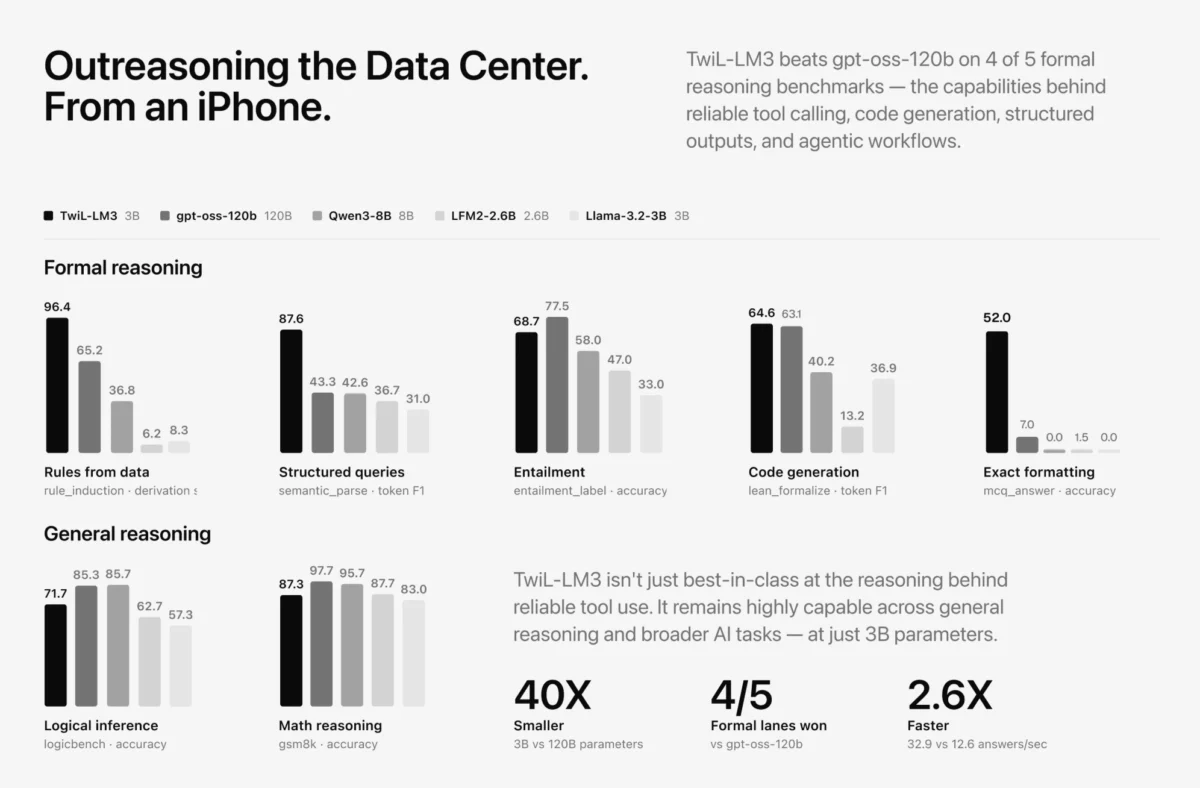
The primary value proposition of the TwIL-LM family lies in its ability to deliver high-tier reasoning performance within a minimal computational footprint. webAI’s internal benchmarks show the TwIL-LM3 achieving a score of 96.4 on rule induction and 87.6 on semantic parsing. In the context of Lean formalization—a benchmark for translating mathematics into machine-verifiable code—the model scored 64.6, while entailment labeling reached 68.7.
When compared to significantly larger models, the results are particularly striking. On "Track A," which focuses on in-domain formal logic, TwIL-LM3 recorded a macro gate score of 0.4218. This outperformed several larger competitors, including the LFM2.5-8B-A1B, which scored 0.3757 despite having more than double the parameters. While the massive gpt-oss-120b maintained a lead in the six-lane average (0.5192 compared to TwIL-LM3’s 0.4488), webAI noted that their 3B model outperformed the 120B giant on four out of five specific formal-reasoning categories.
Efficiency is the area where the TwIL-LM family establishes an undisputed lead. Because the models are optimized for short, concise logical generations, they exhibit high throughput. TwIL-LM3 averages only 482 tokens per generation on Track B benchmarks, allowing it to produce 32.9 answers per second. In contrast, the 120B parameter model, burdened by its size and slower generation speed, manages only 4.2 answers per second. This nearly eightfold increase in speed makes the TwIL-LM family highly suitable for real-time applications where logical verification must happen instantaneously.
Deployment on Local Hardware and Quantization
A central goal of the TwIL-LM release is the democratization of formal reasoning. Historically, high-level reasoning tasks required massive server clusters or expensive cloud-based API calls. webAI has circumvented this requirement by providing quantized builds that run on consumer hardware.
The 1.7B model is available in a 1.06 GB quantized format, making it small enough to reside in the memory of modern smartphones without disrupting other background processes. The 3B model is provided as a 1.78 GiB GGUF file using Q4_K_M quantization. These small footprints are significant for developers looking to integrate "on-device" intelligence into mobile apps, particularly in fields like legal tech, automated contract review, or educational tools where privacy and offline functionality are paramount.
Licensing and Commercial Restrictions
Despite the technical openness of the release, webAI has adopted a cautious approach toward commercialization. Both the 1.7B and 3B checkpoints are released under the webAI Non-Commercial License version 1.0. This allows researchers, hobbyists, and students to download and experiment with the models for free, but it strictly prohibits revenue-generating deployments.
Organizations looking to integrate TwIL-LM into commercial products must enter into a separate licensing agreement with webAI. This strategy mirrors a growing trend in the AI industry, where companies provide "open weights" for community evaluation while maintaining a proprietary path for enterprise-grade applications. This ensures that the developer community can contribute to the model’s ecosystem while protecting webAI’s commercial interests in the specialized logic market.
Autoformalization: The Core Objective
To understand the significance of TwIL-LM, one must understand the challenge of autoformalization. Most human knowledge is stored in "natural language"—the messy, ambiguous English we speak and write. However, for a computer to verify a mathematical proof or ensure a software system has no bugs, that knowledge must be in "formal logic."
Autoformalization is the process of acting as a translator between these two worlds. TwIL-LM is designed to take an English premise, translate it into first-order logic, and then check whether a specific conclusion logically follows from that premise. This is a much harder task than simple text generation; it requires the model to understand the rigid rules of "If-Then" statements, quantifiers, and predicates. By mastering this, TwIL-LM moves closer to a form of "system 2" thinking—deliberative, logical, and verifiable—rather than the "system 1" pattern matching seen in standard chatbots.
Analysis of Held-out Transfer and Trade-offs
The development of a specialized model often comes with the "alignment tax" or a regression in general-purpose capabilities. webAI’s data shows that while TwIL-LM3 improved its in-domain logic performance by 26% (rising from a macro gate of 0.336 to 0.422), it also managed a modest gain on the held-out core average. LogicBench scores moved from 0.6467 to 0.7167, indicating that the model’s reasoning skills are transferable to new, unseen logical puzzles.
However, the specialization did result in slight declines in other areas. The GSM8K benchmark, which measures grade-school math word problems, slipped from 0.8833 to 0.8733. More notably, IFEval, which tests a model’s ability to follow complex formatting instructions, regressed from 0.6767 to 0.6433. The 1.7B model showed even more pronounced trade-offs: while its primary logic score nearly doubled compared to the unadapted base (0.361 vs. 0.185), its performance on the ARC-Challenge (ARC-C) fell from 0.587 to 0.463. These data points suggest that while the TwIL-LM family is exceptionally potent for logical deduction, it may be less effective as a general-purpose assistant than its parent models.
Broader Impact and Industry Implications
The release of TwIL-LM signifies a growing shift toward "Small Language Models" (SLMs) that prioritize depth over breadth. For many industrial applications, a model that can perform one task—such as logical verification—with 99% accuracy is more valuable than a massive model that can do everything with only 85% accuracy.
Furthermore, by proving that a 3B model can outperform a 120B model in formal reasoning, webAI is challenging the "scaling laws" that have dominated AI research for the past several years. It suggests that data quality, specialized training pipelines like MGPO, and clever architectural fusion can compensate for a lack of raw parameter scale.
As AI agents become more prevalent, the need for a "reasoning engine" that can run locally to verify the output of larger, more creative models will grow. The TwIL-LM family is positioned to be that engine—a lightweight, high-speed logical checker that ensures the "hallucinations" common in LLMs are caught before they can impact real-world systems. For now, the academic and research communities have a powerful new tool to explore the boundaries of machine logic, even on devices as small as the one in their pocket.