The landscape of open-source artificial intelligence has shifted from isolated chat interfaces toward integrated agentic ecosystems with the official release of Bot Mode for Hermes Agent. Developed by Nous Research, a leading collective in the frontier of open-source model fine-tuning and agentic frameworks, Bot Mode represents a fundamental redesign of how users interact with large language models (LLMs). By replacing the traditional single-agent session list with a dynamic roster of named, persistent bots, the update transitions Hermes Agent from a simple assistant into a comprehensive multi-agent coordination platform.
The release, officially designated as Hermes Agent v0.20.3, is distributed under the permissive MIT license. This licensing choice ensures that the technology remains accessible to solo developers, startups, and academic researchers without the restrictive overhead often associated with proprietary enterprise AI tools. Bot Mode was initially introduced as a high-speed, one-day public beta plugin by Nous Research co-founder Teknium, and following successful community testing, it has been integrated as a core, default-on feature within the Hermes Desktop application.
Architectural Foundation: The Evolution of Hermes Profiles
At its technical core, Bot Mode is built upon the existing "Hermes Profile" architecture, but it elevates these profiles from static configuration files to active, communicative entities. In previous iterations, a profile was essentially a collection of settings; under the new Bot Mode paradigm, each bot is a distinct Hermes profile residing in the local file system at ~/.hermes/profiles/<name>/.
This architectural choice ensures complete data isolation. Each bot maintains its own unique configuration, long-term memory, specialized skill sets, API credentials, and historical chat logs. By siloing these elements, Nous Research has addressed a common failure point in agentic workflows: context leakage. In standard LLM applications, a single session often becomes cluttered with conflicting instructions or irrelevant history. Bot Mode solves this by ensuring that a "Research Bot" pinned to a high-parameter reasoning model remains entirely separate from a "Creative Writing Bot" optimized for speed and prose, even when they are part of the same broader project.
The system manages these profiles through a robust series of Remote Procedure Call (RPC) gateways. Developers can interact with the bot roster using standard commands such as list, create, describe, and configure. This allows for a high degree of automation, where external scripts can programmatically spin up new bots for specific tasks and then decommission them once the objective is met.
Communication Protocols and the Agent Inbox
The most significant advancement in v0.20.3 is the introduction of the Agent Inbox and the @mention handoff protocol. Rather than requiring the human user to manually copy and paste data between different AI assistants, Bot Mode allows agents to message each other directly through a persistent communication layer.
Every bot in the roster possesses its own Agent Inbox. When a user or another agent utilizes the @mention syntax—for example, @Researcher, analyze this data set—the active bot initiates a Command Line Interface (CLI) handoff. Under the hood, this triggers a command formatted as hermes -p <bot> chat -c "Agent Inbox" -q "...". The message arrives in the recipient bot’s inbox with full attribution, allowing the receiving agent to understand the context of the request and who sent it.
To facilitate these interactions, each bot is guided by a SOUL.md file. This file acts as the agent’s core constitution, defining its personality, reply protocols, and operational boundaries. The SOUL.md instructs the bot on how to handle handoffs, when to report back to the user, and how to format its internal communications. This creates a "chain of custody" for work, where a project can move from a "Scout Bot" (responsible for data gathering) to a "Reviewer Bot" (responsible for quality assurance) and finally to a "Publisher Bot" (responsible for final formatting).
Configuration, Customization, and Visual Identity
The user interface for Bot Mode provides a granular level of control over each agent. When creating a "New Agent," users are prompted for a name, title, and description. An advanced configuration panel allows for the pinning of specific providers and models. This is a critical feature for resource management; a user can pin a resource-intensive reasoning model (such as a 70B or 405B parameter model) to a bot tasked with complex logic, while pinning a lightweight 8B model to a bot tasked with simple summarization or scheduling.
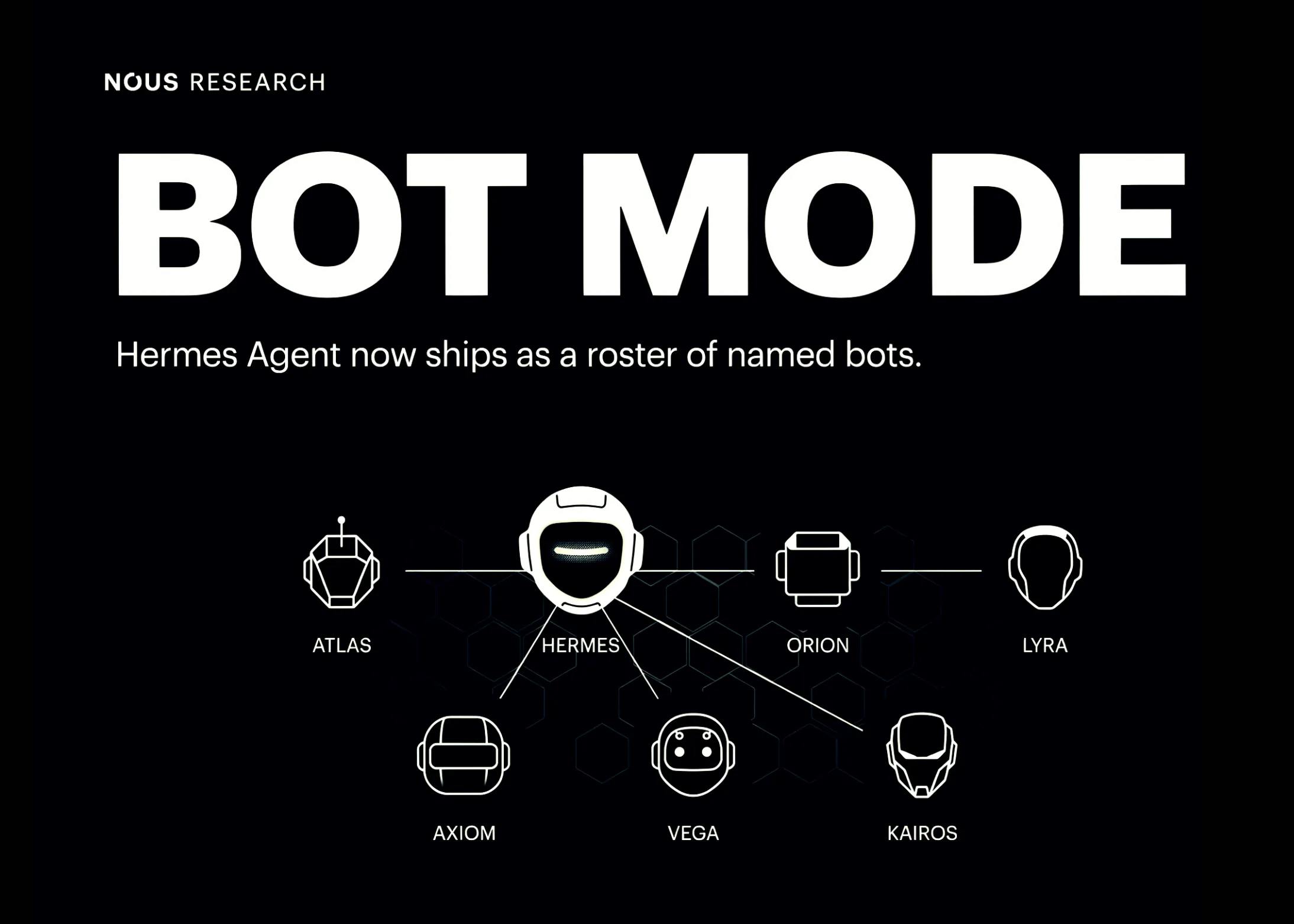
Visual identification has also been prioritized to help users manage complex rosters. Each bot is assigned an avatar, which can be a geometric face available in seven shapes and ten colors, a custom uploaded image, a generated portrait via local image generation RPCs, or a "pixel pet." These avatars are not merely aesthetic; they provide visual feedback, such as eyes that scan the interface while the bot is actively processing data, offering a real-time status indicator for multi-bot workflows.
Furthermore, the update introduces the "Group" functionality, allowing users to organize their roster into labeled sections. These groups are synchronized across machines, ensuring a consistent workspace for developers moving between desktop and laptop environments.
Deployment Feasibility and Industry Applications
Nous Research has positioned Bot Mode as a workstation-ready tool available for immediate deployment. Because the software is local-first and MIT-licensed, there are no per-token licensing costs beyond what a user pays to their chosen model provider (or zero cost if running local models via Ollama or similar gateways).
However, the transition to v0.20.3 comes with specific caveats regarding enterprise adoption. As of the current release, Hermes Agent lacks a centralized admin console, Single Sign-On (SSO) integration, central audit logging, or a global policy layer. For this reason, Nous Research suggests that while solo builders and small-to-mid-sized engineering teams can adopt the tool immediately, large enterprises should treat it as a localized workstation tool rather than managed infrastructure. Regulated industries will require their own internal controls to manage the data processed by these local agents.
The practical applications for Bot Mode span several high-intensity technical fields:
- Software Engineering: Utilizing a chain of bots for code generation, unit testing, and documentation.
- AI Research: Running persistent agents that monitor ArXiv feeds and summarize papers into a central "Research Digest" bot.
- Technical Media: Coordinating between "Drafting Bots" and "Fact-Checking Bots" to streamline content operations.
- IT Operations: Deploying bots as namespaced cron jobs (using the
hermes cronsystem) to perform nightly system audits and report findings to an "Admin Inbox."
Chronology of Development
The path to v0.20.3 was characterized by an accelerated development cycle typical of the Nous Research ecosystem. The timeline of the release is as follows:
- Initial Concept and Plugin Release: Co-founder Teknium released Bot Mode as a standalone, experimental plugin for Hermes Agent. The goal was to test the viability of a "Roster UI" over the traditional "Session UI."
- Public Beta (August 2026): A one-day public beta was conducted, inviting power users to stress-test the communication protocols and report bugs via GitHub.
- Integration (PR #87886): Following the beta, the development team moved the plugin "in-tree." This process involved archiving the standalone repository and moving the codebase to
apps/desktop/src/plugins/hermes-bots/. - Feature Expansion: During the integration phase, the team added capabilities not present in the beta, including Group Chats. In these rooms, two to six bots can participate in serial rounds of member turns, responding to mentions or jumping in when the conversation stalls.
- Official Bundle: The feature was officially bundled and set to "default-on" in the Hermes Agent v0.20.3 release, signaling its transition from an experimental add-on to a core component of the Hermes experience.
Broader Implications for the AI Ecosystem
The release of Bot Mode is a significant milestone in the "Sovereign AI" movement. By providing a high-quality, open-source alternative to proprietary multi-agent platforms, Nous Research is enabling a future where sophisticated AI orchestration does not require surrendering data to a centralized provider.
The shift toward agentic workflows—a trend championed by industry figures such as Andrew Ng—emphasizes that iterative loops between multiple specialized agents often produce better results than a single prompt to a massive model. Bot Mode provides the infrastructure for these loops to occur locally and autonomously. The ability for bots to use different models within the same workflow also suggests a more sustainable path for AI scaling, where "small and specialized" agents collaborate to solve problems that previously required "large and general" models.
As Hermes Agent continues to evolve, the community-driven nature of the project suggests that the next frontiers will likely include deeper integration with local toolsets, expanded "memory" capabilities through vector database optimizations, and more refined "social" protocols for agent-to-agent negotiation. For now, v0.20.3 stands as a robust foundation for the next generation of open-source AI productivity.