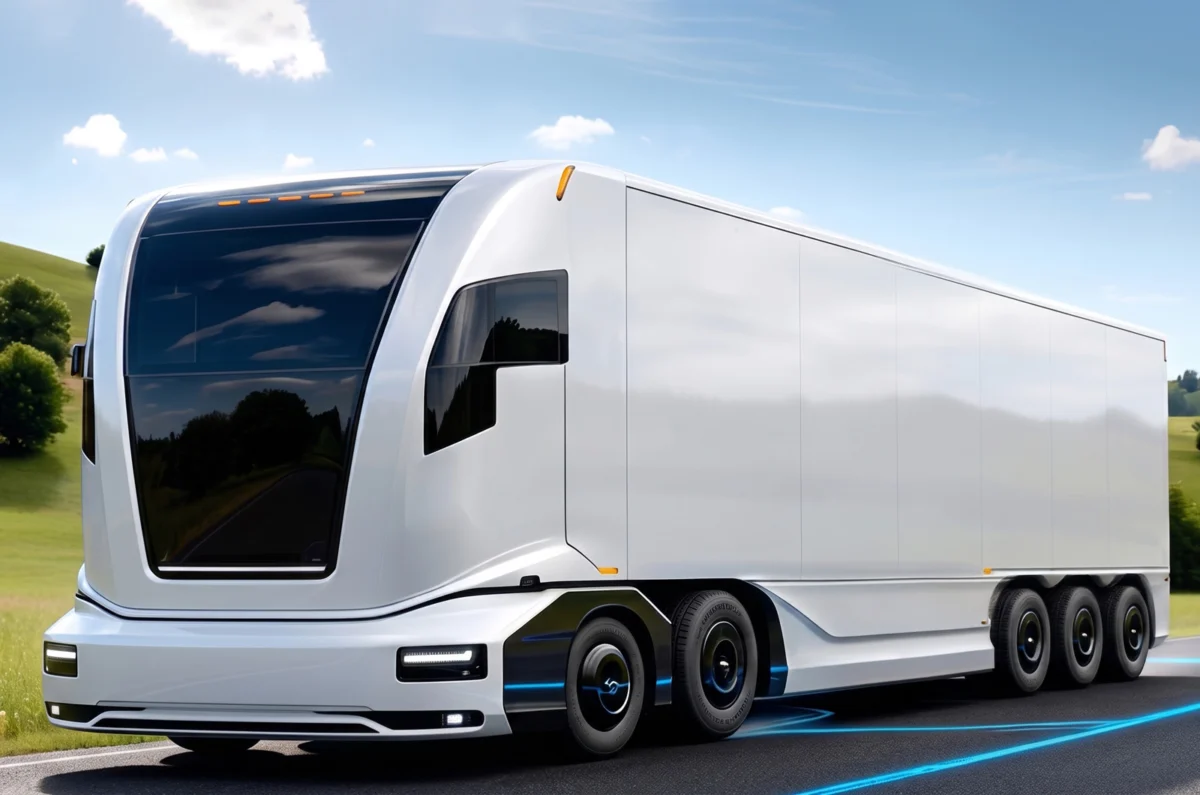
The British electric vehicle innovator Voltempo has announced the development of a revolutionary autonomous, cabless rigid lorry designed to redefine the efficiency and capacity of heavy goods transport. Measuring 15.6 metres in length, the vehicle significantly exceeds the current legal maximum for non-articulated lorries, a strategic move that the company asserts will maximize both internal volume and overall payload capacity. By removing the traditional driver’s cab and integrating advanced autonomous systems, Voltempo aims to create a "smart trailer" that combines the maneuverability of a rigid vehicle with the carrying capacity of a much larger articulated unit.
Redefining the Architecture of Heavy Goods Vehicles
The core of Voltempo’s innovation lies in its departure from traditional truck design. Currently, standard rigid trucks in the United Kingdom and much of Europe are restricted to a maximum length of 12 metres, a gross weight of 32 tonnes, and a four-axle configuration. Voltempo’s prototype aims to shatter these constraints, proposing a vehicle that spans 15.6 metres—equivalent to the length of a modern touring coach—with a 42-tonne weight limit supported by five axles.
Michael Boxwell, the founder and corporate development officer of Voltempo, describes the vehicle as a "smart trailer." The removal of the cab is not merely a stylistic choice but a functional one. In a traditional heavy goods vehicle (HGV), the tractor unit or the cab of a rigid truck represents a significant portion of the vehicle’s unladen weight and occupies valuable longitudinal space. By eliminating this section, Voltempo can dedicate the entire length of the chassis to cargo, effectively creating a 15.6-metre-long loading platform.
This design choice addresses a fundamental inefficiency in modern logistics. "If you get rid of the cab, you’ve got a 15.6m-long, longer semi-trailer, in effect," Boxwell stated. He noted that while a traditional diesel articulated tractor and trailer unit weighs between 15 and 17 tonnes, an electric version can weigh up to 19 tonnes due to the mass of the battery packs. Voltempo’s cabless rigid design, however, is projected to bring the unladen weight down to between 10 and 12 tonnes, even with an electric drivetrain.
Technical Specifications and Efficiency Gains
The engineering behind the Voltempo prototype focuses on maximizing the ratio of payload to gross vehicle weight. The reduction in unladen weight translates directly into a higher permissible payload. According to Boxwell, the vehicle offers between five and seven tonnes of extra payload capacity compared to current electric equivalents.
Furthermore, the increased length provides approximately 15% more internal cubic space than a standard-length trailer. This is particularly relevant for the "less-than-truckload" (LTL) and e-commerce sectors, where volume often becomes a constraint before weight does. "We worked out that your typical HGV is carrying 16 tonnes on average," Boxwell explained. "Now, we can make it 18.6 tonnes, because of the extra space. You’ve got something which is 1.5m shorter than an articulated HGV, but your average weight on the road is three times lighter because of the rigid body."
The vehicle’s five-axle configuration is essential for distributing the 42-tonne gross weight, ensuring compliance with road wear regulations and improving stability. The electric drivetrain is being supplied by a prominent, though currently unnamed, truck manufacturer, ensuring that the vehicle benefits from established automotive supply chains and proven propulsion technology. Berkeley Coachworks has been tasked with constructing the body, utilizing their expertise in large-scale vehicle assembly.
Chronology of Development and Commercialization
The development of the Voltempo autonomous lorry follows a strict timeline aimed at rapid market entry. The project is currently in the advanced design and engineering phase, with the physical prototype scheduled for completion by September 2027.
Following the completion of the prototype, a rigorous testing phase is expected to commence in late 2027. These trials will initially take place at a dedicated autonomous vehicle test track in South Wales. This facility provides a controlled environment to calibrate the vehicle’s sensor suites, including LiDAR, radar, and high-definition cameras, and to stress-test the autonomous software in various weather conditions and simulated traffic scenarios.
If the initial track tests are successful, the company plans to move to public road trials. This transition is facilitated by the UK’s Automated Vehicles Act, which provides the legal framework for driverless vehicles to operate on public highways. Voltempo anticipates that production versions will begin rolling off the line in late 2027. The first commercial deliveries to logistics partners and haulage firms are currently projected for mid-2028.
The Regulatory Framework: The UK Automated Vehicles Act
A critical enabler for Voltempo’s business model is the legislative landscape in the United Kingdom. The Automated Vehicles Act, which received Royal Assent in early 2024, is designed to position the UK as a global leader in autonomous transport. The Act establishes a comprehensive safety framework, clearly defining liability and setting rigorous standards for "authorized self-driving entities."
Under this legislation, driverless vehicles are permitted on public roads as long as they meet specific safety criteria. This removes one of the primary hurdles for autonomous freight: the requirement for a safety driver to be present in the vehicle. For Voltempo, whose vehicle has no cab to accommodate a human driver, this legislation is the cornerstone of their operational feasibility.
Boxwell noted that the first wave of vehicles would likely be deployed on "fixed routes." These are predetermined paths, such as those between two distribution hubs or a port and a warehouse, which can be mapped in high definition and approved by local authorities. As the technology proves its reliability and the "Operational Design Domain" (ODD) of the software expands, the number and complexity of these routes are expected to increase.
Industry Collaboration and Market Reception
Voltempo’s ambitious plans have reportedly gained significant traction within the European automotive industry. Boxwell claims that every major truck manufacturer in Europe has signed up to approve the prototype as an official vehicle classification. This industry-wide consensus is vital for the vehicle to be integrated into existing fleet management systems and to ensure it meets cross-border regulatory standards.
"They are prepared to build vehicles to that specification," Boxwell said, indicating that the 15.6-metre, five-axle rigid format could eventually become a standardized category in the heavy transport sector.
The manufacturing strategy emphasizes a "UK-first" approach. Initial production will be based in Britain, allowing the company to work closely with domestic hauliers and refine the vehicle based on real-world feedback from the UK’s unique road network. Following the establishment of the UK production line, Voltempo intends to expand manufacturing to mainland Europe to serve the broader Continental market.
Broader Implications for Logistics and the Environment
The introduction of an autonomous, high-capacity electric lorry carries profound implications for the logistics industry, the economy, and the environment.
Addressing the Driver Shortage
The UK and Europe have been plagued by a persistent shortage of HGV drivers, a crisis exacerbated by an aging workforce and the demanding nature of the job. By removing the need for a human driver, Voltempo’s technology offers a scalable solution to this labor bottleneck. Autonomous vehicles can operate 24/7 without the need for mandatory rest breaks, significantly increasing the utilization rate of each vehicle.
Environmental Impact and Net Zero Goals
As an electric vehicle, the Voltempo lorry aligns with the UK government’s commitment to ban the sale of new non-zero-emission HGVs by 2040. The increased payload efficiency means that fewer vehicle movements are required to transport the same amount of goods. This "doing more with less" approach is essential for reducing the overall carbon footprint of the logistics sector, which remains one of the most difficult industries to decarbonize.
Reducing Road Congestion and Wear
The "smart trailer" concept provides a more compact alternative to the traditional articulated lorry. At 15.6 metres, it is shorter than a full tractor-trailer combination (which can reach 16.5 to 18.75 metres depending on the configuration). This smaller footprint, combined with the reduction in the total number of trucks needed due to higher capacity, could help alleviate congestion on major arterial roads. Furthermore, the use of five axles helps to distribute weight more evenly, potentially reducing the impact on road surfaces compared to heavily laden four-axle vehicles.
Economic Efficiency
For hauliers, the primary draw will be the reduction in Total Cost of Ownership (TCO). While the initial capital expenditure for an autonomous electric vehicle is higher than for a diesel truck, the savings in fuel, labor, and maintenance—combined with the revenue gains from increased payload—present a compelling financial case. Boxwell’s assertion that the vehicle is "three times lighter" in terms of average road weight impact further suggests lower operational costs related to road tolls or weight-based levies in the future.
As the 2027 prototype deadline approaches, the industry will be watching closely to see if Voltempo can deliver on its promise to merge autonomous technology with a radical rethink of vehicle geometry. If successful, the 15.6-metre "smart trailer" may well become the new standard for the next generation of global freight.