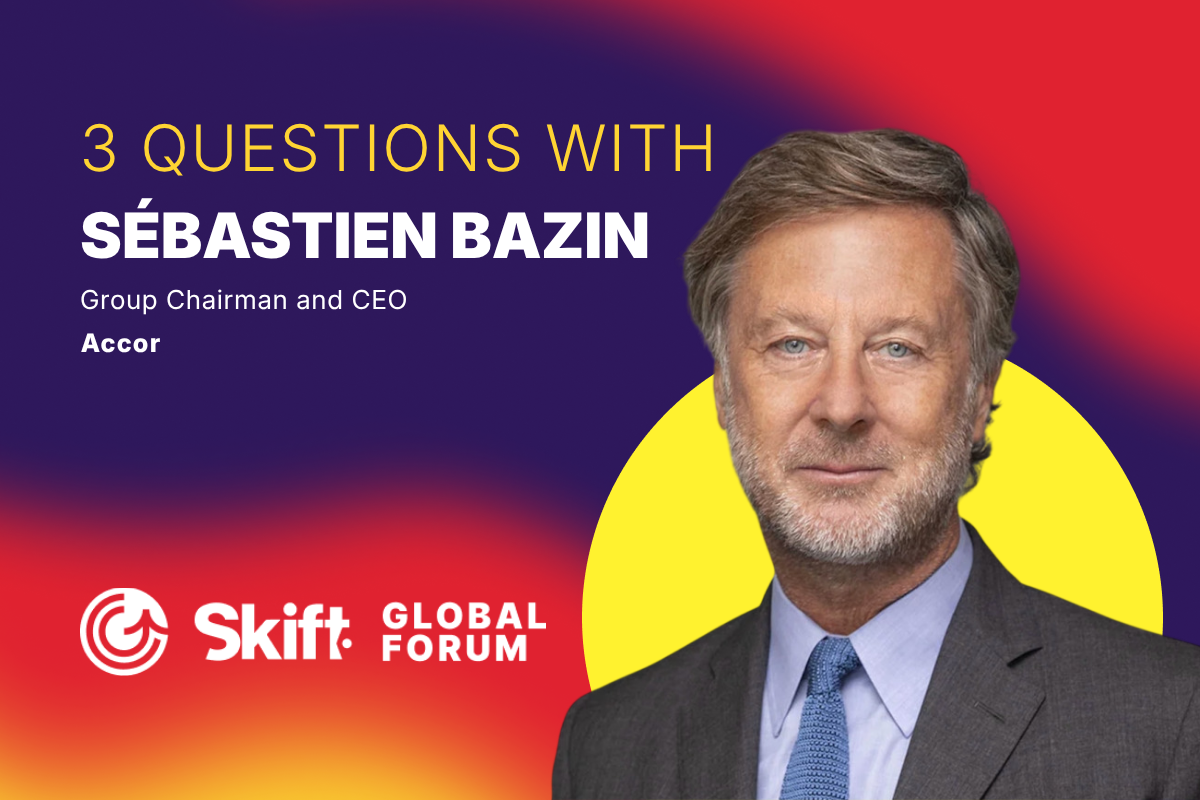
Sébastien Bazin, the Chairman and Chief Executive Officer of Accor, is scheduled to headline the Skift Global Forum in New York City from September 22–24, 2026, where he will provide an in-depth exploration of the decision-making framework that governs one of the world’s largest hospitality portfolios. Since assuming the mantle of leadership in 2013, Bazin has overseen a radical transformation of the French multinational, navigating the complexities of global economic shifts, a pandemic that paralyzed international travel, and the aggressive rise of digital disruption. At the heart of his tenure is a philosophical approach to leadership that prioritizes human intuition over raw analytics—a stance that challenges the prevailing corporate reliance on big data as the sole arbiter of strategy.
The upcoming forum serves as a critical platform for Bazin to articulate how his "instinct-first" methodology operates across Accor’s sprawling ecosystem, which currently encompasses more than 45 distinct brands and a footprint of approximately 5,800 hotels and resorts worldwide. As the travel industry grapples with the integration of generative artificial intelligence and shifting consumer demographics, Bazin’s insights offer a blueprint for maintaining brand soul in an increasingly automated landscape.
The Evolution of Accor Under Sébastien Bazin
To understand Bazin’s current strategic outlook, one must examine the chronological evolution of Accor during his thirteen-year tenure. When Bazin transitioned from the board of directors to the CEO role in August 2013, Accor was a company in transition, heavily weighted toward its European roots and physical real estate holdings. Bazin immediately initiated a shift toward an "asset-light" model, separating the company’s hotel operations from its property assets to increase agility and shareholder value.
A pivotal moment in this timeline occurred in 2016 with the acquisition of FRHI Hotels & Resorts, which brought the prestigious Fairmont, Raffles, and Swissôtel brands under the Accor umbrella. This move signaled Bazin’s intent to dominate the luxury segment, a departure from Accor’s historical focus on economy and midscale brands like Ibis and Novotel. By 2021, Bazin further refined the company’s structure by entering a joint venture with Ennismore, creating the world’s fastest-growing lifestyle hospitality company. This focused on brands like The Hoxton and Mondrian, which prioritize social spaces and "vibe" over traditional luxury tropes.
In 2023, Bazin orchestrated a significant internal reorganization, splitting the company into two distinct divisions: "Premium, Midscale & Economy" and "Luxury & Lifestyle." This structural change was designed to allow each segment to pursue tailored growth strategies. By the time of the 2026 Skift Global Forum, this reorganization will have had three years to mature, providing Bazin with a wealth of data to support his thesis that while structure is necessary, the "human touch" remains the primary driver of the hospitality experience.
The Tripartite Decision-Making Model: Gut, Heart, and Brain
Central to Bazin’s leadership is a three-tiered test for making high-stakes decisions: starting with the gut, moving to the heart, and concluding with the brain. In a dialogue regarding the pace of modern industry change, Bazin emphasized that while data is an "essential nourishment" for the decision-making process, it should never be the final judge.
The "gut" represents the CEO’s instinct—a culmination of decades of experience in finance and hospitality that allows for rapid assessment in high-volatility environments. Bazin posits that in a world moving at breakneck speed, waiting for "perfect" data often results in missed opportunities. The "heart" phase of his decision-making process considers the human impact. In an organization with hundreds of thousands of employees (often referred to as "Heartists" within the Accor culture), Bazin weighs how a corporate pivot or a technological implementation will affect the morale and livelihoods of his workforce. Finally, the "brain" is utilized for technical execution and timing—determining not what to do, but when and how to do it most effectively.
This model is particularly relevant as Accor expands its presence in emerging markets and high-growth sectors. Industry analysts note that Bazin’s willingness to trust instinct allowed Accor to move faster than more bureaucratic competitors in the lifestyle and branded residential spaces, which have become major revenue drivers for the group.
Data Integration and the Challenge of AI in Travel
While Bazin champions instinct, he does not dismiss the technological revolution. Accor has invested heavily in its digital infrastructure, specifically the "ALL – Accor Live Limitless" loyalty platform, which serves as a massive data engine. At the Skift Global Forum, Bazin is expected to discuss how AI will transform the customer journey, making it more fragmented yet more personalized.
The CEO anticipates that AI will soon handle the majority of travel discovery and planning phases. Travelers in 2026 and beyond will expect intuitive, individualized experiences that anticipate their needs before they arrive at a property. However, Bazin draws a firm line where technology ends and hospitality begins. He argues that as AI becomes more powerful and ubiquitous, the value of genuine human connection increases.
"In fact, as technology becomes more powerful, I believe the human touch becomes even more valuable," Bazin stated. This perspective suggests that Accor’s strategy involves using AI to remove friction from the "transactional" parts of travel (booking, check-in, billing) to free up staff to focus on "relational" hospitality.
Supporting Data: Accor’s Global Footprint and Market Position
Accor’s scale provides a unique vantage point on global travel trends. As of recent filings leading into the 2026 cycle, the group operates in over 110 countries. The "Luxury & Lifestyle" division has seen the most aggressive growth, with a pipeline that frequently outpaces its competitors in terms of brand diversity.
Market data indicates that the lifestyle segment—hotels that integrate high-concept food and beverage (F&B) programs and social hubs—now accounts for a disproportionate share of Accor’s development pipeline. This shift is a direct result of Bazin’s "gut" feeling nearly a decade ago that travelers were moving away from standardized hotel rooms toward "experiences."
Furthermore, Accor’s financial performance has shown resilience through diversification. By balancing a massive economy portfolio (Ibis, Mercure) with high-margin luxury brands (Raffles, Orient Express), the company has created a hedge against regional economic downturns. In 2024 and 2025, the company reported strong RevPAR (Revenue Per Available Room) growth, particularly in the Middle East and Asia-Pacific regions, validating Bazin’s focus on global expansion outside of the saturated North American market.
The "Social Elevator" and the Future of the Workforce
One of Bazin’s most passionate stances involves the role of the hospitality industry as a "social elevator." He frequently highlights that hospitality is one of the few remaining sectors where individuals from diverse socioeconomic and educational backgrounds can rise to executive positions through merit and hard work.
During the forum, Bazin is expected to address the labor shortages that have plagued the industry post-2020. His solution focuses on the "Heart" portion of his leadership model: making hospitality an attractive, long-term career path rather than a transient job. By emphasizing the human role in an AI-driven world, Bazin aims to reposition the hotel worker as a "skilled artisan of experience" rather than a service provider.
"We talk about technology, distribution, and changing traveler behavior, but hospitality is fundamentally about human connection," Bazin noted. This focus on the workforce is not just philanthropic; it is a strategic necessity. As luxury travelers demand higher levels of service, the ability to attract and retain talent becomes a primary competitive advantage.
Industry Implications and the Skift Global Forum Context
The presence of Bazin at the Skift Global Forum alongside other industry titans—including Ariane Gorin of Expedia Group, Geoff Ballotti of Wyndham, and Hamad Al-Khater of Qatar Airways Group—highlights a period of intense collaboration and competition in the travel sector. The forum, held in the heart of New York City, serves as the unofficial start of the industry’s high-level planning season for the following fiscal year.
Bazin’s appearance is particularly anticipated because Accor represents a "third way" in the global hotel wars. Unlike the American giants Marriott and Hilton, which have focused heavily on the North American domestic market and standardized loyalty rewards, Accor under Bazin has leaned into European flair, global diversity, and a "collection" approach to branding.
The implications of Bazin’s leadership style extend beyond Accor. If his "instinct over data" approach continues to yield market-beating results, it may prompt a broader re-evaluation of management styles in the travel tech space. In an era where "data-driven" is the standard corporate buzzword, Bazin’s success provides a counter-narrative that emphasizes the irreplaceable nature of human judgment.
As the Skift Global Forum 2026 approaches, the industry will look to Bazin for cues on the next decade of travel. Whether discussing the revival of the Orient Express brand or the implementation of carbon-neutral initiatives across 5,800 properties, Bazin’s message remains consistent: the future of hospitality lies in the balance between the precision of the brain and the intuition of the heart.