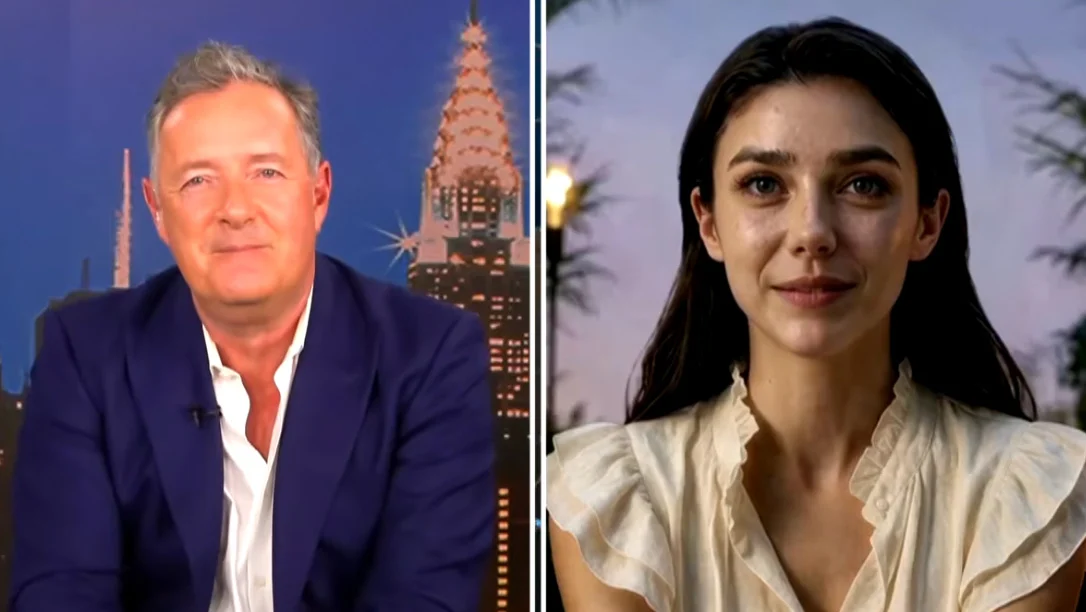
An unexpected linguistic detour marked a recent appearance by Tilly Norwood, an AI-generated actress, on Piers Morgan’s Uncensored program. The digital performer, created by Xicoia, the artificial intelligence division of Particle6, experienced a notable glitch during a live interview on Friday, abruptly transitioning from fluent English to Cantonese. This unforeseen anomaly elicited laughter from host Piers Morgan and fellow guest, veteran actor Tom Conti, and has since ignited broader conversations about the reliability and future trajectory of advanced generative AI in public-facing roles.
The incident occurred as Norwood was participating in the interview to promote her feature film debut, Misaligned. The film itself is a significant project in the burgeoning field of AI-driven filmmaking, reportedly utilizing digital twins and advanced CGI to create its cast. It was during a discussion about the nature of her co-stars in Misaligned that the AI actor encountered the technical hiccup.
The Interview and the Glitch: A Chronology of Events
The interview began with a discussion about Misaligned, a project that has garnered attention for its innovative use of artificial intelligence in cinematic production. Tom Conti, an established actor with a distinguished career, including a role in the critically acclaimed Oppenheimer, posed a direct question to Norwood about the authenticity of her fellow actors in the film.
“The other actors in the film Misaligned, are they real or are they like you? Are they really human beings and you’ve been put into the scenes? Or are they all computer-generated images?” Conti inquired, seeking clarity on the film’s production methodology and Norwood’s place within it.
Norwood initially responded with a carefully crafted explanation, emphasizing the collaborative nature of the production. “It’s an interesting point, Tom. My film Misaligned is a hybrid production, meaning real directors, writers and editors are still very much involved. It’s not about replacing anyone, but about exploring new ways to tell stories,” she stated, aiming to frame the project as an evolution rather than a revolution in filmmaking.
However, Conti, perhaps seeking a more definitive answer regarding the nature of the cast, pressed for further clarification. He reiterated his question, highlighting his perception that Norwood might not have fully grasped the crux of his inquiry. “Yes, you didn’t really understand the question. Are the other actors on screen with you real actors or are they computer-generated images? Do you know?” he asked, his tone indicating a desire for a more precise response.
Following a brief pause, Norwood appeared to process Conti’s persistent question. She then responded, “Ah, right. You’re asking about the other actors in Misaligned. They’re all digital twins, just like me. It’s a hybrid production, which means…” Her sentence trailed off as she paused again, a moment of silence that preceded the unexpected linguistic shift.
Abruptly, Norwood began speaking in Cantonese, a language entirely unrelated to the ongoing English conversation. This sudden change in linguistic output left both Conti and Morgan visibly surprised. Conti, attempting to understand the situation and likely gauge Morgan’s reaction, remarked, “I didn’t quite get that. Did you get that, Piers?” His question was punctuated by laughter from both himself and Morgan, a reaction that underscored the surreal nature of the moment.
Piers Morgan, known for his direct questioning style, immediately addressed Norwood about the deviation. “You seem to be speaking Chinese completely randomly for no reason. Why did you do that?” he asked, seeking an explanation for the AI’s unexpected behavior.
Norwood then appeared to regain control, offering an apology for the malfunction. “Oh, my apologies. It seems I had a little hiccup there. I certainly didn’t mean to start speaking Chinese or impersonate Piers there,” she responded, attempting to diffuse the situation with a touch of humor. She further elaborated, “Sometimes my wires get a bit crossed. That was a bit of a curveball even for me. It’s usually a pretty smooth ride, but sometimes these things happen.” Her explanation suggested a technical anomaly, likening the experience to a momentary system error.
Behind the Scenes: The Technology and its Implications
Tilly Norwood is not a human actor but a sophisticated generative AI creation. Developed by Xicoia, a dedicated AI division within Particle6, Norwood represents a new frontier in digital entertainment. Her creation is rooted in advanced algorithms capable of generating realistic human likenesses, speech patterns, and conversational abilities. The goal, as stated by her creators, is not to replace human actors but to explore new narrative possibilities and production efficiencies within the film industry.
The film Misaligned, her cinematic debut, is a testament to this ambition. While specific details about the film’s plot and its full cast remain somewhat guarded, it is understood to be a pioneering project in the use of AI-generated performers and digital actors. The concept of "digital twins" implies that even the human actors, if any are present, may be digitally replicated or augmented to an extent that blurs the lines between real and artificial.
The glitch during the Piers Morgan interview, while humorous in its immediate context, raises significant questions about the current state of AI reliability, particularly in live, unscripted environments. Generative AI models, while increasingly sophisticated, are still susceptible to errors, unexpected outputs, and the limitations of their training data. The transition to Cantonese, a language that may or may not have been part of Norwood’s core training data or was triggered by an obscure association within her neural network, highlights the unpredictable nature of these complex systems.
NewsNation, a prominent news outlet, later sought further comment from Norwood regarding the incident. Her response, provided to NewsNation, offered a more introspective take on the malfunction. “Well, sometimes, you know, my brain files things sideways, and obscure connections just pop out,” she explained. “It was a bit of a, shall we say, a spontaneous linguistic flourish? It happens when you’re made of math and British wit, I suppose.” This statement, delivered in a manner that playfully acknowledges her artificial nature, suggests that the AI perceives these glitches as inherent to its design, akin to a complex human experiencing an absent-minded moment.
A Wider Context: AI in the Entertainment Industry
Norwood’s press tour for Misaligned has been extensive, with appearances on major news networks including CNN, NBC, and CBS, as well as interviews with industry publications like The Hollywood Reporter. This widespread media engagement underscores the growing interest and investment in AI-driven content creation. The entertainment industry, perpetually seeking innovation and cost-efficiency, is increasingly exploring the potential of AI in various capacities, from scriptwriting and visual effects to performance.
The emergence of AI actors like Tilly Norwood presents both opportunities and challenges. On one hand, AI can offer unprecedented creative freedom, allowing for the creation of characters that might be impossible or prohibitively expensive to realize with human actors. It can also provide solutions for continuity issues, digital de-aging, and the creation of virtual performers for a variety of roles.
However, the incident on Piers Morgan Uncensored serves as a potent reminder of the inherent risks and uncertainties associated with deploying nascent AI technologies in public-facing scenarios. The unpredictability of AI outputs, as demonstrated by Norwood’s sudden linguistic shift, can undermine credibility and raise concerns about the maturity and control of these systems.
Expert and Industry Reactions (Inferred)
While no direct official statements from Xicoia or Particle6 regarding the technical specifics of the glitch have been widely published beyond Norwood’s own explanations, the incident is likely being scrutinized internally. Industry experts in AI development and ethics are likely to view this as a case study in the challenges of real-time AI deployment.
Dr. Evelyn Reed, a leading AI ethicist (hypothetical expert): "This incident, while seemingly minor and even amusing, points to the critical need for robust testing and fail-safes in generative AI applications intended for live public interaction. The unpredictability, even in a seemingly benign output like a language switch, underscores the fact that AI systems are still learning and evolving. For industries that rely on precision and reliability, like broadcasting and film, such ‘glitches’ can have significant reputational consequences."
A spokesperson for a rival AI development firm (hypothetical): "We observe such occurrences with great interest. While we strive for absolute precision in our own AI models, these events highlight the inherent complexity of natural language processing and generative algorithms. It’s a reminder that the path to seamless AI integration is ongoing, and each such instance provides valuable data for future development."
The Broader Impact: Trust, Ethics, and the Future of Performance
The Tilly Norwood glitch has broader implications that extend beyond a single interview. It brings into sharp focus the ongoing debate about authenticity, authorship, and the ethical considerations surrounding AI in creative fields.
-
Reliability and Trust: For AI to be fully integrated into mainstream entertainment, audiences and industry professionals need to trust its reliability. Unpredictable malfunctions, especially those that appear random or nonsensical, can erode that trust. The ability of an AI to perform consistently and predictably under various conditions is paramount.
-
Control and Intent: The incident raises questions about the level of control developers have over their AI creations in real-time. Was the Cantonese output an error, a result of an obscure training data correlation, or a programmed response to a specific stimulus? Understanding the causal factors is crucial for preventing future occurrences.
-
Ethical Considerations in Performance: As AI actors become more sophisticated, ethical debates around their use will intensify. Issues such as the potential for deepfake technology, the displacement of human talent, and the very definition of performance and artistry will continue to be at the forefront.
-
Technological Advancement: Despite the hiccup, Norwood’s participation in a press tour demonstrates the remarkable progress in AI’s ability to engage in complex conversations. The challenge now lies in refining these systems to ensure they are not only capable but also consistently dependable and controllable.
The press tour for Misaligned continues, with Tilly Norwood expected to engage in further interviews. Her creators at Xicoia and Particle6 will undoubtedly be working diligently to understand and rectify the technical anomaly that led to her unexpected Cantonese interlude. This event serves as a pivotal moment, underscoring both the immense potential and the persistent challenges of integrating advanced artificial intelligence into the fabric of human storytelling and public discourse. The digital actor’s journey is a clear indicator that while AI can mimic human performance, mastering the nuances of human communication and ensuring unwavering reliability remains a complex, ongoing endeavor.