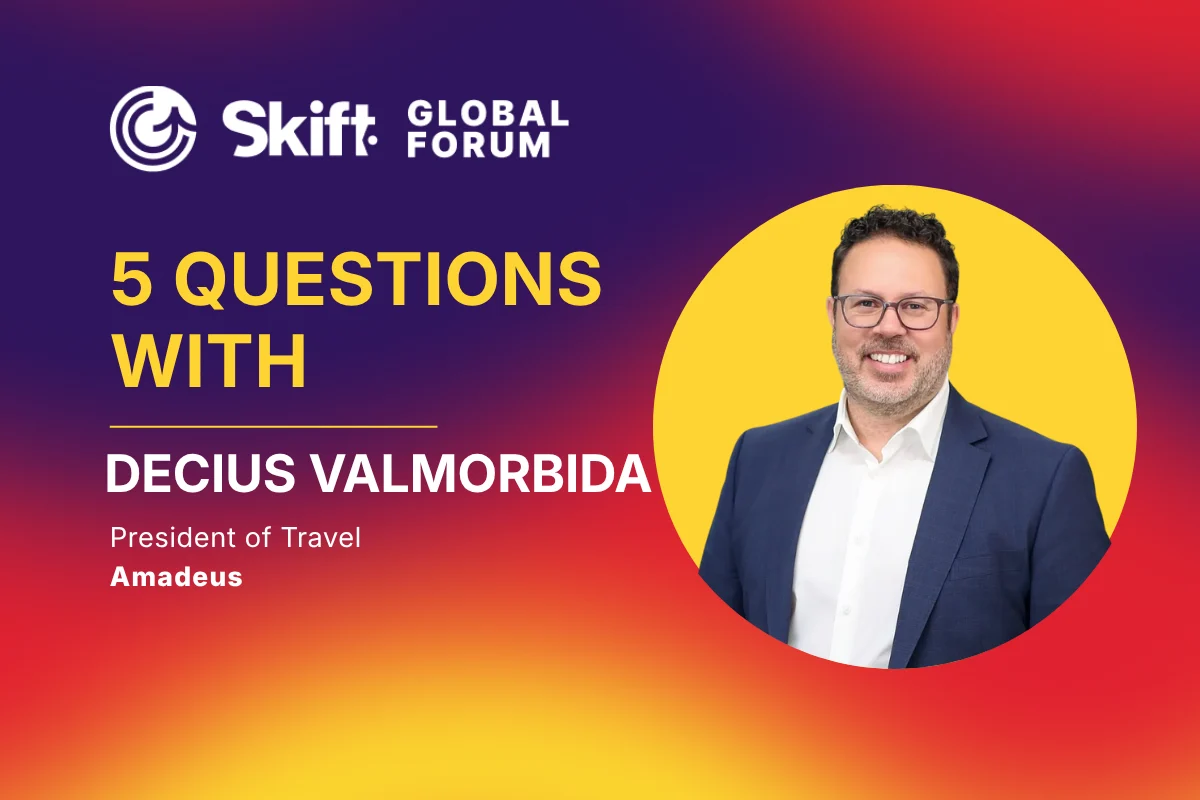
The global travel industry stands at a critical juncture where the traditional boundaries of competition are being redrawn, moving away from isolated proprietary platforms toward a more integrated, open-source philosophy. Decius Valmorbida, President of Travel at Amadeus, has emerged as a leading proponent of this shift, arguing that the future of travel depends less on "closed walls" and more on a shared foundation of technological "plumbing." As Amadeus approaches its 40th anniversary, Valmorbida’s vision reflects a broader maturation of the travel technology sector, transitioning from a focus on individual transactions to a holistic, traveler-centric experience. This perspective will take center stage at the upcoming Skift Global Forum in New York City, scheduled for September 22–24, 2026, where Valmorbida will join other industry titans to debate the merits of collaboration versus isolation in an increasingly fragmented digital landscape.
The Strategy of Longevity Over Technological Hype
In an era characterized by rapid-fire technological breakthroughs—from generative artificial intelligence to the metaverse—Valmorbida emphasizes a disciplined approach to investment. For Amadeus, a company that has served as the connective tissue of the travel booking world for four decades, the primary filter for any new innovation is its potential for longevity. Valmorbida asserts that the industry often falls into the trap of "jumping on every passing bandwagon," reacting to the excitement of the moment rather than the long-term utility of the technology.
The "test" applied by Amadeus leadership focuses on whether a specific innovation strengthens the company’s core technology foundation and solves tangible customer problems. This conservative yet forward-looking strategy has allowed the firm to maintain consistent investment cycles even through periods of extreme volatility, including the global pandemic. By prioritizing capabilities that can be built upon over decades rather than months, Amadeus seeks to avoid the "hype cycle" and instead focus on the infrastructure that moves the entire industry forward. This approach suggests a belief that lasting competitive advantage is not found in the newest gadget, but in the most reliable and scalable systems.
Dismantling Closed Ecosystems for Traveler Empowerment
A central pillar of Valmorbida’s argument is the rejection of the "closed ecosystem" model. Historically, airlines, hotel chains, and travel agencies have sought to build walled gardens, curating every aspect of the traveler’s journey within their own proprietary systems to maximize brand loyalty and data capture. However, Valmorbida suggests that this model ultimately limits value for the traveler. In a fragmented journey where a traveler must interact with multiple disconnected platforms, the result is often friction, lack of transparency, and a loss of control.
The proposed alternative is an "open ecosystem" where the traveler sits at the center, empowered by data that flows seamlessly across different providers. In this model, the traveler is in command of their choices, while providers cooperate behind the scenes on the underlying infrastructure. This shift requires a fundamental change in mindset: moving from a focus on owning the customer to a focus on facilitating the customer’s journey. By sharing data responsibly and adhering to common standards, the industry can create a personal and seamless experience that feels like a one-stop shop, regardless of how many different companies are involved in the actual delivery of services.
The Evolution of Travel Technology: A Forty-Year Chronology
To understand Valmorbida’s current stance, it is necessary to examine the chronological evolution of Amadeus and the wider travel tech landscape. The industry has moved through several distinct eras:
- The Era of Global Distribution (1980s–1990s): Amadeus was founded in 1987 by Air France, Iberia, Lufthansa, and SAS. This period was defined by the creation of Global Distribution Systems (GDS) that allowed travel agents to access airline inventories in real-time. The focus was purely on transactional efficiency and connectivity.
- The Transition to the Cloud (2000s–2010s): As the internet matured, the industry shifted toward web-based bookings and cloud-native architectures. Amadeus expanded its reach into the hospitality sector and developed the Altéa suite, moving beyond just distribution to providing the core operational software for airlines.
- The Push for Modern Retailing (2015–Present): The introduction of New Distribution Capability (NDC) standards by IATA marked a shift toward more sophisticated retailing, allowing airlines to offer personalized bundles and dynamic pricing.
- The Era of Open Interoperability (2026 and Beyond): The current phase, as envisioned by Valmorbida, focuses on "plumbing"—the shared foundations of identity, data standards, and interoperability. This era is defined by the realization that while brands compete on the "front end" (service and product), they must cooperate on the "back end" (infrastructure) to ensure the industry’s growth.
Data Standards and the "Plumbing" of Modern Travel
Valmorbida’s call for cooperation on "plumbing" refers to the technical standards that allow different systems to talk to one another. Currently, the travel industry suffers from high levels of fragmentation. For example, a traveler’s digital identity might be verified by an airline, then again by an airport security team, and once more by a hotel. By cooperating on shared foundations like biometrics and digital identity standards, the industry can remove these repetitive points of friction.
Market data supports the need for this integration. According to industry analysis, the travel technology market is projected to grow significantly as providers move away from legacy systems. However, the cost of maintaining siloed, non-interoperable systems remains a significant burden on the industry’s bottom line. By adopting shared data standards, companies can reduce the "friction tax" that travelers currently pay in the form of time and complexity. Valmorbida argues that if the industry can solve the challenges of identity and interoperability together, the "pie" will grow for everyone, leading to higher overall travel volumes and better customer satisfaction.
Trust as the New Differentiator in an AI-Driven World
As technology like AI and biometrics becomes more prevalent, the nature of the relationship between travel brands and customers is evolving from transactional to experiential. Valmorbida posits that in a world of infinite choice, trust becomes the most valuable currency. Travelers are no longer just buying a seat on a plane or a room in a hotel; they are purchasing an end-to-end experience.
Trust is earned when a brand delivers on its promise, particularly during "moments of truth"—those critical points in a journey where things can go wrong, such as flight cancellations or lost luggage. While technology provides the tools to handle these moments—such as automated rebooking or real-time baggage tracking—the real differentiator is how a company uses those tools to strengthen the customer relationship. Valmorbida believes that the ongoing retailing transformation in the travel sector is not just about selling more ancillaries, but about understanding traveler needs deeply enough to provide value when it is needed most.
Broader Impact and Industry Implications
The implications of Valmorbida’s "open foundation" philosophy extend beyond Amadeus. If the industry moves toward this collaborative model, it could level the playing field for smaller players who currently struggle to compete with the massive R&D budgets of "walled garden" giants. It also places a greater emphasis on regulatory compliance and data privacy, as a shared ecosystem requires robust frameworks for responsible data handling.
Industry observers note that this call for cooperation comes at a time when other major players are pursuing different strategies. For instance, companies like Uber are attempting to become "super apps" that own the entire travel stack, while major hotel chains like Hilton focus heavily on proprietary loyalty ecosystems. The tension between these "super app" ambitions and Valmorbida’s "open plumbing" vision will likely be a primary theme of the Skift Global Forum.
Looking Ahead to Skift Global Forum 2026
The upcoming Skift Global Forum in New York City will serve as a high-stakes arena for these ideas. Valmorbida will share the stage with some of the most influential figures in the travel and tech sectors, including Uber CEO Dara Khosrowshahi, Airbnb CEO Brian Chesky, and Hilton CEO Christopher Nassetta. The presence of these leaders suggests a recognition that the travel industry’s biggest challenges—and opportunities—cannot be addressed in isolation.
The forum is expected to draw over 500 C-suite executives and industry innovators, focusing on the theme of "The Great Integration." As Valmorbida prepares to present his case for open ecosystems, the industry will be watching to see if rivals can truly set aside their competitive instincts to build the shared foundations necessary for the next decade of travel. The outcome of these discussions will likely influence the trajectory of travel technology investments and the quality of the traveler experience for years to come. In Valmorbida’s view, the choice is clear: continue to build walls and limit the industry’s potential, or build the shared plumbing that allows the entire ecosystem to flourish.