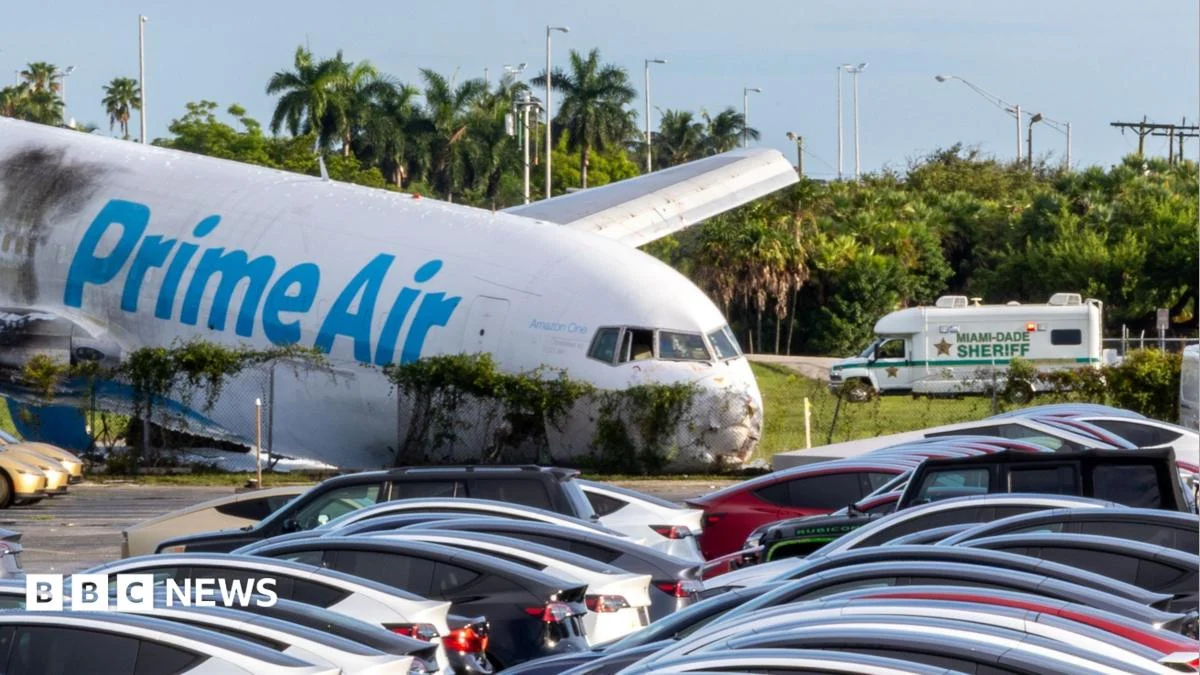
Miami, FL – A deadly incident unfolded on Sunday at Miami International Airport (MIA) when an Amazon-branded cargo plane, operated by 21 Air, overshot its runway after landing, resulting in the deaths of five individuals and serious injuries to five others. Authorities have launched a comprehensive investigation into the precise cause of the crash, which occurred just before 2:00 PM local time (18:00 GMT) on a busy Labor Day weekend, prompting significant disruptions to air travel and drawing immediate national attention.
The Catastrophic Incident Unfolds
The aircraft involved, a Boeing 767-300 freighter, was attempting to land at Miami International Airport after a flight from Luis Muñoz Marín International Airport in San Juan, Puerto Rico. According to preliminary reports and flight data from tracking sites such as FlightRadar24, the plane exited the usable portion of the runway at a speed of approximately 112 knots (129 mph, 207 km/h). Instead of decelerating safely, it continued beyond the paved surface, crossed an adjacent service road, and collided with multiple vehicles on the ground before coming to rest near a car park that serves an Amazon warehouse and other businesses. The impact and subsequent events tragically claimed five lives, though it remains unclear at this early stage whether the fatalities were among those onboard the aircraft, individuals in the vehicles on the ground, or a combination of both. Five additional individuals sustained serious injuries, with three reported to be in critical condition, highlighting the severity of the crash.
Immediate Emergency Response and Rescue Efforts
The response to the unfolding disaster was swift and extensive. Miami-Dade County Mayor Daniella Levine Cava confirmed at a Sunday evening news conference that rescue crews arrived at the scene within "seconds" of the crash. The sheer scale of the incident necessitated a massive deployment of emergency services, with over 200 firefighters responding to the site after the plane reportedly burst into flames. Miami Fire Chief Raied Jadallah detailed the challenging rescue operations, noting that several of the injured were trapped inside or beneath vehicles struck by the aircraft, requiring complex extrication efforts by fire and rescue personnel. The coordinated efforts of multiple agencies were critical in managing the immediate aftermath, tending to the injured, and securing the crash site. The swiftness of the response was lauded by local officials, emphasizing the airport’s robust emergency protocols, though the tragic loss of life cast a somber shadow over the operation.
The Role of Investigative Agencies
The National Transportation Safety Board (NTSB), the federal agency responsible for investigating civil aviation accidents in the United States, immediately dispatched a "go-team" of experts to Miami. These specialists, including investigators focused on operations, air traffic control, human factors, aircraft systems, and maintenance, are tasked with meticulously gathering evidence, analyzing flight recorders (the "black boxes"), and interviewing witnesses and personnel involved. A preliminary briefing for reporters from the NTSB team is anticipated on Monday afternoon, providing initial insights into their investigative approach and timeline.
Concurrently, the Federal Aviation Administration (FAA), which regulates U.S. air transportation, took immediate action by temporarily grounding all flights at Miami International Airport following the incident. This measure was crucial for safety, to allow emergency services unrestricted access, and to prevent further complications. The FAA will cooperate closely with the NTSB, providing technical expertise and data related to air traffic control communications, aircraft certification, and operational procedures. The comprehensive investigation is expected to be a lengthy and detailed process, aiming to determine the exact sequence of events, contributing factors, and ultimately, to issue safety recommendations to prevent similar incidents in the future.
The Aircraft and Its Operator
The ill-fated aircraft was a Boeing 767-300, a widely used and highly reliable twin-engine, wide-body airliner, specifically configured as a freighter (767-300F). This variant is a workhorse of global air cargo operations, known for its significant payload capacity and long-range capabilities. The particular aircraft involved was operating under the Amazon Air brand, part of Amazon’s extensive logistics network designed to enhance delivery speeds and efficiency. While the plane carried Amazon livery, it was operated by 21 Air, a North Carolina-based charter cargo airline.
21 Air, like many cargo carriers, operates under contract for larger logistics companies, providing the aircraft, crew, maintenance, and insurance (ACMI) services. Following the crash, 21 Air released a statement through its CEO, Keith Winters, expressing devastation and offering "deepest condolences" to the families and loved ones of those who lost their lives. The company affirmed its commitment to supporting those affected and fully cooperating with the ongoing investigation. Amazon’s Director of Corporate Global Media Relations, Kelly Nantel, echoed these sentiments, stating the company was "heartbroken" and extended "deepest sympathies" to those impacted, also pledging full cooperation with authorities. The collaboration between the contracting company (Amazon) and the operator (21 Air) will be a key aspect of the investigation, examining operational agreements, maintenance records, and flight crew training.
Weather Conditions and Initial Observations
Weather conditions at the time of the incident are a significant focus for investigators. Flight tracking site FlightRadar24 reported light thunderstorms and gusting winds in Miami around the time of the crash. Such conditions can pose considerable challenges for pilots during landing, potentially affecting visibility, creating wind shear, and necessitating precise control inputs. Aviation experts, speaking to the Associated Press, suggested that video footage of the plane’s approach and landing would be crucial. Investigators would specifically look to determine if the aircraft touched down within the designated landing zone on the runway. An "overshoot" often implies a landing that occurred too far down the runway, leaving insufficient distance for the aircraft to decelerate and stop before the end of the paved surface. This could be exacerbated by factors such as excessive speed on touchdown, an un-stabilized approach, or issues with braking systems and thrust reversers. The interplay of environmental factors, pilot actions, and aircraft performance will be meticulously examined.
Broader Impact on Airport Operations and Travel
The crash occurred during Labor Day weekend, one of the busiest travel periods of the year in the United States. The Transportation Security Administration (TSA) had predicted a staggering 17 million travelers would pass through U.S. airports in the week leading up to the holiday, with approximately 2.3 million projected to fly on Sunday alone. The grounding of all flights at Miami International Airport sent immediate ripples throughout the national air travel network. Passengers at MIA reported significant frustration due to widespread flight cancellations and delays, and a pronounced lack of information from officials in the immediate aftermath.
Long queues formed at airline counters as travelers attempted to reschedule their plans. Many faced the prospect of unexpected overnight stays in Miami, scrambling to find hotel accommodations amidst the holiday rush. One traveler, Faroush, recounted the difficulty, stating, "The earliest I could find to fly to San Francisco was Tuesday morning. I’ll probably have to find a hotel and spend more time in Miami." The disruption not only affected passengers directly flying into or out of Miami but also had cascading effects on connecting flights and crew rotations across the country, highlighting the interconnectedness of modern air travel. For Amazon, while its vast logistics network is resilient, any disruption involving one of its branded aircraft can lead to temporary delays in cargo movement, particularly given the reliance on air freight for expedited deliveries.
Miami International Airport: A Vital Hub
Miami International Airport (MIA) is not just a regional airport; it is a critical artery in global commerce and travel. Founded in 1928, MIA holds the distinction of being America’s busiest airport for international freight and the second busiest for international passengers. Its strategic geographical location makes it the premier gateway to Latin America and the Caribbean, offering more flights to these regions than any other U.S. airport. Approximately 60% of all international visitors to Florida arrive through MIA, underscoring its immense economic and logistical importance. The incident, therefore, not only impacts the immediate vicinity but has broader implications for international trade and tourism flows that depend on this vital hub. The swift efforts to clear the runway and resume operations are crucial for minimizing long-term economic repercussions.
Looking Ahead: The Path to Understanding
The NTSB’s investigation will be exhaustive, involving months, if not over a year, of detailed analysis. It will encompass a review of the aircraft’s maintenance history, the flight crew’s training and recent flight hours, air traffic control recordings, radar data, and the black box flight data and cockpit voice recorders. The findings will be made public in a comprehensive report, which will detail the probable cause of the accident and may include safety recommendations for manufacturers, operators, or regulatory bodies. This meticulous process is a cornerstone of global aviation safety, continually striving to learn from tragedies and implement improvements that enhance the security of air travel for everyone. In the interim, the focus remains on supporting the victims and their families, and on ensuring full transparency and cooperation from all parties involved as the complex picture of what transpired on Sunday afternoon at Miami International Airport gradually emerges.