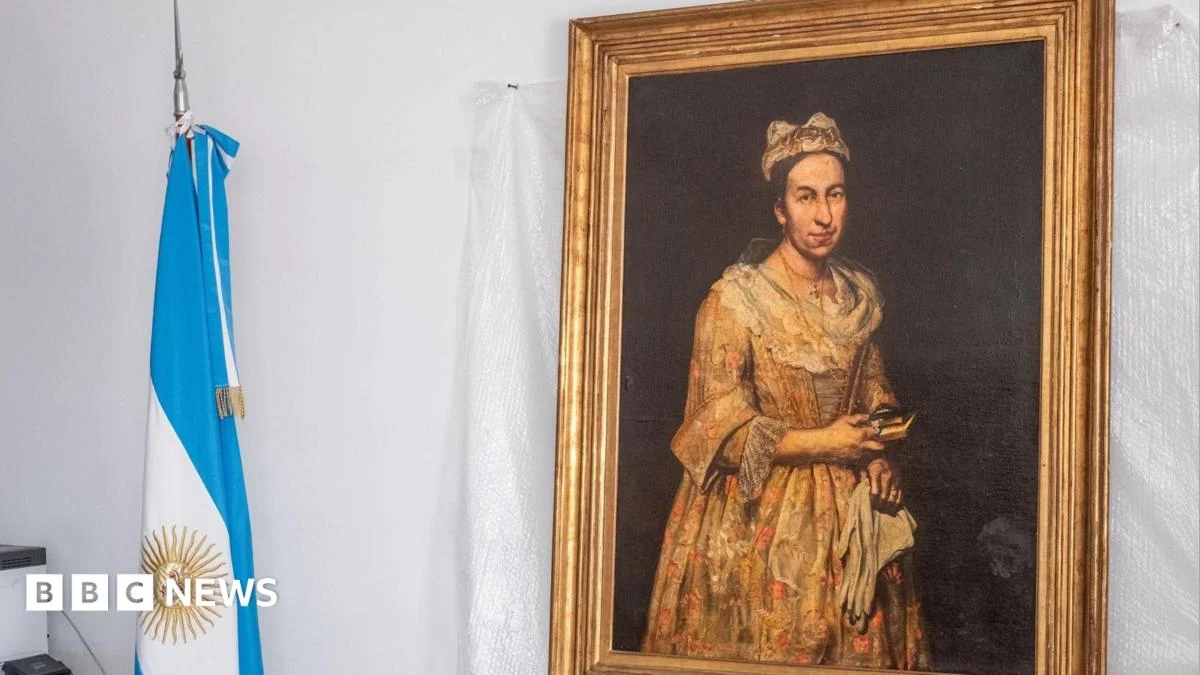
The ruling culminates an 80-year odyssey for the painting, which vanished from public view following the Nazi invasion of the Netherlands in 1940 and only re-emerged in photographs of a property listed for sale near Buenos Aires. The house belonged to Patricia Kadgien, daughter of Friedrich Kadgien, a high-ranking Nazi fugitive who found refuge in Argentina after the collapse of the Third Reich. In a development underscoring the complexities of restitution, Kadgien has agreed to relinquish the artwork in exchange for immunity from prosecution for concealing the painting from authorities. The "Portrait of a Lady" is but one of over a thousand artworks plundered from the extensive collection of prominent Jewish art dealer Jacques Goudstikker. His daughter-in-law and sole heir, Marei von Saher, has expressed her intent for the painting to be temporarily loaned to the Holocaust Museum of Buenos Aires, aiming to leverage its recovery to raise crucial awareness about the historical injustices of art looting. Von Saher has consistently affirmed her family’s dedication to "bring back every single artwork robbed from Jacques’ collection, and to restore his legacy," a mission that continues to drive decades-long restitution efforts. The painting’s re-identification occurred in August 2025, when the Dutch Algemeen Dagblad (AD) newspaper recognised it on an estate agent’s website advertising a property in the coastal town of Mar del Plata, Argentina. It was conspicuously displayed above a green sofa in the living room of Patricia Kadgien, whose father, Friedrich Kadgien, had served as a top adviser to Hermann Göring, Adolf Hitler’s second-in-command and a notorious orchestrator of art plunder across occupied Europe.
A Legacy Forged in Tragedy: The Goudstikker Collection
Jacques Goudstikker was a pre-eminent Dutch-Jewish art dealer, operating one of Amsterdam’s most prestigious galleries in the early 20th century. His discerning eye and sophisticated taste allowed him to amass an extraordinary collection of Old Master paintings, numbering over 1,400 works. His gallery was renowned internationally, attracting collectors and connoisseurs from across Europe and America. The collection included masterpieces by Dutch and Flemish artists, Italian Renaissance painters, and various other significant works that reflected centuries of European artistic heritage.
The idyllic existence of the Goudstikker family and the thriving art world he inhabited were brutally shattered with the Nazi invasion of the Netherlands on May 10, 1940. As German forces advanced, Goudstikker, his wife Dési, and their infant son Eduoard, along with other family members, made a desperate escape aboard the steamer SS Bodegraven. In the chaos of their flight, Goudstikker tragically fell to his death from a ship’s ladder. His death left his family in exile and his invaluable art collection vulnerable. Within days of his demise, the Goudstikker gallery and its contents were seized by the Nazis. Hermann Göring, a fervent art collector with an insatiable appetite for plundered treasures, personally oversaw the confiscation of much of the collection. Acting through his agent, Alois Miedl, the Goudstikker inventory was acquired under duress and coercion for a fraction of its true value, a common tactic used by the Nazis to "legalize" their thefts. These transactions were, in essence, forced sales under duress, rendering them illegal under international law. Many of the works found their way into Göring’s private collection at Carinhall, his lavish country estate, while others were dispersed through various channels of the Nazi art trade. The "Portrait of a Lady," a late-baroque piece, was among these thousands of artworks swallowed by the Nazi war machine, lost to the Goudstikker family for more than eight decades.
The Architect of Plunder: Göring and Kadgien’s Complicity
Hermann Göring was not merely a high-ranking Nazi official; he was a central figure in the systematic looting of art across Europe. As head of the Luftwaffe and director of the Four Year Plan, Göring wielded immense power, which he frequently abused to enrich himself. He established and commanded special units, such as the "Einsatzstab Reichsleiter Rosenberg" (ERR), ostensibly tasked with cultural preservation but, in reality, operating as a sophisticated plunder organization. The ERR systematically seized Jewish-owned art collections, libraries, and cultural institutions throughout occupied territories, sending truckloads of treasures back to Germany. Göring often had first choice of the looted items, personally selecting pieces for his private collection.
Friedrich Kadgien, identified as a "top adviser to Hermann Göring," played a direct, albeit perhaps less public, role in this vast network of cultural theft. As an adviser to Göring, Kadgien would have been intimately involved in the logistics, administration, or identification of assets targeted for confiscation. His proximity to one of the most prolific art looters of the Nazi regime strongly suggests complicity in the crimes committed against Jewish families and cultural heritage. The fact that Kadgien chose to flee to Argentina after the war, and retained a significant artwork from the Goudstikker collection, further corroborates his involvement and subsequent efforts to conceal his wartime activities and ill-gotten gains. The "Portrait of a Lady" thus represents not only a lost artwork but also a tangible link to the perpetrators and beneficiaries of Nazi crimes.
Decades in the Shadows: The Journey to Recovery
The journey of the "Portrait of a Lady" from the Goudstikker gallery in Amsterdam to a living room in Mar del Plata, Argentina, spans nearly a century and illustrates the protracted and often serendipitous nature of art restitution. After its confiscation in 1940, the painting’s precise whereabouts for the majority of the 20th century remain largely unknown, a common challenge in the field of looted art. It is believed to have been among the pieces Göring kept for himself or traded, eventually making its way to Friedrich Kadgien through unknown means, likely as a personal acquisition or reward for his services to the Nazi regime.
Post-World War II, as Allied forces began the monumental task of recovering and restituting looted art, millions of pieces were identified and returned. However, countless others remained missing, dispersed globally, often deliberately hidden by those who had acquired them illicitly. It was not until August 2025 that the "Portrait of a Lady" resurfaced, igniting the latest chapter in its restitution. The Dutch newspaper Algemeen Dagblad (AD), through its investigative journalism, spotted the painting on an online real estate listing for a property in Mar del Plata, Argentina. This discovery highlights the increasingly vital role of digital platforms and open-source intelligence in modern art recovery efforts. Researchers and journalists frequently scour auction catalogues, private collections, and now, even real estate websites, for clues to missing artworks. The image, showing the distinctive late-baroque painting hanging above a green sofa, immediately struck a chord with those familiar with the Goudstikker inventory. Experts at the Goudstikker Art Research Project, along with art historians and provenance researchers, quickly verified the painting’s identity against existing records and photographs of the pre-war Goudstikker collection. This identification led to formal claims by Marei von Saher and subsequent legal actions in Argentina. The recovery in Argentina last year, following the identification, involved painstaking diplomatic and legal work, culminating in the recent court order.
Argentina’s Hidden Histories: A Haven for Fugitives
Argentina’s role as a post-World War II sanctuary for Nazi fugitives is a well-documented and controversial chapter of its history. Under the presidency of Juan Perón, Argentina adopted policies that facilitated the entry of thousands of Europeans, including numerous Nazi officials and collaborators seeking to evade justice for their war crimes. This network, often referred to as "ratlines," involved clandestine routes supported by sympathetic elements within the Catholic Church, the Red Cross, and corrupt government officials, enabling figures like Adolf Eichmann, Josef Mengele, and many others to establish new lives in South America.
Friedrich Kadgien’s presence in Argentina is consistent with this historical pattern. His flight to a country known for offering refuge to those fleeing accountability for their roles in the Third Reich suggests a deliberate attempt to escape prosecution. For decades, these fugitives and their descendants lived largely undisturbed, some openly, others in relative anonymity, often holding onto secrets and, in some cases, tangible evidence of their wartime activities, such as looted art. The discovery of the "Portrait of a Lady" in Patricia Kadgien’s home in Mar del Plata underscores how these historical narratives continue to intersect with contemporary justice. Argentina’s evolving political landscape and increasing international cooperation have led to greater willingness to address these historical grievances, moving away from its past as a haven towards a more active role in international justice and restitution efforts. The agreement by Patricia Kadgien to return the painting in exchange for non-prosecution reflects this shift, indicating a desire to resolve historical wrongs, albeit with legal compromises.
The Long Arm of Justice: Legal Proceedings and Restitution
The court’s decision in Argentina to mandate the return of the "Portrait of a Lady" represents a significant legal milestone and reaffirms international principles of art restitution. Legal proceedings in such cases are often complex, requiring extensive provenance research, expert testimony, and navigation of different national legal systems. Marei von Saher, as the sole heir of Jacques Goudstikker, has been at the forefront of these efforts for decades, working tirelessly to recover her family’s stolen heritage. Her claims are underpinned by the Washington Principles on Nazi-Confiscated Art, a non-binding international agreement established in 1998, which urges signatory nations to identify and return art looted by the Nazis. While non-binding, these principles have significantly influenced national legal frameworks and judicial decisions regarding restitution.
The agreement with Patricia Kadgien, exchanging the painting for immunity from prosecution for concealment, highlights the practical challenges and compromises often involved in restitution cases. While some might argue for full prosecution, the primary goal in many restitution efforts is the return of the artwork to its rightful owners. Such agreements can expedite the process, avoid lengthy and costly legal battles, and ensure the artwork’s recovery. It also implicitly acknowledges the historical injustice without requiring a criminal conviction, a pragmatic approach to addressing historical wrongs when direct prosecution might be legally difficult after so many decades. The Argentine court’s ruling reinforces the notion that stolen property, regardless of how long it has been held or how many hands it has passed through, ultimately belongs to its original rightful owners or their heirs, especially in cases of Nazi looting.
Symbol of Remembrance: The Painting’s Future
Marei von Saher’s intention to loan the "Portrait of a Lady" to the Holocaust Museum of Buenos Aires is deeply symbolic and carries profound educational significance. Rather than immediately selling the recovered masterpiece, von Saher prioritises its role in spreading awareness and remembering the victims of the Holocaust. This decision aligns with the broader mission of Holocaust museums worldwide: to educate future generations about the atrocities of the Nazi regime, the systemic persecution of Jews, and the devastating impact on individuals, families, and cultural heritage.
The exhibition of the "Portrait of a Lady" in Buenos Aires will serve as a powerful testament to the enduring legacy of Nazi looting and the ongoing pursuit of justice. It will allow visitors to connect a specific artwork to a tragic historical narrative, illustrating how art became a casualty of war and genocide. It underscores that behind every looted artwork is a story of a family, a life, and a culture irrevocably altered. Von Saher’s unwavering commitment to "bring back every single artwork robbed from Jacques’ collection, and to restore his legacy" reflects a broader movement by heirs of Holocaust victims to reclaim not just material possessions, but also the dignity and memory of their ancestors. This temporary loan will undoubtedly foster dialogue, encourage further research into stolen art, and remind the public that the repercussions of World War II continue to resonate today.
Broader Implications: The Global Pursuit of Justice
The restitution of the "Portrait of a Lady" carries significant broader implications for the global pursuit of justice in art restitution. It serves as a powerful reminder that despite the passage of over 80 years since the end of World War II, the work of identifying, recovering, and returning Nazi-looted art is far from over. This case demonstrates the persistence required by heirs, researchers, and legal professionals, and the often unexpected ways in which these artworks resurface. The role of digital media, such as online real estate listings, in the identification process highlights how technological advancements are aiding these efforts, offering new avenues for discovery that did not exist in previous decades.
Furthermore, this case reinforces the principle that national borders and the passage of time do not extinguish the moral and legal imperative to return stolen cultural property. It sends a clear message to individuals and institutions that might still be in possession of looted art that these objects will eventually be identified and claimed. The cooperation between Dutch media, international researchers, and Argentine authorities in this case exemplifies the transnational collaboration essential for successful restitution. As more archives are declassified, and as public awareness grows, similar discoveries are likely to continue, ensuring that the legacy of Nazi art looting remains a critical area of focus for historians, legal experts, and the art world alike. This ruling is not just about a single painting; it is about the unwavering commitment to historical justice and the restoration of cultural heritage.