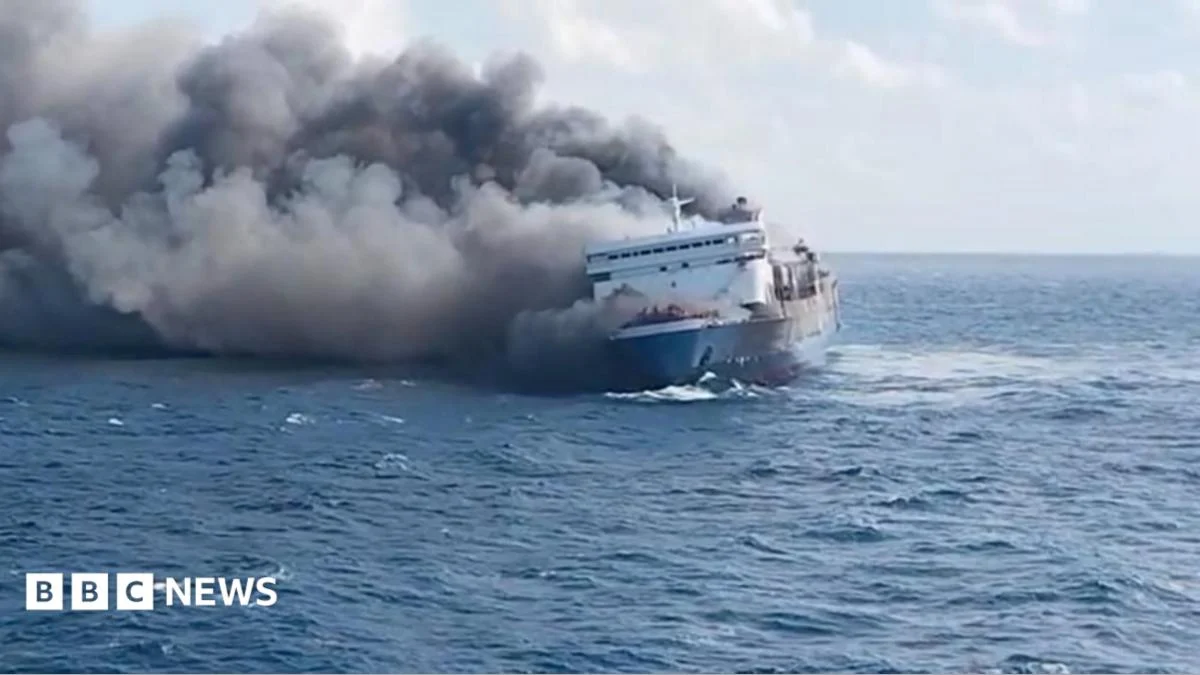
The KMP Mutiara Sentosa 2, a passenger ferry carrying an estimated 250 individuals, erupted into a catastrophic fire while traversing the sea off Madura island, resulting in the confirmed deaths of five people and leaving 41 unaccounted for, according to official statements from Indonesian authorities. The vessel, which departed from Surabaya, East Java, Indonesia’s second-largest city, was en route to Makassar in South Sulawesi when the inferno ignited, triggering a large-scale search and rescue operation in the vast waters of the archipelago.
The Catastrophic Event Unfolds
The harrowing incident began in the early hours, with the captain of the KMP Mutiara Sentosa 2 reportedly notifying maritime authorities of the blaze. Basarnas, the National Search and Rescue Agency, confirmed that the Surabaya Search and Rescue office received an initial alert regarding the passenger ship fire at approximately 08:24 local time (02:24 GMT). This notification, however, came hours after the fire was believed to have first broken out. Information subsequently provided by the shipping company indicated that the conflagration commenced sometime between 06:00 and 07:00 local time (00:00-01:00 GMT), suggesting a significant period elapsed between the initial ignition and the official distress signal reaching external rescue agencies.
As the fire rapidly escalated, engulfing large sections of the KMP Mutiara Sentosa 2, a desperate struggle for survival unfolded onboard. Visual documentation, including footage disseminated by local Indonesian news outlets such as iNews and videos posted by Basarnas on its social media platforms, captured the terrifying scenes. These clips depicted numerous passengers donning life jackets, some huddled precariously on what appeared to be a lifeboat, while others were seen scrambling down the side of the burning ferry. Flames and dense plumes of smoke billowed from the upper decks of the vessel, painting a grim picture of the escalating emergency. Later confirmations from Basarnas indicated that the ferry was "almost entirely engulfed in flames," forcing "passengers to hold on in the ship’s bridge and bow while awaiting rescue." The sheer scale of the fire and the rapid consumption of the vessel underscore the immediate and grave danger faced by those aboard.
The footage further illustrated the terrifying choices passengers were forced to make in the face of the encroaching fire. Many were observed leaping into the open sea, a desperate attempt to escape the inferno, relying on life jackets and the hope of swift rescue. Crowds of people in life jackets could be seen congregating in the water, with lifebuoys being thrown to assist them before they were eventually brought aboard rescue ships. The chaotic nature of the abandonment and the vastness of the ocean presented immense challenges for both the passengers and the incoming rescue teams.
Chronology of a Maritime Disaster
The voyage of the KMP Mutiara Sentosa 2 typically represents a critical maritime link between Java and Sulawesi, two of Indonesia’s most populous islands. The journey from Surabaya to Makassar is a considerable undertaking, often spanning more than 24 hours. The initial hours of the journey, prior to the fire, would have been routine, with passengers settling in for the long crossing.
Pre-Dawn Ignition (06:00-07:00 Local Time / 00:00-01:00 GMT): The first signs of trouble emerged as the sun began to rise. The precise origin of the fire remains unknown and is a key focus of ongoing investigations. It is understood that the fire rapidly took hold, spreading quickly through the ship’s structure. Given the materials commonly used in ferry construction and the potential presence of flammable cargo, such rapid escalation is a critical concern. Crew members would have initiated initial firefighting protocols, but the speed and intensity of the blaze suggest these efforts were quickly overwhelmed.
Captain’s Distress Call: Faced with an uncontrollable fire, the captain made the crucial decision to issue a distress signal. This signal would have alerted nearby vessels and maritime traffic control, initiating the broader emergency response protocols. However, the exact timing of this initial report in relation to the fire’s onset is a subject of scrutiny, particularly given the subsequent Basarnas notification time.
Basarnas Notification (08:24 Local Time / 02:24 GMT): More than an hour, potentially two, after the fire was first reported by the shipping company, the Surabaya Search and Rescue office received the official alert. This delay, whether due to communication challenges or the time taken for the situation to be fully assessed before escalating the call to Basarnas, is a critical element in understanding the unfolding response. Upon receiving the notification, Basarnas immediately mobilised its assets and coordinated with other relevant agencies.
Rapid Deterioration and Abandon Ship: As rescue efforts were being mobilised, conditions on the KMP Mutiara Sentosa 2 worsened dramatically. With the ferry "almost entirely engulfed in flames," the command to abandon ship would have been issued or, more likely, passengers would have taken the initiative to escape the immediate danger. The images of people jumping into the sea and clinging to life rafts attest to the desperate circumstances. The focus shifted from containing the fire to saving lives from the water.
Search and Rescue Deployment: Multiple assets were dispatched to the scene. These would typically include Basarnas vessels, Indonesian Navy ships, Coast Guard patrols, and potentially commercial vessels in the vicinity that responded to the distress call. The coordination of these diverse units is crucial in large-scale maritime emergencies. The primary objectives were to locate survivors in the water, retrieve bodies, and provide immediate medical aid.
Arrival of Rescue Vessels and Survivor Transfers: The first rescue vessels arriving at the scene encountered a chaotic environment. Survivors, many suffering from shock, hypothermia, and potential injuries from the fire or the jump, were systematically pulled from the water. The process of transferring individuals from the sea or lifeboats onto larger, more stable rescue ships is a complex operation, particularly in potentially choppy waters or amidst the wreckage.
Ongoing Search and Recovery: In the aftermath of the initial rescue, the operation transitioned into a prolonged search and recovery phase. With 41 individuals still missing, Basarnas and its partners continued to comb the designated search area, factoring in sea currents and wind patterns that could have carried victims far from the disaster site. The hope of finding further survivors diminishes with each passing hour, intensifying the focus on recovering those still unaccounted for.
Indonesia’s Maritime Context and Safety Challenges
Indonesia, an archipelago nation comprising over 17,000 islands, relies heavily on sea transportation for both passenger travel and cargo movement. Ferries are the lifeblood connecting communities, facilitating trade, and supporting tourism across its vast maritime domain. Routes like Surabaya to Makassar are essential arteries, underscoring the critical importance of safe and reliable maritime transport infrastructure.
However, this reliance also exposes the nation to significant safety challenges. Indonesia has a lamentable history of ferry accidents, often attributed to a confluence of factors:
- Overcrowding: Despite official capacity limits, unofficial overloading of passengers and cargo remains a persistent problem, particularly during peak seasons or holidays.
- Aging Infrastructure: Many vessels in the Indonesian fleet are old, and regular, comprehensive maintenance is sometimes neglected due to economic pressures or lax enforcement.
- Inadequate Safety Equipment: While regulations mandate specific safety equipment (life jackets, life rafts, fire extinguishers), their quantity, condition, and accessibility can be insufficient or poorly maintained.
- Human Error: Crew training, adherence to safety protocols, and proper decision-making in emergencies are crucial, and deficiencies in these areas have contributed to past disasters.
- Weather Conditions: While not explicitly cited in this incident, Indonesia’s seas can be unpredictable, with sudden storms posing significant risks to vessels, particularly older ones.
- Fire Safety: Engine room fires, electrical faults, or fires originating from cargo (e.g., vehicles carrying fuel) are not uncommon and can spread rapidly if fire suppression systems are inadequate or not promptly activated. The KMP Mutiara Sentosa 2 incident highlights the devastating potential of onboard fires.
The regulatory framework for maritime safety falls under the purview of the Ministry of Transportation, which works in conjunction with agencies like Basarnas and the Indonesian Coast Guard (Bakamla) to enforce regulations and conduct search and rescue operations. Despite efforts to improve safety standards following previous high-profile incidents, challenges persist in consistent enforcement and compliance across the diverse and often remote maritime network.
Official Responses and Investigative Commitments
In the wake of the KMP Mutiara Sentosa 2 tragedy, various government bodies and related parties have issued statements and outlined their commitments.
Basarnas: The National Search and Rescue Agency affirmed its unwavering commitment to the ongoing search and rescue mission. A spokesperson for Basarnas stated, "Our primary focus remains on locating the 41 individuals still reported missing. We are deploying all available resources, including multiple vessels and aerial surveillance, to cover the broadest possible search area. We understand the anguish of the families, and we will not cease our efforts until every possibility has been exhausted." Basarnas also confirmed the immediate provision of psychological support and logistical aid to survivors and the families of victims.
Ministry of Transportation: Expressing profound sorrow over the loss of life, the Ministry of Transportation pledged a thorough and transparent investigation into the cause of the fire. A high-ranking official remarked, "We extend our deepest condolences to the families who have lost loved ones in this tragic incident. A comprehensive investigation will be launched by the National Transportation Safety Committee (KNKT) to determine the exact cause of the fire and any contributing factors. We are committed to taking all necessary measures to prevent such disasters from recurring and to enhance maritime safety across the archipelago." The Ministry also indicated that it would review the safety certificates and operational procedures of the shipping company involved.
The Vessel Operator: While specific statements from the shipping company operating KMP Mutiara Sentosa 2 (likely PT Darma Lautan Utama, though not explicitly stated in the original prompt) were not detailed, such entities are expected to cooperate fully with the investigation. In typical scenarios, the operator would issue a statement expressing deep regret, offering condolences, and pledging full assistance to authorities and the affected families. They would also likely emphasize their commitment to safety and the welfare of their passengers and crew.
Local Government and Humanitarian Aid: Local government officials in East Java and South Sulawesi, as well as humanitarian organizations, have mobilised to provide support. This includes setting up crisis centres for families of the missing, providing food, shelter, and medical assistance to survivors, and coordinating the identification process for the deceased. The disaster has prompted an outpouring of community support, reflecting the collective impact of such a tragedy.
Broader Impact and Implications
The KMP Mutiara Sentosa 2 disaster carries significant implications that extend beyond the immediate human tragedy.
Erosion of Public Trust: Each major maritime accident in Indonesia inevitably erodes public confidence in ferry travel. For millions of Indonesians who have no alternative means of inter-island transport, such incidents fuel anxiety and calls for more stringent oversight. Restoring this trust requires not only thorough investigations but also demonstrable improvements in safety standards and enforcement.
Renewed Focus on Maritime Safety Regulations: This incident is likely to trigger renewed scrutiny of existing maritime safety regulations, vessel inspection protocols, and crew training standards. Policymakers may face increased pressure to implement stricter measures, potentially leading to more frequent and rigorous inspections of vessels, particularly older ones, and enhanced training for ferry crews in emergency response and fire management. The role of technology in early fire detection and suppression systems onboard ferries might also be re-evaluated.
Economic and Social Disruption: While the immediate economic impact on the Surabaya-Makassar route might be limited, a broader downturn in ferry travel could affect local economies reliant on inter-island trade and tourism. Socially, the trauma experienced by survivors and the grief of the bereaved families will have lasting effects, requiring sustained psychological and community support.
International Scrutiny: Major maritime disasters in archipelagic nations often draw international attention, particularly from maritime safety organizations and neighbouring countries. This can lead to calls for adherence to international maritime conventions and best practices, potentially influencing Indonesia’s maritime policy and investment in modernizing its ferry fleet.
The KMP Mutiara Sentosa 2 tragedy serves as a stark reminder of the inherent risks associated with maritime travel, particularly in regions heavily dependent on it. As the search for the missing continues and the investigation unfolds, the focus will remain on understanding the full scope of the disaster, providing solace to those affected, and striving to ensure that such a catastrophic loss of life is not repeated on Indonesia’s vital sea lanes.