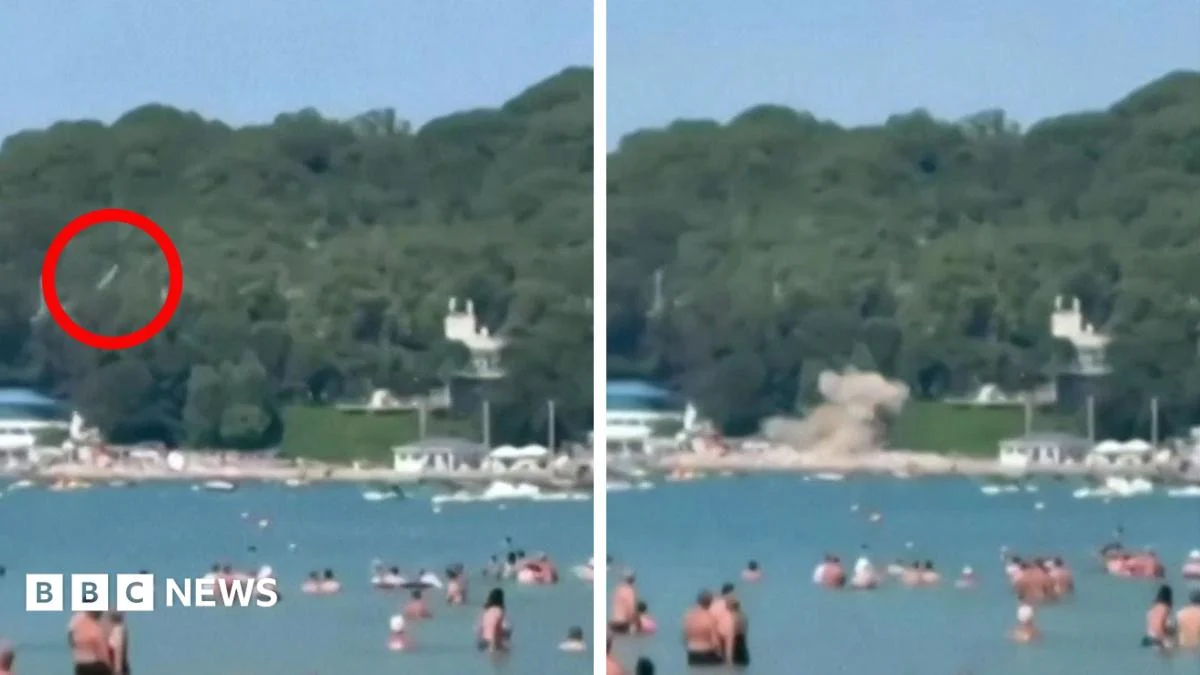
A drone strike on a popular tourist beach in Arkhipo-Osipovka, a resort village nestled on Russia’s southern Black Sea coast, has resulted in the deaths of seven individuals, including three children, and injured 40 others, according to local authorities. The incident, which occurred during what would typically be a bustling period for the resort, has cast a somber shadow over the region and significantly escalated concerns regarding the reach and impact of the ongoing conflict. The governor of the Krasnodar region, Veniamin Kondratyev, swiftly accused Ukraine of perpetrating "a deliberate strike on civilians," a charge that Ukraine has not yet directly addressed. Both sides in the conflict have consistently denied intentionally targeting civilian populations, despite numerous incidents leading to civilian casualties on both Russian and Ukrainian territory.
The precise circumstances surrounding the drone’s crash remain ambiguous, with conflicting reports and theories emerging from the aftermath. Social media footage, independently verified by international media outlets, depicted a drone rapidly descending towards a cliffside before culminating in a fiery explosion on the sandy beach below. Tourists, who were either on the shore or enjoying the water, could be seen reacting to the dramatic and terrifying spectacle. The sheer scale of casualties, including the particularly tragic loss of young lives, underscores the indiscriminate nature of modern warfare when it encroaches upon civilian spaces.
The Deadly Incident at Arkhipo-Osipovka
The tranquil morning on the Black Sea coast was abruptly shattered by the drone’s impact. Eyewitness accounts paint a harrowing picture of sudden chaos and terror. Several holidaymakers and local residents reported hearing distinct sounds of gunfire immediately preceding the explosion, suggesting that Russian air defense systems may have attempted to intercept the unmanned aerial vehicle (UAV) before it reached its intended or unintended destination. "We covered ourselves with sun loungers, and didn’t see where it exploded," one shaken tourist recounted to local media, highlighting the sheer speed and unexpected nature of the attack. Another witness described hearing "gunfire, like a machine gun," followed by a deafening blast. The psychological toll on those present was immediate and profound; "This all happened in front of my children. My child is having a nervous breakdown," a third individual shared, illustrating the deep trauma inflicted by such an event.
Emergency services were rapidly deployed to the scene, where they faced a grim task. Of the 40 injured individuals, 17 required hospitalization for varying degrees of trauma and physical harm. The confirmed fatalities, including three children, have been a focal point of official statements, emphasizing the human cost of the conflict’s expansion. The lack of any preceding air raid sirens was a critical point raised by several witnesses, suggesting either a failure in warning systems or the unexpected nature of the drone’s trajectory, which could have been altered by electronic warfare or an attempted interception. Such a lapse in warning amplifies the vulnerability felt by civilians in regions increasingly exposed to cross-border attacks.
A Popular Tourist Destination Under Attack
Arkhipo-Osipovka, situated in the Krasnodar region, holds significant appeal as a holiday destination for Russians. Its warm climate, extensive beaches, and well-developed tourist infrastructure make it a perennial favorite, particularly since international travel options for many Russians have been curtailed by Western sanctions imposed after the full-scale invasion of Ukraine in February 2022. The village is part of a broader network of resorts along the Black Sea coast that attract millions of domestic tourists annually, offering a respite from daily life and the opportunity for seaside recreation. The Krasnodar region itself is strategically important, bordering the Sea of Azov and located relatively close to the Crimean Peninsula, which Russia annexed in 2014 and uses as a crucial military hub.
The choice or accidental impact point of the drone on a busy beach during peak season is profoundly symbolic, bringing the realities of the conflict directly into the leisure spaces of ordinary citizens. For many Russians, these coastal resorts represent a sanctuary, a place where the distant war should not intrude. The strike fundamentally challenges this perception of safety, potentially impacting future domestic tourism and increasing public anxieties about personal security within Russia’s borders. The incident serves as a stark reminder that no region, however seemingly removed from the front lines, is entirely immune to the conflict’s reach.
Official Reactions and Conflicting Narratives
The immediate aftermath saw a flurry of official statements, primarily from Russian authorities. Governor Veniamin Kondratyev’s accusation of "a deliberate strike on civilians" by Ukraine set a clear narrative for Russian state media, framing the incident as an act of terrorism. This strong condemnation aligns with a broader pattern of Russian officials characterizing Ukrainian attacks on Russian territory as unprovoked aggression against non-military targets. The Russian Investigative Committee has reportedly launched a criminal investigation into the incident, a standard procedure for such events, aiming to ascertain the full details and assign responsibility.
Ukraine, consistent with its policy of strategic ambiguity regarding strikes on Russian territory, has not offered an immediate comment on the Arkhipo-Osipovka incident. This non-response allows Kyiv to maintain operational secrecy while simultaneously avoiding direct admission or denial of responsibility, which could have international diplomatic implications. However, the broader context of the conflict shows both sides denying deliberate targeting of civilians.
The question of the drone’s ultimate fate before impact remains a significant point of contention and speculation. Several theories have emerged:
- Electronic Warfare (EW) Jamming: Some Ukrainian Telegram channels, often reflecting unofficial military or intelligence perspectives, have suggested that the drone may have crashed onto the beach as a result of Russian electronic warfare systems jamming its signal. Such jamming could cause a drone to lose its programmed course, potentially leading to an uncontrolled descent or a crash far from its intended target.
- Air Defense Interception: The eyewitness accounts of gunfire preceding the explosion strongly indicate that Russian air defense units may have engaged the drone. If successfully hit, a drone could indeed fall out of the sky and explode on impact, potentially causing collateral damage. The debris field and the nature of the explosion would be key to verifying this scenario.
- Malfunction: As with any complex machinery, a drone could suffer a mechanical or system malfunction, leading to an uncontrolled crash. However, the reported gunfire makes this less likely to be the sole cause.
- Deliberate Targeting: While Governor Kondratyev’s statement implies deliberate targeting, proving intent in such a scenario is incredibly challenging without clear evidence of the drone’s programmed trajectory or the nature of its payload. If it was a deliberate strike on civilians, it would constitute a grave violation of international humanitarian law.
The lack of immediate, verifiable information from an independent source means the true cause of the crash and the drone’s intended target remain subjects of intense scrutiny and conflicting narratives.
Escalating Cross-Border Strikes: A Dangerous Pattern
The drone strike in Arkhipo-Osipovka is not an isolated incident but rather a significant escalation in a growing pattern of cross-border attacks that have increasingly brought the conflict into civilian areas of both Russia and Ukraine.
Ukrainian Offensive Capabilities:
Over the past year, Ukraine has demonstrated increasing success and sophistication in conducting long-range strikes deep into Russian territory. Initially limited, these attacks have grown in frequency, range, and impact, utilizing a combination of domestically developed drones and, in some cases, modified commercial UAVs. The primary stated objectives of these strikes are to disrupt Russia’s war effort by targeting:
- Energy Infrastructure: Oil refineries, fuel depots, and energy facilities crucial for supplying the Russian military and economy. Examples include strikes hundreds of kilometers from the border, impacting Russia’s oil processing capacity.
- Military Infrastructure: Airfields, barracks, command centers, and arms depots.
- Logistics Hubs: Transportation nodes and warehouses believed to be used for military supply chains.
- Psychological Impact: To bring the reality of the war closer to the Russian populace and challenge the Kremlin’s narrative of a distant "special military operation."
While Ukraine typically avoids claiming responsibility for these deep strikes, its officials often hint at them as legitimate responses to Russia’s aggression. These attacks have, on several occasions, resulted in civilian casualties within Russia. For instance, reports from the preceding weekend indicated eight civilian deaths in various Russian cities due to such strikes, underscoring the inherent risks when military and civilian infrastructure are intertwined or when weapons go astray. The expanding geographical scope of these attacks, reaching areas far from the border, signals Ukraine’s evolving military capabilities and its determination to inflict costs on Russia beyond the immediate front lines.
Russia’s Campaign Against Ukrainian Civilians:
Meanwhile, Russia has systematically launched attacks on residential areas and cities across Ukraine since the outset of its full-scale invasion in February 2022. These attacks, often indiscriminate and involving ballistic missiles, cruise missiles, and various types of drones (including Iranian-made Shahed-136s), have resulted in thousands of civilian deaths and injuries, as well as widespread destruction of civilian infrastructure.
- High Civilian Toll: International bodies and human rights organizations have consistently documented Russia’s targeting of residential buildings, hospitals, schools, and energy grids, which constitute grave violations of international humanitarian law.
- Recent Examples: Just days before the Arkhipo-Osipovka incident, at least nine people were killed and dozens injured in Russian ballistic missile strikes on Kyiv, according to Ukrainian President Volodymyr Zelensky. The city’s mayor reported that a residential building in the Shevchenkivskyi district was partially destroyed, trapping people inside. A week prior, a strike on a building in Ukraine’s Kryvyi Rih area killed a family of 10, highlighting the devastating impact of these routine attacks on Ukrainian civilians.
- International Condemnation: These actions have drawn widespread international condemnation, with many nations and organizations labeling them as potential war crimes.
This reciprocal cycle of attacks, particularly those impacting civilians, underscores the brutal reality of a conflict where the distinction between combatant and non-combatant zones is increasingly blurred.
The "Wildberries" Nexus: Blurring Civilian and Military Lines
A particularly illustrative example of this blurring of lines is Ukraine’s recent targeting of warehouses belonging to Wildberries, a major online retailer often dubbed the "Russian Amazon." In recent weeks, Ukrainian strikes have specifically focused on these depots.
- Extensive Reach: Dozens of Wildberries warehouses, many located thousands of kilometers from the Ukrainian border, have been hit, including a recent strike in the Vladimir region, east of Moscow.
- Kyiv’s Justification: Ukrainian officials contend that Wildberries depots are utilized to supply the Russian military, thereby making them legitimate military targets. This claim is based on the platform’s alleged sale of military-related goods, such as body armor, until recently, alongside items with both civilian and dual-use applications (e.g., electronics that could be repurposed for drone production).
- Moscow’s Denial: Russia has vehemently denied these allegations, asserting that Wildberries is purely a civilian commercial enterprise.
This strategic targeting of commercial infrastructure, based on perceived links to the military supply chain, represents a significant development in the conflict. It expands the definition of a "legitimate target" and brings economic warfare to the forefront, potentially disrupting civilian logistics while simultaneously aiming to impact military resupply. The sheer geographic spread of these attacks also demonstrates Ukraine’s ability to reach deep into Russia’s economic heartland, creating widespread disruption and insecurity.
International Law and the Ethics of Conflict
The drone strike on Arkhipo-Osipovka, like many incidents in the ongoing conflict, raises critical questions regarding international humanitarian law (IHL) and the ethics of warfare. IHL, often referred to as the laws of armed conflict, mandates that parties to a conflict must distinguish between combatants and civilians, and between military objectives and civilian objects. Directing attacks against civilians or civilian objects is strictly prohibited and constitutes a war crime. The principles of proportionality (military advantage must outweigh civilian harm) and precaution (all feasible measures must be taken to avoid civilian harm) are also central.
If the drone strike on the beach was indeed a deliberate attack on civilians, as alleged by Russian authorities, it would be a clear violation of IHL. Conversely, if it was an unintended consequence of an attempted interception or a malfunction, while still tragic, the legal implications would be different. However, the consistent pattern of both Russian and Ukrainian strikes resulting in civilian casualties, irrespective of intent, underscores the profound challenges in adhering to these laws in a complex, high-intensity conflict. The cycle of accusations and denials highlights the difficulty of independent verification in real-time and the weaponization of information in the ongoing information war.
Broader Implications and Future Outlook
The deadly drone strike on the Arkhipo-Osipovka beach carries significant broader implications for the trajectory of the conflict and the populations involved:
- Erosion of Security and Morale in Russia: For the Russian populace, incidents like this directly challenge the narrative of a distant, controlled "special military operation." The attack on a popular beach during what should be a peaceful holiday period shatters the sense of domestic security, potentially leading to increased public anxiety and pressure on the Kremlin to enhance air defenses and ensure civilian safety. It could also fuel nationalist sentiment and support for retaliatory actions.
- Economic Repercussions: The tourism sector in southern Russia, already impacted by geopolitical tensions and sanctions, is likely to face further challenges. Incidents involving civilian casualties in resort areas could deter domestic tourists, leading to economic losses for local businesses and communities.
- Escalation of the Conflict: The strike represents a further geographical and psychological expansion of the war. As both sides demonstrate increased capabilities to strike deep into each other’s territories, the risk of miscalculation and uncontrolled escalation grows. The cycle of retaliation, where each attack on one side prompts a similar response from the other, threatens to perpetuate and intensify the violence.
- Challenges for De-escalation: The targeting of civilian areas, whether intentional or accidental, complicates any potential future de-escalation efforts or peace negotiations. The accumulated grievances and civilian casualties on both sides deepen the animosity and make reconciliation seem ever more distant.
- International Scrutiny: Such incidents will continue to draw international scrutiny, particularly from human rights organizations and bodies tasked with monitoring violations of international law. The lack of clear evidence and the conflicting narratives, however, often make it difficult for international actors to assign definitive blame, contributing to a sense of impunity.
The Arkhipo-Osipovka drone strike serves as a stark and tragic reminder that the conflict in Ukraine is far from contained, increasingly spilling over borders and impacting the lives of ordinary citizens in devastating ways. As the war continues, the expansion of its geographical reach and the blurring of lines between military and civilian targets will likely continue to define its brutal trajectory, with profound consequences for all involved.