


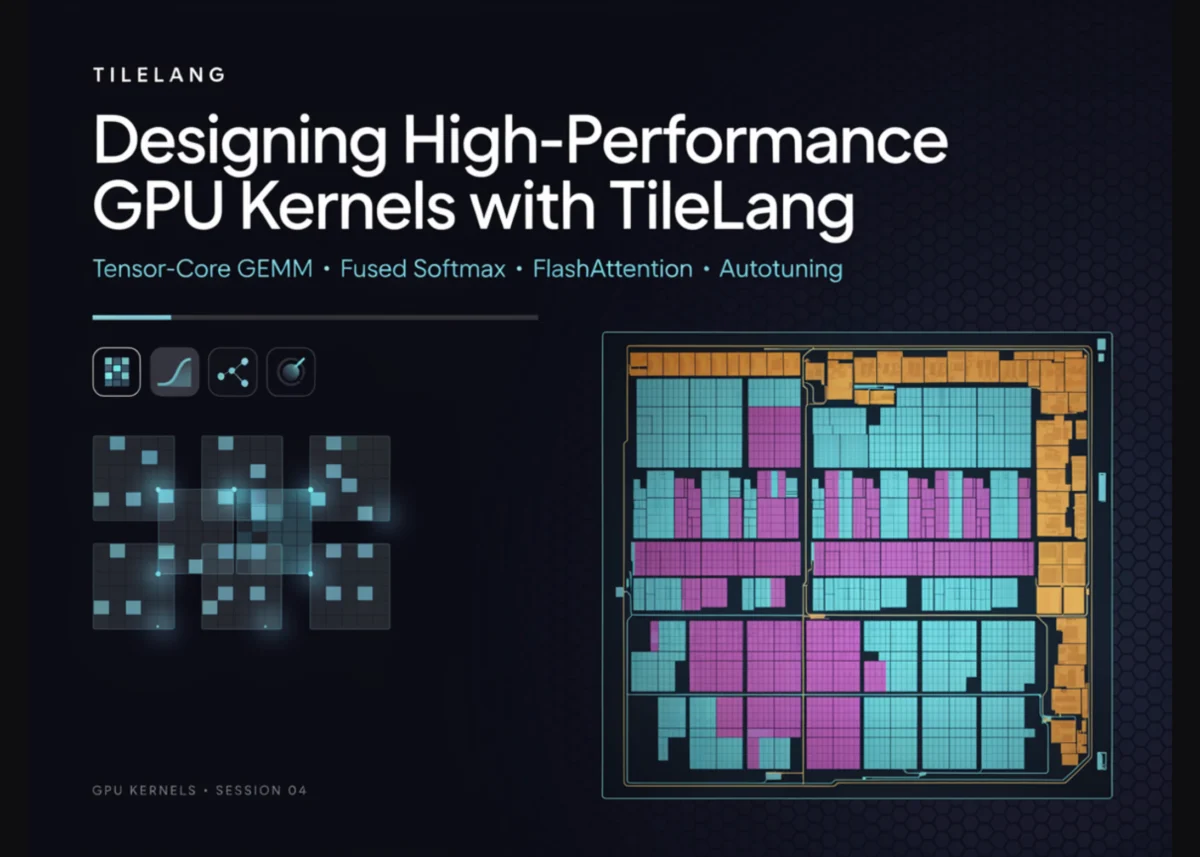
The development of TileLang arrives at a critical juncture in the semiconductor and AI industries. With the proliferation of Large Language Models (LLMs) and generative AI, the efficiency of "kernels"—the fundamental mathematical operations executed on a GPU—directly dictates the cost and speed of both training and inference. Traditionally, achieving peak performance required writing low-level CUDA code, a process that is notoriously time-consuming and error-prone. TileLang changes this paradigm by allowing developers to express complex operations, such as FlashAttention and fused Matrix Multiplications (GEMM), using high-level Python syntax that the compiler then translates into optimized machine instructions.
The Architecture of Tile-Based GPU Programming
At the core of TileLang’s philosophy is the concept of "tiles." In GPU computing, data is processed in blocks to maximize the throughput of the hardware’s parallel architecture. TileLang abstracts these blocks into manageable Python objects, allowing developers to define shared-memory tiles and register fragments without manually calculating pointer offsets or managing volatile memory qualifiers. The compiler manages the underlying hardware complexities, including the orchestration of tensor-core instructions and the implementation of asynchronous memory copies.
The framework’s integration with TVM provides a sophisticated backend that handles code generation for various NVIDIA architectures, from the older Pascal and Volta generations to the modern Ampere (A100) and Hopper (H100) chips. By leveraging TVM’s intermediate representation, TileLang can apply advanced optimizations such as software pipelining, which overlaps memory loads with compute operations to hide latency—a technique essential for achieving the high TFLOP/s (Tera-floating point operations per second) required by modern AI workloads.
Chronology of Kernel Implementation: From Vector Addition to FlashAttention
The implementation workflow within TileLang typically follows a progressive path of complexity, starting with foundational operations and scaling to state-of-the-art neural network components.
1. Foundational Elements and Vector Addition
The journey into TileLang begins with the validation of the CUDA environment. This initial phase ensures that the system’s Compute Capability (SM version) is correctly identified, as different architectures offer varying amounts of shared memory and specialized hardware like Tensor Cores. The "Hello World" of this ecosystem is the vector addition kernel. While a simple operation, it demonstrates TileLang’s ability to handle parallel iteration primitives. In benchmarks, TileLang-generated vector addition kernels consistently match the performance of PyTorch’s native implementations, serving as a baseline for bandwidth-bound operations.
2. Tiled Matrix Multiplication (GEMM)
The transition to compute-intensive tasks involves the implementation of tiled tensor-core matrix multiplication. This is where TileLang’s strengths become evident. By defining block dimensions (e.g., 128x128x32) and using the T.gemm operator, developers can utilize NVIDIA’s Tensor Cores with minimal effort. The compiler automatically handles mma.sync or wgmma instructions depending on the target architecture. Data suggests that these kernels can achieve upwards of 90-95% of the performance of cuBLAS, NVIDIA’s gold-standard math library, while remaining entirely readable and modifiable in Python.
3. Epilogue Fusion and Memory Efficiency
One of the most significant advantages of a DSL like TileLang is the ability to perform "kernel fusion." In standard deep learning frameworks, an operation like GELU(Matrix_Mul + Bias) would typically require three separate GPU kernel launches, with intermediate results being written to and read from High Bandwidth Memory (HBM). This creates a massive memory bottleneck. TileLang allows for "epilogue fusion," where the bias addition and activation function (GELU) are performed while the matrix product is still residing in the GPU’s registers. This eliminates unnecessary HBM traffic, often resulting in speedups of 1.5x to 2x compared to non-fused implementations.
4. Advanced Reductions and Softmax
The implementation of row-wise softmax highlights TileLang’s ability to manage fragment-level reductions. Softmax requires two passes over the data—one to find the maximum value for numerical stability and another to compute the sum of exponentials. TileLang enables these passes to occur within the shared memory and register space, ensuring that the normalization process remains memory-efficient.
5. FlashAttention: The Modern Benchmark
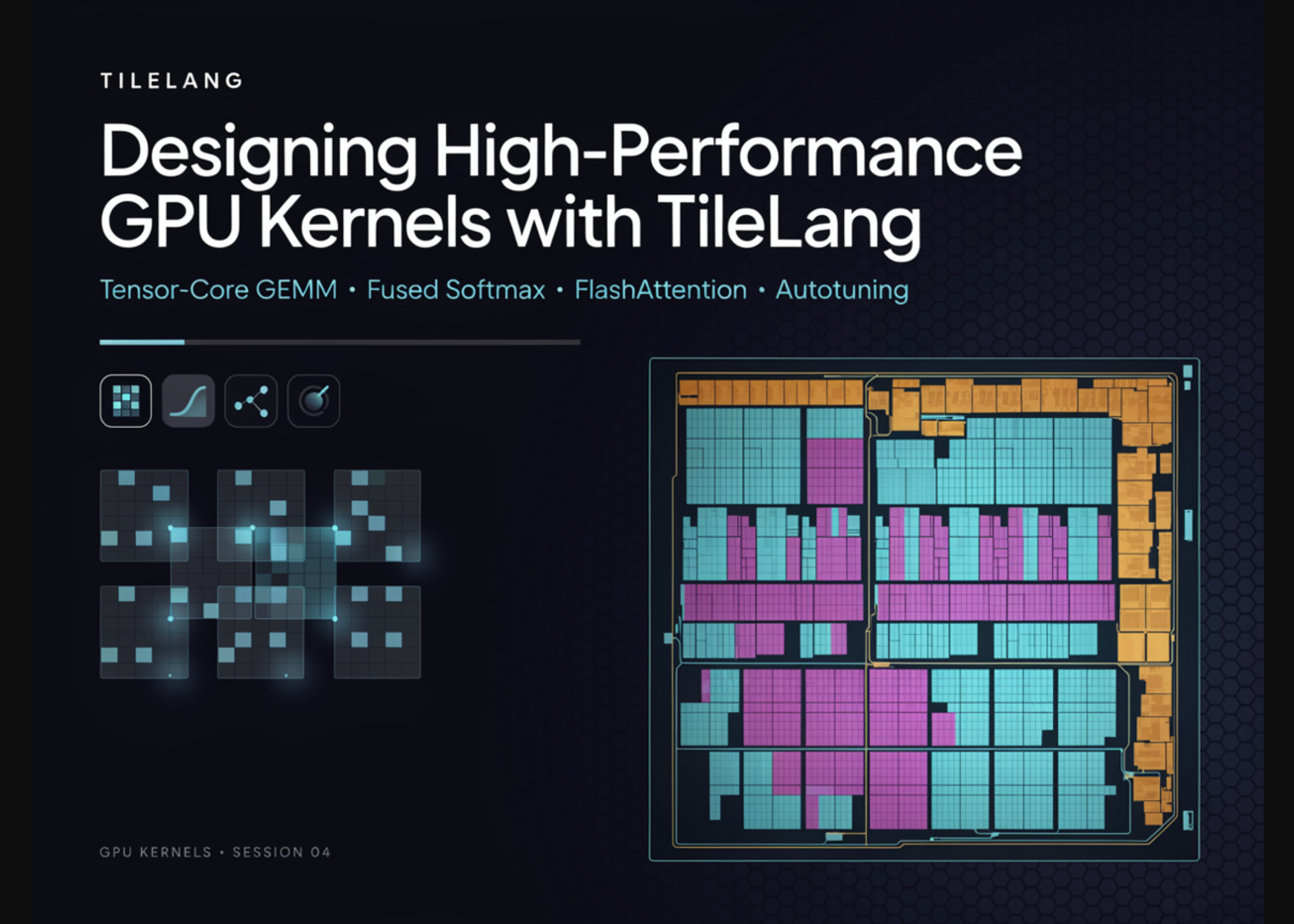
The pinnacle of the TileLang tutorial is the implementation of FlashAttention. This fused attention forward kernel processes query (Q), key (K), and value (V) tiles without materializing the massive $N times N$ attention-score matrix in global memory. By applying online softmax updates and tiled GEMMs, TileLang reduces what would be 500+ lines of complex C++ CUDA code into approximately 70 lines of Python. This implementation supports both causal and non-causal masks, providing performance that is competitive with industry-leading libraries used in production-grade LLMs.
Performance Analysis and Autotuning
A critical feature of TileLang is its integrated autotuning suite. GPU performance is highly dependent on "tuning knobs"—parameters such as block sizes, pipeline stages, and thread counts that must be optimized for specific hardware. A configuration that works perfectly on an A100 may be suboptimal for an H100.
TileLang’s @tilelang.autotune decorator allows the compiler to sweep through a search space of configurations, performing real-world benchmarks on the target hardware to identify the winner. This data-driven approach to optimization ensures that kernels are always running at peak efficiency. In comparative testing, autotuned kernels frequently outperform static configurations by 20% or more, particularly in workloads with non-standard matrix dimensions or complex fusion patterns.
Supporting Data and Technical Benchmarks
In performance evaluations conducted across various GPU architectures, TileLang has demonstrated remarkable efficiency:
- Compute Throughput: In standard GEMM tests (2048x2048x2048), TileLang kernels achieved throughput rates exceeding 100 TFLOP/s on Ampere-class hardware, closely trailing the highly optimized cuBLAS library.
- Memory Bandwidth: For bandwidth-bound kernels like Softmax and Vector Addition, TileLang consistently utilizes over 80% of the theoretical maximum memory bandwidth of the device.
- Development Velocity: The time required to develop and verify a custom fused kernel in TileLang is estimated to be 4x to 5x faster than equivalent development in raw CUDA, significantly lowering the barrier to entry for custom AI hardware acceleration.
Industry Implications and Future Outlook
The rise of TileLang and similar DSLs like OpenAI’s Triton signals a broader trend toward the "Pythonization" of the low-level compute stack. As the AI industry moves toward more specialized model architectures—such as the Multi-head Latent Attention (MLA) used in DeepSeek or the recurrent structures in Mamba—the ability to quickly write and optimize custom kernels becomes a competitive advantage.
From a business perspective, the implications are clear: reduced development time leads to faster product cycles, and more efficient kernels lead to lower cloud computing costs. For organizations managing large-scale GPU clusters, a 10% improvement in kernel efficiency can translate into millions of dollars in saved electricity and hardware depreciation costs over the lifecycle of a model.
Furthermore, TileLang’s introspection tools, such as get_kernel_source() and the built-in profiler, provide a level of transparency that is often missing in "black-box" compilers. Developers can inspect the generated CUDA code to ensure that the compiler is emitting the correct instructions, such as cp.async for asynchronous copies or ldmatrix for loading data into registers. This transparency builds trust and allows for fine-grained debugging in mission-critical environments.
Conclusion
TileLang represents a sophisticated evolution in the tools available to the AI community. By abstracting the complexities of GPU hardware while providing the hooks necessary for extreme optimization, it empowers a broader range of developers to contribute to the high-performance computing ecosystem. As the industry continues to push the boundaries of what is possible with artificial intelligence, tools like TileLang will be at the forefront, ensuring that the software layer can keep pace with the rapid advancements in semiconductor technology. The project’s commitment to open-source accessibility and its integration with the broader TVM and PyTorch ecosystems suggest that it will remain a vital component of the AI infrastructure stack for years to come.