The nearly three-decade-long quest for justice in the murder of hip-hop icon Tupac Shakur reached a pivotal moment on Monday, as a Las Vegas jury delivered a guilty verdict against Duane "Keffe D" Davis. The 63-year-old former leader of the South Side Compton Crips street gang was found guilty of one count of murder with a deadly weapon, marking the first conviction in a cold case that has captivated and mystified fans and investigators since the rap superstar’s death in a drive-by shooting on September 7, 1996. Dressed in a black suit, Davis stood impassively in the Clark County District Court as the verdict was read, later indicating his intention to appeal the decision. The swiftness of the jury’s decision, reached within hours of being handed the case, underscored the weight of the evidence presented by the prosecution, largely centered on Davis’s own admissions over the years.
A Landmark Verdict in a Decades-Old Cold Case
The conviction of Duane "Keffe D" Davis represents a monumental breakthrough in one of America’s most enduring and high-profile cold cases. For nearly 30 years, the murder of Tupac Shakur has fueled countless conspiracy theories, documentaries, and debates, leaving an indelible mark on both pop culture and the criminal justice system. Shakur, who was just 25 at the time of his death, was at the zenith of his career, celebrated for his poetic lyricism, raw authenticity, and groundbreaking albums that sold over 75 million records worldwide. His untimely demise on the Las Vegas Strip left a gaping void in the music industry and an unresolved mystery that many believed would never see a resolution.
The jury’s finding that Davis orchestrated the murder, despite not being the triggerman, is a testament to the prosecution’s strategy. Prosecutors argued that even though Davis did not personally fire the bullets that killed Shakur, he was the mastermind behind the fatal shooting. They contended that he ordered the attack and supplied the weapon to his nephew, Orlando Anderson, who was believed to have pulled the trigger. Anderson, who always denied his involvement, died in an unrelated shooting in 1998, two years after Shakur’s death. This legal approach highlights the principle of accomplice liability, where an individual can be held responsible for a crime if they actively participate in its planning or execution, even without committing the direct act.
During the emotionally charged verdict reading, members of Tupac Shakur’s family, present in the courtroom, held hands, some embracing and openly weeping. Their tears symbolized decades of pain, frustration, and a long-awaited glimmer of closure. The case’s progression from an open secret within certain circles to a criminal conviction underscores the relentless pursuit of justice by law enforcement and the enduring impact of Shakur’s legacy.
The Night of September 7, 1996: A Chronology of Events
To fully grasp the significance of Davis’s conviction, it is crucial to revisit the tumultuous events that culminated in Tupac Shakur’s murder. The backdrop was the intense and often violent East Coast-West Coast hip-hop rivalry, a feud that pitted artists from Death Row Records, led by Suge Knight and featuring Tupac, against Bad Boy Records, headed by Sean "Diddy" Combs and home to The Notorious B.I.G. This rivalry transcended music, spilling into real-life confrontations, public diss tracks, and escalating tensions that would tragically claim the lives of both Shakur and B.I.G.
The East-West Hip-Hop Rivalry: A Volatile Backdrop
By 1996, the rivalry had reached a fever pitch. Tupac Shakur, having recently signed with Death Row Records after his release from prison, became a central figure in the West Coast’s aggressive stance. His album "All Eyez on Me" and numerous diss tracks targeted at East Coast artists intensified the animosity. This period was characterized by lavish lifestyles, gang affiliations, and a pervasive sense of danger that permeated the rap industry. Duane "Keffe D" Davis, as a prominent figure within the South Side Compton Crips, was deeply embedded in the street culture that intersected with the burgeoning gangsta rap scene, providing him with access and motives within this volatile environment.
The MGM Grand Altercation
The chain of events leading directly to Shakur’s murder began on the night of September 7, 1996, in Las Vegas. Shakur, accompanied by Suge Knight, the notorious CEO of Death Row Records, attended a Mike Tyson boxing match at the MGM Grand Garden Arena. After the fight, while in the hotel lobby, Shakur and Knight encountered Orlando Anderson, a known member of the South Side Compton Crips gang. An altercation immediately erupted, with Shakur and members of his entourage physically assaulting Anderson. Surveillance footage from the MGM Grand Hotel captured portions of this beating. The motive for the assault was widely believed to be a prior incident involving Anderson and a Death Row medallion, though details remain debated. This public confrontation, witnessed by numerous people, set the stage for a violent retaliation.
The Drive-By on the Las Vegas Strip
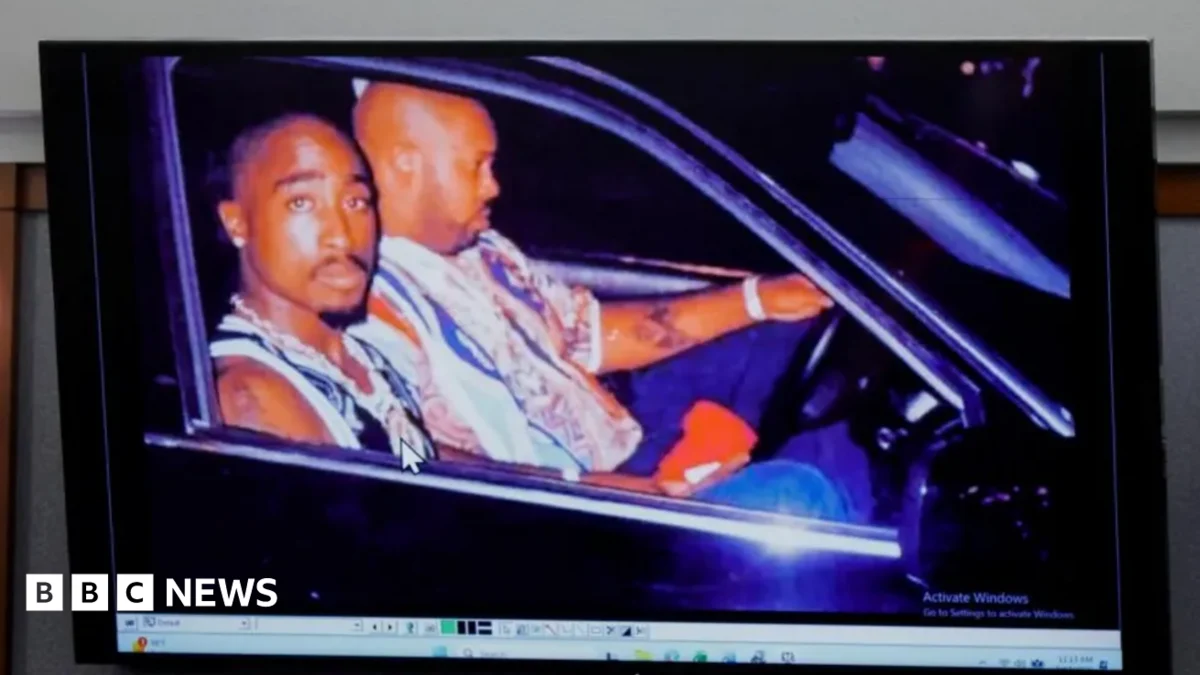
Following the altercation, Shakur and Knight left the MGM Grand. Knight was driving his black 1996 BMW 750iL, with Shakur in the passenger seat. They were part of a larger convoy heading to a party at Club 662, a venue owned by Knight. At approximately 11:15 p.m., while stopped at a red light at the intersection of East Flamingo Road and Koval Lane, a white Cadillac pulled up alongside Knight’s BMW. According to witnesses and later corroborated by Davis’s own admissions, shots were fired from the Cadillac, striking Shakur multiple times. Knight also sustained a minor injury from a bullet fragment.
Shakur was critically wounded, suffering gunshot wounds to his chest, pelvis, right hand, and thigh. Emergency services rushed him to the University Medical Center of Southern Nevada, where he underwent surgery and was placed on life support. Despite the medical team’s efforts, Tupac Amaru Shakur succumbed to his injuries six days later, on September 13, 1996, officially dying from respiratory failure and cardiac arrest. His death sent shockwaves across the globe, solidifying his status as a martyr in the eyes of many fans and deepening the mystery surrounding his killer.
The Investigation’s Long Shadow: Nearly Three Decades of Unanswered Questions
The immediate aftermath of Tupac Shakur’s murder was chaotic. Despite Suge Knight being present and claiming to have seen the assailants, and numerous witnesses to the MGM Grand altercation, the official police investigation struggled to yield concrete results. For years, the case remained cold, plagued by a lack of cooperation from witnesses, the complexities of gang-related violence, and the shadowy nature of the hip-hop world at the time.
Orlando Anderson and the Early Suspicions
From the outset, Orlando Anderson was a prime suspect. His public altercation with Shakur just hours before the shooting provided a clear motive for retaliation. Law enforcement authorities in both Las Vegas and Compton investigated Anderson, and he was questioned multiple times. However, he consistently denied any involvement in Shakur’s murder. Legal action was taken against Anderson, but in a civil rather than criminal context, with Shakur’s mother, Afeni Shakur, filing a wrongful death lawsuit against him. Anderson’s life, however, was also cut short. He was killed in an unrelated gang shooting in Compton in May 1998, taking his denials and any potential direct testimony to his grave. With Anderson’s death, many believed the last credible lead had vanished, consigning the case to perpetual cold status.
Keffe D’s Evolving Narrative: From Confidant to Suspect
The turning point in the investigation came years later, largely through the evolving narrative of Duane "Keffe D" Davis. Davis, as the uncle of Orlando Anderson and a self-proclaimed "on-the-scene commander" for the South Side Compton Crips, had intimate knowledge of the events. Over the years, particularly after the statute of limitations for some crimes had expired, Davis began to speak more openly about his involvement.
In 2008, Davis participated in a police interview where he admitted to being in the white Cadillac from which the shots were fired. He explicitly stated that he did not fire the bullets himself but was present in the vehicle. These admissions, coupled with statements made in interviews for various documentaries and his 2018 memoir, "Compton Street Legend," became central to the prosecution’s case. In his book and public statements, Davis claimed he was given the gun and passed it to the back seat, where he alleged Anderson fired the fatal shots. He consistently maintained that the shooting was an act of retaliation for the beating Anderson suffered at the MGM Grand. While the defense would later argue these statements were mere bravado and exaggeration intended to sell books, prosecutors viewed them as crucial confessions from an insider.
The publication of Davis’s book and his increasingly public pronouncements about the murder reignited interest in the case among law enforcement. Clark County District Attorney Steven Wolfson acknowledged that these admissions, previously dismissed or considered insufficient, became critical when re-evaluated in the context of a renewed investigation. The Las Vegas Metropolitan Police Department dedicated a task force to the case, meticulously reviewing old evidence and re-interviewing witnesses, ultimately leading to Davis’s arrest in September 2023.
The Legal Proceedings: A Case Built on Confession and Conspiracy
The trial of Duane "Keffe D" Davis in Las Vegas drew intense national and international media attention. The prosecution faced the challenge of proving that Davis was not merely a passive observer but an active orchestrator, despite not being the one to pull the trigger.
The Prosecution’s Case: Orchestration and Supply
Prosecutors, led by Steven Wolfson, built their case around Davis’s own words. They presented recordings of his 2008 police interview and excerpts from his memoir, where he detailed his presence in the Cadillac and his role in supplying the firearm. The state argued that Davis, as a gang leader and a figure seeking revenge for his nephew, had the motive, means, and opportunity to coordinate the shooting. They contended that under Nevada law, an individual who aids, abets, or conspires in a murder is equally culpable as the person who commits the direct act. The argument was that Davis’s actions—providing the gun and being present to facilitate the drive-by—constituted murder with a deadly weapon, regardless of whether he pulled the trigger. Prosecutors explicitly stated that the motive was retaliation for the beating of Orlando Anderson at the MGM Grand, a direct link between the earlier altercation and the fatal shooting.
The Defense’s Counter: Bravado and Fabrication
Davis’s defense team, led by attorney Michael Sanft, vehemently challenged the prosecution’s narrative. Their primary strategy was to discredit Davis’s own admissions, portraying them as fabricated stories designed to sensationalize his book and gain notoriety. Sanft urged the jury to view Davis as a liar, a showman who crafted a fictionalized account for financial gain and street credibility, rather than a truthful confessor. He argued that there was "no proof" beyond Davis’s self-serving statements, which he claimed were unreliable and inconsistent. The defense attempted to sow doubt by highlighting the lack of direct physical evidence linking Davis to the shooting, emphasizing that the prosecution relied heavily on a defendant’s self-incriminating, yet later disavowed, narrative.
Despite the defense’s efforts to portray Davis as a fabulist, the jury deliberated for only a few hours before returning a guilty verdict. This swift decision suggests that the jury found Davis’s past admissions, particularly the detailed police interview, to be credible and compelling evidence of his involvement in orchestrating Tupac Shakur’s murder.
Reactions and Implications: Justice Delayed, Not Denied
The verdict in the Duane "Keffe D" Davis trial reverberated across the nation, bringing a sense of finality to a case that has haunted the music world for decades. Clark County District Court Judge Carli Kierny set Davis’s sentencing for October 13, where he faces a minimum of 40 years in prison. District Attorney Steven Wolfson indicated that prosecutors would not seek to add gang enhancements to his sentence, largely due to Davis’s advanced age, but expressed confidence in the strength of their case and the impending sentence. Davis’s immediate declaration of intent to appeal, a common legal maneuver, suggests the legal battle may continue, but the initial conviction stands as a powerful statement.
A Moment of Closure for the Shakur Family
For the family of Tupac Shakur, the verdict represents a profound moment of closure after nearly 30 years of unanswered questions and profound grief. Their presence in the courtroom and their emotional reactions underscored the deep impact of Shakur’s death on their lives. The conviction validates their long wait and the tireless efforts of investigators to bring a measure of justice. While no legal outcome can fully heal the wound of losing a loved one, particularly under such tragic circumstances, the verdict offers a tangible step towards accountability for the crime.
Legal Ramifications and Future Appeals
As expected, Davis’s legal team has already stated their intention to appeal the verdict. Such appeals are standard procedure in high-profile criminal cases and often focus on procedural errors, the admissibility of evidence, or the sufficiency of the evidence presented. The defense is likely to reiterate their arguments regarding the unreliability of Davis’s past statements and the perceived lack of corroborating evidence. However, prosecutors, including Steven Wolfson, have expressed confidence in the robustness of their case and believe the conviction will withstand appellate challenges. The legal proceedings following the sentencing will be closely watched, as they could set precedents for cold cases heavily reliant on a defendant’s self-incriminating statements.
The Enduring Legacy of Tupac Shakur
The conviction of Duane "Keffe D" Davis inevitably refocuses attention on the enduring legacy of Tupac Shakur. Shakur’s music, often confrontational yet deeply reflective, explored themes of racial injustice, poverty, police brutality, and the struggles of inner-city life. His influence extends far beyond hip-hop, impacting literature, film, and social commentary. For many, his murder symbolized the dangers inherent in the volatile intersection of fame, street culture, and systemic issues. This verdict, while bringing legal closure, also serves as a poignant reminder of a talent lost too soon and the profound impact he had on a generation.
Broader Impact on Cold Cases and Hip-Hop History
This landmark conviction carries significant implications for other cold cases, particularly those within the music industry. It demonstrates that even decades after a crime, dedicated investigative efforts, combined with evolving forensic techniques and the eventual willingness of individuals to come forward, can lead to accountability. The success in this case may embolden law enforcement agencies to revisit other long-dormant investigations, including potentially the unsolved murder of The Notorious B.I.G. just six months after Shakur’s death. The verdict also serves as a crucial chapter in the history of hip-hop, offering a definitive legal answer to one of its most enduring mysteries and perhaps beginning to unravel the complex narratives surrounding the violent era of the East-West rivalry. It marks a moment where a deeply entrenched "code of silence" was finally broken, allowing justice, however delayed, to prevail.