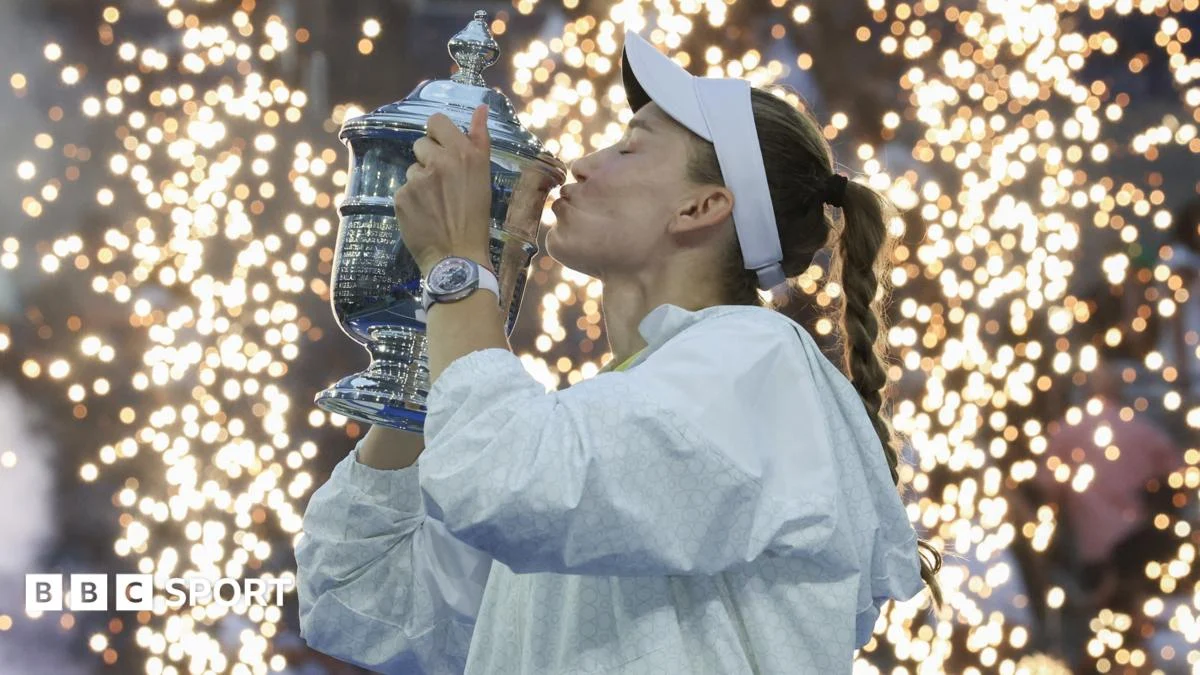
Elena Rybakina has emphatically cemented her status as the world’s premier female tennis player, clinching her maiden US Open title with a commanding victory over two-time defending champion Aryna Sabalenka. The Kazakhstan star, whose ascent to the pinnacle of the sport was already assured prior to the final, celebrated her impending reign as World No. 1 with a hard-fought 6-4, 5-7, 6-2 triumph on the iconic Arthur Ashe Stadium. This latest Grand Slam conquest marks the third major of Rybakina’s burgeoning career, adding the prestigious US Open to her already impressive collection that includes Wimbledon in 2022 and the Australian Open earlier this year.
The championship match, a highly anticipated showdown between two of the game’s most formidable talents, pitted Rybakina’s serene composure against Sabalenka’s explosive power and often tempestuous on-court demeanor. This contrast in personalities, coupled with their shared dedication to aggressive, high-octane tennis, has forged a compelling rivalry that captivated tennis aficionados worldwide. In this particular encounter, it was Rybakina’s unshakeable mental fortitude that proved to be the decisive factor, allowing her to navigate the pressures of a Grand Slam final and overcome the formidable challenge posed by the outgoing World No. 1.
A Masterclass in Composure and Execution
From the outset, Rybakina exhibited a level of poise that belied the significance of the occasion. While her typically potent first serve was not firing at its absolute peak during the opening set, she compensated with a devastating returning game that relentlessly pressured Sabalenka. The Belarusian, despite her reputation for powerful groundstrokes, found herself consistently on the defensive, struggling to contain Rybakina’s deep, penetrating returns. This tactical advantage allowed Rybakina to dictate play and secure the first set with a 6-4 scoreline, a testament to her ability to adapt and excel even when certain aspects of her game were not fully optimized.
The second set witnessed a dramatic shift in momentum. As Rybakina’s level experienced a slight dip, Sabalenka capitalized, unleashing her formidable groundstrokes with greater precision and aggression. The tension escalated, with both players holding serve through a series of closely contested games. Sabalenka, demonstrating the resilience that has characterized her rise to the top of the WTA rankings, eventually broke through in the 12th game. Seizing her third opportunity, she unleashed a fierce onslaught on Rybakina’s second serve, securing the set 7-5 and forcing a decisive third set. The crowd on Arthur Ashe Stadium roared, anticipating a thrilling conclusion to this epic encounter.
However, the third set saw a return to the early-set narrative. The loose shots and signs of frustration that had plagued Sabalenka in the opening exchanges reappeared. Rybakina, sensing the opportunity, intensified her pressure, her deep returns pinning Sabalenka to the baseline. This relentless assault led to a crucial break in the third game, giving Rybakina a 2-1 lead. From this point onwards, the incoming World No. 1 visibly grew in stature and confidence. Her game plan was executed with surgical precision, and the momentum firmly shifted in her favor.
Overcoming Adversity and Doubts
The culmination of Rybakina’s triumph was not without its dramatic moments. Holding a championship point, she faltered with a double fault, momentarily allowing nerves to surface. However, in true champion fashion, she reset immediately, unleashing a powerful ace on the subsequent point to seal her historic victory. The subdued on-court demeanor that Rybakina is known for gave way to a fleeting, yet palpable, smile as she secured her second Grand Slam title of what has been an outstanding 2026 season.
This victory carries particular significance for Rybakina, not only due to the prestige of the US Open but also considering the circumstances leading up to the tournament. Many had not predicted her success in New York, given that she had never advanced beyond the Round of 16 at Flushing Meadows prior to this year. Furthermore, her participation itself was in serious doubt following a severe ankle injury sustained during the Cincinnati Open quarter-finals. Rybakina revealed that she was unable to walk for several days after the incident, casting a shadow over her prospects for the final Grand Slam of the year.
"Some magic is happening," Rybakina shared with Sky Sports after her victory. "I was unlucky with injury and just going day by day. We didn’t know how it was going to be so I’m super happy and still can’t believe it." This testament to her resilience underscores the depth of her achievement, overcoming both physical setbacks and the immense pressure of a Grand Slam final.
Sabalenka’s Persistent Challenge and Near Misses
For Aryna Sabalenka, the US Open final represented an opportunity to not only secure a third consecutive title at Flushing Meadows but also to symbolically reclaim the World No. 1 ranking from the very player who had dethroned her. However, the weight of expectation and the pressure of the occasion appeared to trouble the Belarusian from the early stages of the match. Rybakina’s exceptional return of serve served as a constant irritant, forcing Sabalenka into uncomfortable positions and contributing to unforced errors.
The stress Sabalenka experienced manifested in her second serve, which became increasingly aggressive in an attempt to gain an advantage. It was one such ambitious second serve that ultimately went long on the decisive break point in the opening set, handing Rybakina a crucial early lead. While Sabalenka displayed flashes of the tenacity and fighting spirit that have propelled her to the summit of the sport, she never truly looked at ease throughout the match.
Her emotional outbursts, including shouting, dramatic gestures, and the occasional bounce of her racquet, were attempts to release tension and regain control. However, these displays, while characteristic of her passionate approach, were ultimately insufficient to propel her to the victory that would have been considered one of her finest. This defeat marks Sabalenka’s fifth loss in nine Grand Slam singles finals, a statistic that continues to fuel discussions about her performance at the sport’s most prestigious events, particularly in light of her consistent dominance on the WTA Tour.
Addressing the crowd on Arthur Ashe Stadium, an emotional Sabalenka stated, "The last thing I want to do right now is give a speech but I will try my best. I wish I could have performed a little bit better, but I guess next year." Her words reflected the disappointment of another near miss at a major, a recurring theme in her Grand Slam career.
Rybakina’s Evolving Relationship with New York
Despite her consistent success on the Grand Slam stage, Rybakina’s journey at the US Open had been notably less fruitful than at other majors. Her victory this year marked a significant breakthrough at Flushing Meadows, a tournament where she had previously struggled to advance beyond the early rounds. This success has seemingly altered her perception of the iconic New York venue.
"I was coming here for the last 10 years and it was never successful. I’m falling in love with New York more and more," Rybakina, now 27, remarked, indicating a newfound appreciation for the city and its tournament. This sentiment suggests a potential shift in her mindset and approach to playing on the hard courts of the USTA Billie Jean King National Tennis Center.
The Tactical Battle and Future Implications
Rybakina’s game, characterized by a penetrating serve and thunderous groundstrokes, embodies a potent brand of first-strike tennis capable of overwhelming any opponent. Her ability to dictate play from the baseline and consistently land winners was a significant factor in her triumph. The tactical battle unfolded as Rybakina aimed to neutralize Sabalenka’s powerful serves and exploit any perceived weaknesses in her court positioning. Her deep returns not only set up offensive opportunities but also forced Sabalenka into extended rallies, where Rybakina’s consistency often proved superior.
The impact of this victory extends beyond the immediate prize money and ranking points. Rybakina’s US Open title, combined with her previous Grand Slam successes, solidifies her position as a dominant force in women’s tennis. Her ability to perform at her best on the biggest stages, even when facing physical challenges, speaks volumes about her mental strength and dedication.
With this US Open title, Rybakina is now just one Grand Slam away from completing a career Grand Slam, with only the French Open remaining. Her consistent performances across all surfaces suggest that this is a realistic aspiration for the Kazakhstani star.
A New Era in Women’s Tennis
The 2026 season has been a remarkable one for Elena Rybakina. Her ability to navigate a challenging draw, overcome an injury, and defeat the reigning World No. 1 in a Grand Slam final underscores her growth as a player. The implications of her US Open triumph are significant for the landscape of women’s tennis. She has not only claimed a major title but has also ascended to the World No. 1 ranking, signaling a potential shift in the sport’s hierarchy.
Her calm demeanor, strategic prowess, and unwavering focus on the court have set her apart. While Sabalenka will undoubtedly regroup and aim to reclaim her top ranking, Rybakina has made a powerful statement with her US Open victory. The rivalry between these two exceptional athletes is poised to continue to captivate audiences, with each player pushing the other to new heights. The future of women’s tennis appears to be in capable hands, with Rybakina leading the charge as the undisputed queen of the court.