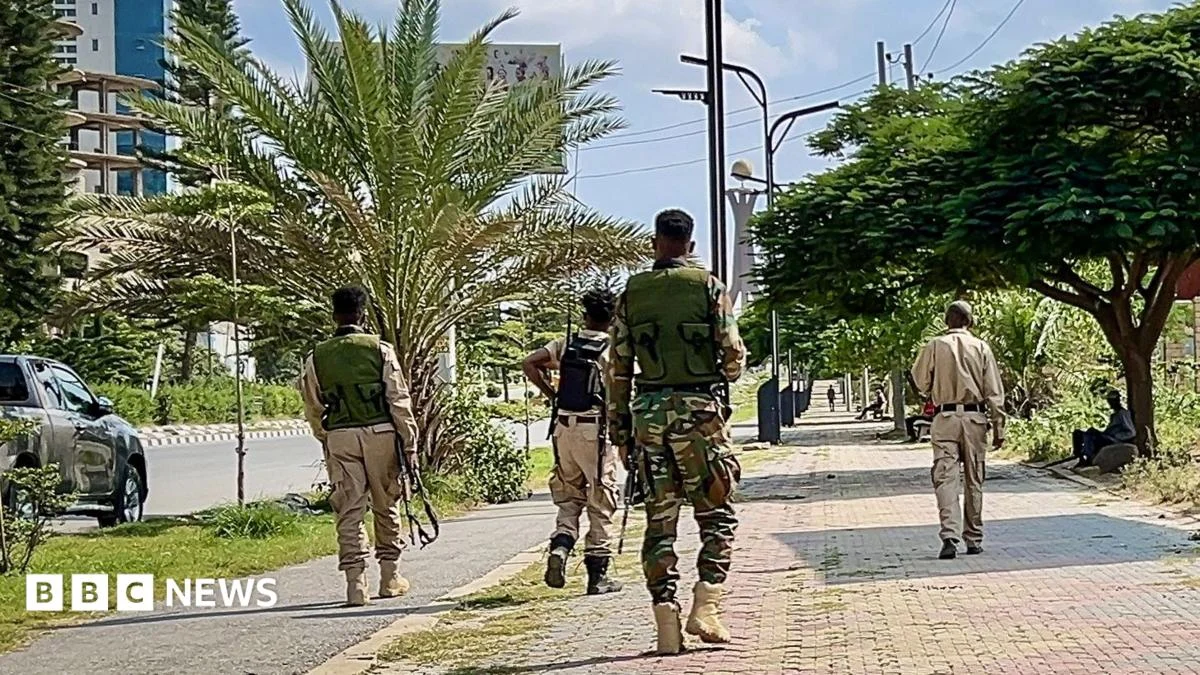
Ethiopia’s fragile peace, painstakingly brokered after a devastating two-year conflict, has been shattered as both the federal government in Addis Ababa and the Tigray People’s Liberation Front (TPLF), the ruling party of the northern Tigray region, have accused each other of launching wide-ranging offensives. This alarming escalation has ignited profound fears of a full-scale return to the brutal civil war that ravaged the country and its people between late 2020 and late 2022, a conflict estimated to have claimed hundreds of thousands of lives and pushed millions to the brink of famine. The renewed hostilities mark a critical setback for stability in the volatile Horn of Africa, drawing immediate condemnation and urgent calls for de-escalation from international bodies and diplomatic missions.
Accusations and Counter-Accusations Mark Renewed Hostilities
The recent surge in tensions reached a critical point with a flurry of mutual accusations. Getachew Reda, a cabinet minister and senior advisor to Ethiopian Prime Minister Abiy Ahmed, made serious allegations, stating that Tigrayan forces had seized control of federally administered airports within Tigray and initiated offensives into the neighbouring Afar and Amhara regions. In a statement shared across social media platforms, Getachew expressed profound dismay, noting, "It is rather heartbreaking to learn that, despite efforts by many, including the international community, to avoid yet another round of war in Tigray, the TPLF leadership early this morning launched an all-out offensive against government positions in Afar and Amhara." This assertion painted the TPLF as the aggressor, deliberately undermining ongoing peace efforts. Getachew Reda himself has a complex history, having previously led Tigray’s interim administration before falling out with the TPLF in 2025 and subsequently aligning with the federal government.
Conversely, the Tigrayan authorities presented a different narrative, asserting that their forces had been compelled to enter a "defensive war." This declaration from Mekelle, the capital of Tigray, followed a series of reports detailing drone strikes within the region. On Wednesday, Tigrayan authorities explicitly accused Addis Ababa of initiating an "open invasion" of the region, urging its populace to rally behind regional forces and maintain unity in the face of perceived federal aggression. They further alleged that the federal government was in violation of international humanitarian and human rights laws, citing widespread disruptions to public services and critical infrastructure as evidence of the ongoing conflict’s impact. These conflicting accounts underscore the deep-seated mistrust and irreconcilable narratives that continue to fuel the animosity between the two parties, making impartial verification incredibly challenging amidst the fog of war.
The Shadow of a Devastating Past: The 2020-2022 Conflict
The current crisis unfolds against the backdrop of one of the 21st century’s deadliest conflicts. The war, which officially began in November 2020, pitted the Ethiopian federal government and its allies, including Eritrean forces, against the TPLF. The roots of the conflict are multifaceted, stemming from decades of political dominance by the TPLF as the leading faction of the Ethiopian People’s Revolutionary Democratic Front (EPRDF) coalition, which governed Ethiopia for nearly three decades until 2018. When Abiy Ahmed came to power in 2018, initiating sweeping political reforms and dissolving the EPRDF into the new Prosperity Party, the TPLF refused to join, feeling increasingly marginalized and perceiving Abiy’s centralizing reforms as an assault on Ethiopia’s federal structure and their regional autonomy.
Tensions escalated dramatically in September 2020 when Tigray held regional elections, which the federal government declared illegal. The flashpoint came in November 2020 with an alleged attack by Tigrayan forces on a federal military base in Tigray, prompting Prime Minister Abiy to launch a "law enforcement operation." What followed was a brutal two-year conflict marked by widespread human rights abuses, massacres, sexual violence, and the systematic destruction of infrastructure. The African Union’s mediator for the conflict estimated a staggering death toll of some 600,000 people, though precise figures remain elusive. The fighting drove the Tigray region to the precipice of famine, with millions displaced internally and across borders, and humanitarian aid access severely restricted for extended periods, creating one of the world’s most severe humanitarian crises.
The Fragile Peace and Its Unravelling: The Pretoria Agreement
The two-year war officially concluded with the signing of the Pretoria Agreement in November 2022, an African Union-brokered deal hailed as a monumental step towards peace. Key provisions of the agreement included a permanent cessation of hostilities, disarmament of TPLF fighters, restoration of federal authority in Tigray, unfettered humanitarian access, withdrawal of non-ENDF (Ethiopian National Defense Force) forces from Tigray, and the establishment of an interim regional administration. The accord also outlined pathways for transitional justice and accountability.
However, the implementation of the Pretoria Agreement has been fraught with challenges and delays, leading to persistent accusations of violations from both sides. Critical aspects, such as the full disarmament of Tigrayan forces and the complete withdrawal of Eritrean troops, have been slow or incomplete. Disputes over contested territories, particularly the fertile Western Tigray (also known as Welkait), have remained unresolved, serving as a constant source of friction. Furthermore, while humanitarian access improved significantly post-agreement, it has not been entirely consistent, and the restoration of essential services like banking and telecommunications to Tigray has been agonizingly slow for many residents.
In July, Prime Minister Abiy Ahmed publicly accused the TPLF of preparing for renewed conflict during an address to parliament, indicating the deep mistrust that persisted. Just prior to the general election in May (which was not held in Tigray due to the security situation), the TPLF restored its pre-war administration, effectively disbanding an interim one that Abiy had appointed, a move seen by Addis Ababa as a direct challenge to the peace agreement’s spirit. Reports of the TPLF forcibly recruiting young men into its ranks have also circulated, further fueling federal government concerns about their intentions. These unresolved issues and simmering grievances created a volatile environment where the peace deal remained precariously balanced.
Timeline of Escalation: Recent Days of Renewed Conflict
The current escalation has unfolded rapidly over recent days:
- Sunday: The Tigray People’s Liberation Front (TPLF) announced a significant development: an alliance with six other armed groups across Ethiopia. The stated objective of this new coalition is to remove the federal government in Addis Ababa, a declaration that sent shockwaves through the political landscape and was perceived by the federal government as a direct threat to national sovereignty.
- Monday: The US State Department’s Bureau of African Affairs condemned a separate drone strike that reportedly targeted a convoy of Catholic vehicles carrying vital food aid. This incident highlighted the immediate humanitarian risks posed by renewed hostilities, prompting calls for an investigation and urging all parties to prioritize civilian protection.
- Tuesday: A devastating strike in the southern Tigrayan town of Alamata resulted in at least 14 fatalities and 22 injuries, according to Tigrayan authorities. Mogos Shiferaw, the town’s mayor, provided a harrowing account to the BBC, stating that more than five drones and one fighter jet conducted over 21 strikes starting around 03:30 local time. He emphasized the profound "psychological trauma" inflicted on the community and accused federal forces of targeting two secondary schools, which he believed were struck on suspicion of being used by Tigrayan forces. The mayor asserted that all those killed and injured were civilians and that the schools, though previously used as federal military bases during the civil war, were currently unoccupied as the academic year had not yet commenced. The BBC noted it had not independently verified these allegations, and the Ethiopian government has not yet commented on the alleged strikes.
- Wednesday: Tigrayan authorities reported that their forces had been compelled into a "defensive war," following reports of drone strikes in Tigray. Concurrently, residents of Mekelle, Tigray’s main city, informed the BBC that local forces had seized control of the city’s airport from the national police early on Wednesday. This development led Ethiopian Airlines to cancel all flights to Tigray, effectively cutting off crucial air links to the region. Getachew Reda’s subsequent statement accusing the TPLF of launching an "all-out offensive" against federal positions in Afar and Amhara further solidified the narrative of widespread renewed conflict.
International Reactions and Urgent Calls for De-escalation
The rapid deterioration of the situation has drawn immediate and concerned reactions from the international community. Mahmoud Ali Youssouf, the chairperson of the African Union Commission, issued an urgent call for an "immediate de-escalation" of hostilities, imploring both sides to resume talks and uphold the commitments made in the Pretoria Agreement. The AU, having played a pivotal role in mediating the peace deal, views the renewed conflict as a direct threat to its diplomatic efforts and regional stability.
The United States, a key international actor and aid provider to Ethiopia, also weighed in critically. The US ambassador to Ethiopia condemned the TPLF for making "the poor decision to launch a large-scale offensive," describing it as an "unwinnable fight." This strong statement indicates a clear alignment of US concerns regarding the TPLF’s actions. Separately, the US State Department’s Bureau of African Affairs specifically condemned the drone strike on the Catholic aid convoy on Monday, calling for a thorough investigation and urging all parties to resolve their differences through dialogue, while taking concrete steps to prevent similar incidents that endanger humanitarian operations. Ethiopian President Taye Astike Selassie, speaking at the UN General Assembly amidst the rising tensions, asserted that his country had shown "immense restraint" despite "interference in our internal affairs by adversarial elements," without explicitly naming those elements. He concluded with a stark warning: "Our message to forces of destruction and mayhem is loud and clear. We urge them to respect the sacred right of the people of the Horn of Africa to live in peace and prosperity."
Broader Impact and Grave Implications
The resumption of widespread fighting carries severe implications for Ethiopia, the Horn of Africa, and the international humanitarian community.
Humanitarian Catastrophe: The most immediate and tragic consequence will be a deepening of the humanitarian crisis. Millions in Tigray, Afar, and Amhara are already food insecure and reliant on aid. Renewed conflict will inevitably disrupt humanitarian access, exacerbate displacement, and push more people into famine-like conditions. The targeting of aid convoys and infrastructure, as alleged in recent days, points to a grim future for civilian populations caught in the crossfire.
Regional Instability: Ethiopia is a cornerstone of stability in the Horn of Africa. A full-blown civil war would destabilize the entire region, potentially drawing in neighboring countries like Eritrea, which has historically played a significant, albeit often opaque, role in the Tigray conflict. The alliance formed by the TPLF with other armed groups also raises the specter of a wider national conflict, further complicating the already fragile security landscape.
Erosion of Trust and Peace Prospects: The current escalation severely damages the credibility and viability of the Pretoria Agreement. The trust between the federal government and the TPLF, always tenuous, is now profoundly eroded. Rebuilding a path to peace will be significantly more challenging, requiring renewed and robust diplomatic efforts from the African Union and other international partners.
Economic Devastation: Ethiopia’s economy, already struggling with inflation, debt, and the lingering effects of the previous conflict, will face further setbacks. Foreign investment will shy away, and crucial development aid may be jeopardized, further impoverishing a nation already facing immense challenges.
Political Fragmentation: The TPLF’s new alliance with other armed groups to remove the government in Addis Ababa suggests a move beyond regional autonomy towards a broader challenge to Abiy Ahmed’s authority. This could lead to a protracted period of political instability and potentially even national fragmentation, threatening the very fabric of the Ethiopian state.
As the accusations fly and the sound of conflict echoes once more, the hopes for a lasting peace in Ethiopia appear to be fading rapidly. The international community faces a critical challenge to exert maximum pressure on all parties to de-escalate, uphold the principles of the Pretoria Agreement, and prioritize the lives and well-being of millions of vulnerable civilians. The lessons of the recent past underscore the catastrophic human cost of inaction and the urgent necessity for a return to dialogue over violence.