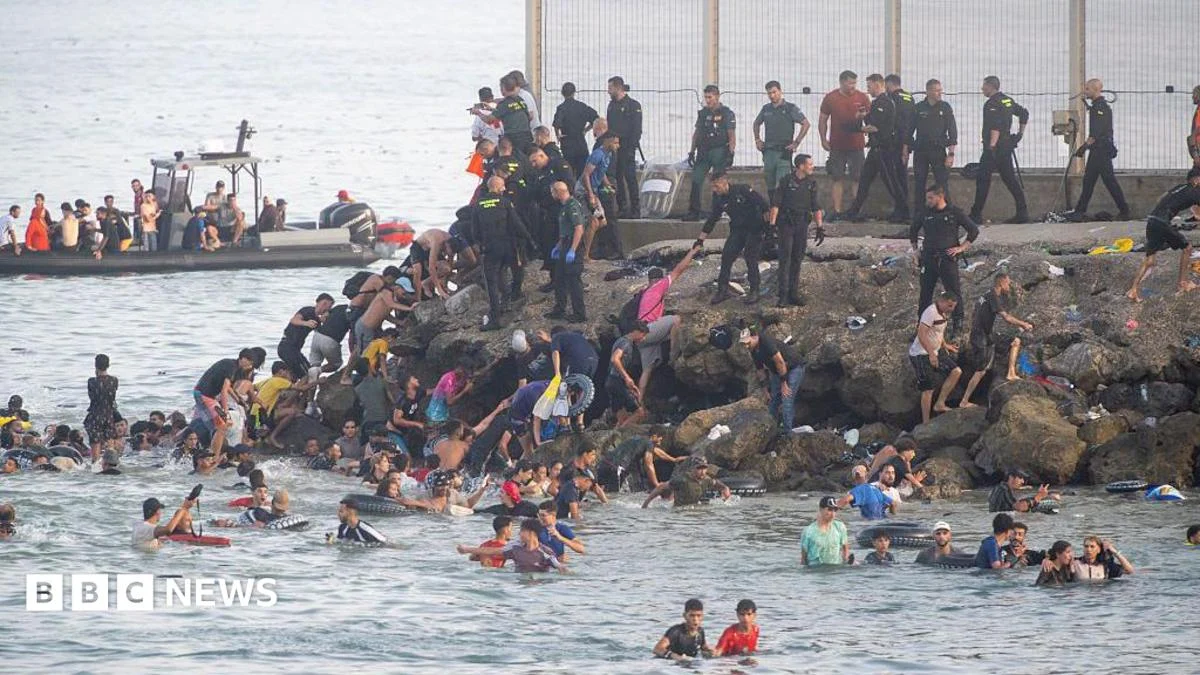
European Commission President Ursula von der Leyen has called for "united action" on border security following the unprecedented and chaotic influx of tens of thousands of migrants from Morocco into the Spanish exclave of Ceuta. The incident, which unfolded rapidly over several days, has not only tested Spain’s immediate response capabilities but has also ignited a contentious debate within the European Union regarding external border management, intra-bloc solidarity, and the future integrity of the Schengen Area. The crisis, characterized by harrowing scenes of individuals, including many minors, attempting to scale fences or swim into Spanish territory, underscored the volatile intersection of geopolitical tensions and humanitarian challenges at Europe’s southern frontier.
The Unprecedented Influx: A Chronology of Events
The dramatic events in Ceuta began to escalate significantly on Monday, May 17th. Over a period of just 48 hours, an estimated 8,000 to 10,000 individuals, predominantly young men but also entire families and unaccompanied minors, surged across the border from Morocco into Ceuta. The sheer volume overwhelmed local Spanish border defenses, which typically manage a steady but much smaller flow of irregular migration.
- Monday, May 17th: Spanish authorities first observed an unusual relaxation of border controls on the Moroccan side near the Tarajal beach crossing point. This perceived inaction by Moroccan border forces allowed thousands of migrants to pour into Ceuta, either by scaling the double border fence or by swimming around the breakwaters that delineate the maritime boundary. Initial estimates suggested several thousand had crossed by nightfall. The Spanish Guardia Civil and army were quickly deployed to reinforce the border.
- Tuesday, May 18th: The influx continued unabated, reaching its peak. Videos and images widely circulated showed continuous streams of people, some using inflatable dinghies, others simply swimming, reaching the shores of Ceuta. Spanish forces, including military personnel, were seen intervening to prevent crossings and to facilitate the return of those who had already entered. The humanitarian situation quickly deteriorated, with aid agencies struggling to provide basic necessities. The death toll began to mount as some individuals drowned during the perilous swim.
- Wednesday, May 19th: Spain intensified its efforts to return migrants, with Spanish Prime Minister Pedro Sánchez making an emergency visit to Ceuta. He reaffirmed Spain’s commitment to defending its borders and announced the deployment of additional military units. Return operations, facilitated by an existing bilateral agreement between Spain and Morocco, commenced swiftly.
- Thursday, May 20th and onward: The situation on the border gradually stabilized as Moroccan authorities, under international pressure, began to reassert control on their side. Spain continued its process of returning migrants, reporting high success rates.
Spain estimates that approximately 6,950 individuals have now been returned to Morocco, exceeding initial projections of 5,000. This rapid repatriation effort, while effective in reducing the numbers within Ceuta, also raised questions from human rights organizations regarding due process, particularly for unaccompanied minors. The official death toll on the Spanish side of the border stands at 72, with 11 deaths reported on the Moroccan side, a grim testament to the dangers faced by those attempting the crossing.
Background Context: Ceuta, Migration, and Diplomatic Tensions
Ceuta, along with Melilla, are two Spanish autonomous cities located on the northern coast of Africa, bordering Morocco. These enclaves represent the European Union’s only land borders with an African nation, making them critical flashpoints for irregular migration. For decades, they have been magnets for migrants from sub-Saharan Africa and North Africa seeking to enter Europe, often attempting to scale formidable border fences or swim around coastal defenses.
The recent crisis, however, differed significantly in scale and apparent motivation from previous migration surges. Historically, migration attempts into Ceuta and Melilla have often involved smaller, organized groups. The sheer number of individuals, many seemingly unhindered by Moroccan authorities for a period, suggested a more complex underlying dynamic.
The immediate trigger for Morocco’s apparent relaxation of border controls was widely attributed to a diplomatic spat between Rabat and Madrid. Spain had provided medical treatment to Brahim Ghali, the leader of the Polisario Front, a Western Sahara independence movement that Morocco considers a terrorist organization. Ghali was admitted to a Spanish hospital in April under a false identity due to a severe COVID-19 infection. Morocco viewed Spain’s actions as a hostile gesture and a breach of trust, particularly given the long-standing dispute over Western Sahara, a territory Morocco claims as its own. Rabat’s perceived inaction at the Ceuta border was interpreted by many analysts as a form of diplomatic pressure or retaliation against Spain, leveraging migration as a geopolitical tool. This phenomenon, often referred to as "hybrid warfare" or the "weaponization of migration," involves using migratory flows to exert political pressure on neighboring states.
Spain and Morocco have a complex, often fraught, relationship. While they cooperate extensively on counter-terrorism and migration control, their historical ties and competing interests in North Africa, particularly concerning Western Sahara, frequently lead to friction. Morocco receives significant financial support from the EU, much of it earmarked for border management, underscoring its role as a crucial partner in controlling migratory flows into Europe.
Furthermore, a recent decision by the Spanish Supreme Court complicated the government’s ability to immediately deport individuals arriving by sea, a point highlighted by Prime Minister Sánchez. He accused migrant traffickers of exploiting this legal constraint, though the primary driver of the Ceuta crisis appeared to be geopolitical rather than purely opportunistic smuggling.
EU’s Immediate Response and Deepening Divisions
The scenes in Ceuta sent shockwaves across Europe, prompting an immediate response from Brussels and exposing underlying tensions among EU member states regarding migration policy. European Commission President Ursula von der Leyen was swift to offer solidarity to Spain. In a letter to Spanish Prime Minister Pedro Sánchez, she praised his "swift handling" of the crisis but crucially added, "From this incident, it is clear that we must do more to further strengthen our borders at critical points." Her call for "united action" on border security underscored the EU’s recognition of the challenge as a shared European responsibility, not merely a Spanish one.
On Tuesday, EU interior ministers convened emergency talks via video conference to discuss the issue. The meeting was intended to draw "lessons" from the Ceuta episode and strategize a "common European response, united action and solidarity" to the challenges of illegal immigration. Von der Leyen urged the EU to "double down" in five critical areas:
- Preventing irregular migration in the first place: Through enhanced cooperation with partner states, particularly those in North Africa and the Sahel.
- Strengthening external borders: Investing in physical barriers, surveillance technology, and increased personnel.
- Implementing early warning systems: To better anticipate and respond to sudden migratory surges.
- Dismantling smuggling networks: Intensifying efforts against human traffickers.
- Reinforcing returns: Streamlining the process of returning individuals who do not qualify for asylum.
However, the crisis also laid bare deep divisions within the EU. While many member states expressed solidarity with Spain, others voiced concerns that directly challenged the principles of free movement within the Schengen Area. Italy, for instance, temporarily suspended the Schengen arrangement with Spain, citing security concerns related to the Ceuta influx. This move was quickly backed by Finland and Denmark. More strikingly, Czech Prime Minister Andrej Babiš urged a temporary suspension of Spain’s Schengen membership altogether, arguing that Spain had failed to adequately protect the EU’s external border.
In response, Prime Minister Sánchez expressed "serious concerns" about the reactions of some European governments. He pointed out that Ceuta, despite being Spanish territory, is not part of the Schengen Area, meaning that migrants arriving there do not automatically gain access to the broader EU free-movement zone. He argued that while most European partners had shown "support and solidarity," others had chosen to attack Spain, "driven by prejudice, fake news, ignorance, or political interest." His comments highlighted the persistent struggle within the EU to forge a cohesive and empathetic approach to migration, often marred by national political agendas and differing interpretations of shared responsibility.
Broader Impact and Implications for Schengen
The Schengen Agreement, a cornerstone of European integration, eliminates border checks for over 450 million people across 29 European countries. It represents a fundamental freedom within the EU, allowing citizens and residents to move freely without internal passport controls. The temporary suspension by Italy and calls for further restrictions by other member states underscore the fragility of this agreement when faced with perceived threats to external border security.
The Ceuta crisis reignited the long-standing debate about the balance between national sovereignty and collective European security. Critics of the Schengen system argue that without robust external border controls, internal free movement becomes untenable. Proponents, however, contend that unilateral actions to suspend Schengen undermine the very principles of solidarity and cooperation that define the European project. The incident amplified calls for a more unified and centrally managed EU border force, potentially expanding the mandate and resources of agencies like Frontex, the European Border and Coast Guard Agency.
Beyond Schengen, the crisis has significant implications for EU-Morocco relations. Morocco is a critical partner for the EU in migration management, counter-terrorism, and trade. The perceived "weaponization" of migration by Morocco risks undermining trust and future cooperation. While diplomatic channels are working to repair the damage, the incident serves as a stark reminder of the leverage that non-EU countries can wield over the bloc through migration flows. The EU’s migration pact, currently under negotiation, aims to establish a more predictable and equitable framework for asylum and migration, including stronger partnerships with third countries. The Ceuta events will undoubtedly add urgency and shape the final contours of this pact, particularly concerning external border management and return mechanisms.
The humanitarian dimension of the crisis also cannot be overlooked. The presence of thousands of unaccompanied minors, some as young as seven, among the migrants raised profound ethical and legal questions about their protection and care. International law dictates that children, regardless of their migratory status, are entitled to special protection. Spain faced the immediate challenge of identifying, sheltering, and caring for these vulnerable individuals, many of whom arrived traumatized and in need of medical attention.
Looking Ahead: A Test of European Solidarity
The Ceuta crisis is more than a localized border incident; it is a profound test of European solidarity, its external border policy, and its diplomatic prowess. The immediate focus remains on stabilizing the situation in Ceuta, ensuring the humane treatment of all individuals, and repatriating those without legal grounds to remain, while upholding international obligations, particularly for minors.
In the long term, the EU faces the daunting task of strengthening its external borders without compromising humanitarian principles or undermining internal freedoms. This requires not only physical barriers and enhanced surveillance but also robust diplomatic engagement with key transit countries like Morocco. The incident highlights the need for a comprehensive EU migration strategy that addresses the root causes of irregular migration, fosters sustainable development in origin countries, combats human trafficking, and ensures a fair and efficient asylum system. The lessons drawn from Ceuta will inevitably shape the future of EU migration policy, influencing discussions on funding for border infrastructure, the role of Frontex, and the delicate balance between security and human rights at Europe’s periphery. The path forward demands unity, pragmatism, and a shared understanding that the challenges at Europe’s borders are, in essence, shared European challenges.