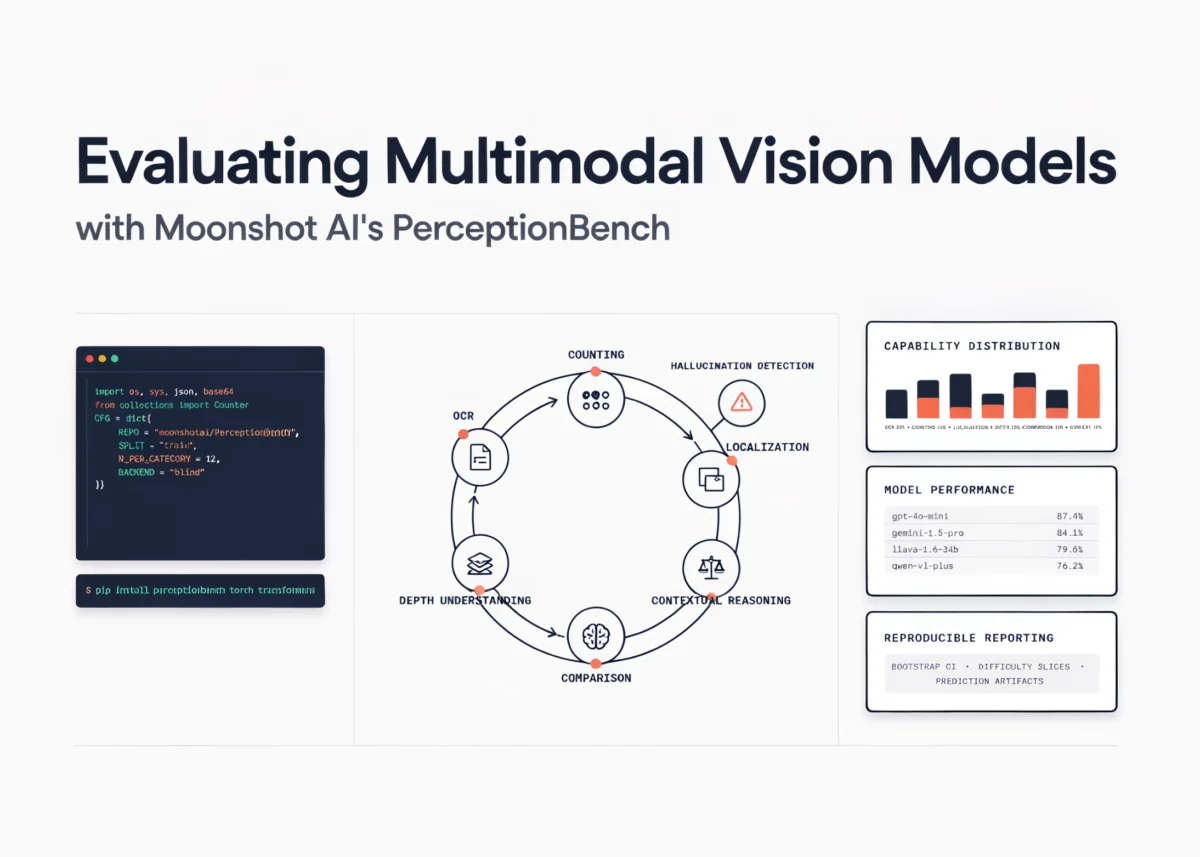
The rapid evolution of Multimodal Large Language Models (MLLMs) has necessitated the development of more rigorous evaluation frameworks to measure their actual "perceptive" capabilities versus their ability to guess based on linguistic priors. PerceptionBench, a benchmark recently introduced by Moonshot AI, represents a significant step forward in this domain, providing a granular assessment of how vision-language models interpret complex visual data. Unlike previous benchmarks that focused on general image captioning or high-level scene recognition, PerceptionBench isolates ten specific atomic capabilities, ranging from optical character recognition (OCR) and counting to depth understanding and hallucination detection. This technical evolution marks a transition from testing AI on what it "sees" to testing what it "understands" about the spatial and contextual relationships within an image.
The Evolution of Multimodal Evaluation
The current landscape of artificial intelligence is increasingly defined by the integration of multiple modalities, where models must process text, images, and sometimes video or audio simultaneously. However, researchers have long noted a discrepancy between a model’s performance on standard benchmarks and its utility in real-world applications. This gap is often attributed to "hallucinations"—where a model confidently describes elements not present in an image—or a reliance on linguistic shortcuts. For instance, if a model is asked how many wheels are on a car, it may answer "four" based on textual knowledge rather than actually counting the wheels in the provided photograph.
PerceptionBench addresses these shortcomings by constructing a dataset of 3,000 high-quality examples designed to challenge the limits of fine-grained visual perception. The benchmark is divided into 40% newly authored content and 60% decomposed examples from existing datasets, ensuring a mix of fresh challenges and established baseline comparisons. The objective is to provide a reproducible and modular workflow that allows developers to stress-test their models across a variety of hardware environments, from local GPU-accelerated setups to cloud-based API integrations.
Technical Architecture and Implementation Workflow
The implementation of an end-to-end evaluation for PerceptionBench involves a multi-stage technical workflow designed for reproducibility and robustness. The process begins with the configuration of a compatible environment, typically utilizing Google Colab or a local Python-based ecosystem. This setup requires the installation of specialized libraries, including datasets for streaming large-scale visual data, Pillow for image manipulation, and transformers for hosting local vision-language models (VLMs).
A critical component of this workflow is the resilient data loading strategy. Given the high memory requirements of multimodal datasets—the PerceptionBench corpus is approximately 1.63 GB—the evaluation harness employs a multi-stage streaming approach. It first attempts to stream converted Parquet shards to minimize latency and memory overhead. If streaming is unavailable, the system falls back to downloading original data files. This ensures that the evaluation can proceed even under constrained network conditions.
Once the data is ingested, the system performs complex image decoding and normalization. PerceptionBench examples often include interleaved images and text, requiring the parser to identify image placeholders (e.g., <|image_1|>) and map them to their corresponding visual assets. Images are decoded from various formats, including base64-encoded strings and data URIs, and then normalized into a consistent RGB format. To manage the computational "token bill" associated with high-resolution images, the framework includes downscaling utilities that resize images while maintaining aspect ratios, preventing a single 3000-pixel screenshot from consuming an excessive amount of vision tokens.
Categorization of the Ten Atomic Capabilities
The core of PerceptionBench lies in its stratification of visual tasks. By isolating specific capabilities, the benchmark provides a "capability profile" for each model, revealing strengths and weaknesses that an overall accuracy score would otherwise obscure. These ten categories include:
- OCR (Optical Character Recognition): Measuring the ability to extract and interpret text from complex backgrounds, including handwriting and stylized fonts.
- Counting: Testing the model’s ability to identify and enumerate multiple instances of the same object within a scene.
- Localization: Requiring the model to identify the specific coordinates or relative positions of objects.
- Contextual Reasoning: Assessing how well a model integrates visual cues with external knowledge to reach a conclusion.
- Comparison: Challenging the model to find similarities or differences between two or more objects or images.
- Depth and 3D Understanding: Evaluating the model’s grasp of spatial perspective and the three-dimensional nature of physical objects.
- Attribute Recognition: Focusing on the specific characteristics of objects, such as color, texture, or material.
- Visual Relation: Determining how objects interact with one another (e.g., "the cup is on the left of the plate").
- Fine-Grained Recognition: Testing the ability to distinguish between very similar sub-categories of objects.
- Perception Hallucination Detection: Specifically designed to catch instances where models "see" things that are not there, often by providing deceptive prompts.
The Role of the Blind-Prior Baseline
One of the most innovative aspects of the PerceptionBench evaluation workflow is the inclusion of a "Blind-Prior" backend. This serves as a control condition where the model is provided with the question and any textual hints but is denied access to the actual pixels of the image.
The significance of this baseline cannot be overstated. If a vision-language model achieves an accuracy of 55% on a counting task, but the Blind-Prior baseline (which is essentially guessing based on common answers) achieves 50%, the model’s actual visual contribution is a mere 5%. This diagnostic tool allows researchers to determine whether a model is truly perceiving visual data or simply leveraging its massive internal language database to provide statistically likely answers.
Comparative Performance and the 60% Ceiling
Data derived from the PerceptionBench leaderboard reveals a sobering reality for the current state of multimodal AI. Despite the rapid advancement of frontier models like GPT-4o, Gemini 1.5 Pro, and Claude 3.5 Sonnet, no model has yet exceeded an overall accuracy of 60% on this benchmark.
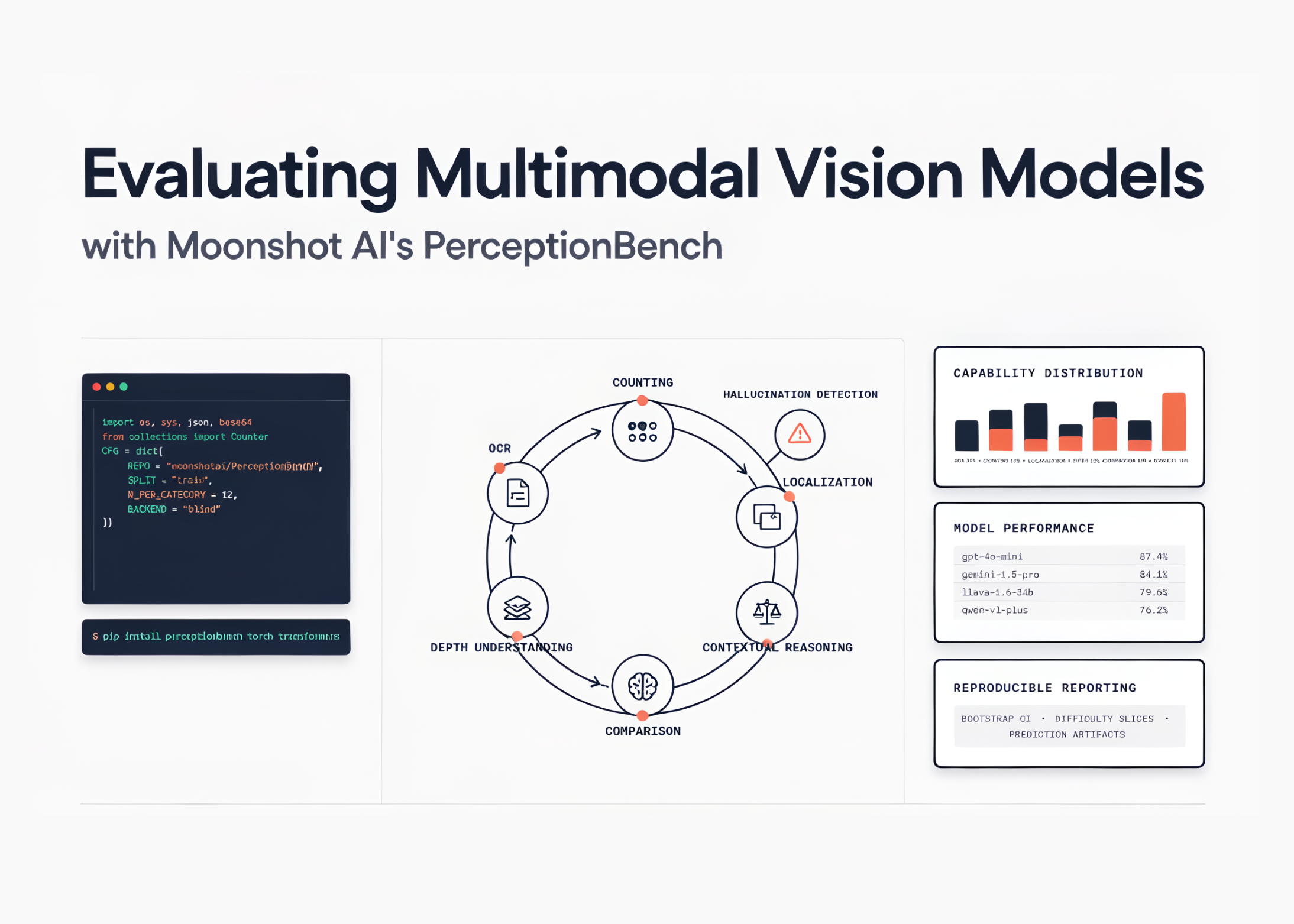
According to the reported statistics, top-tier models such as "GPT-5.6-Sol" (a placeholder for upcoming frontier iterations) show a significant lead in categories like OCR (69.7%) and Attribute Recognition (76.7%). However, performance drops precipitously in the Hallucination Detection category, where even the most advanced models struggle to maintain consistency. For example, while many models excel at "Visual Relation" tasks, their performance in "Perception Hallucination" often falls to the 26% to 45% range, suggesting that current architectures are highly susceptible to visual suggestion.
The "Hallu" (Hallucination) column remains the weakest point across the board. Research suggests this is because most VLMs are trained to be helpful assistants, making them prone to confirming a user’s false premise if a question is phrased suggestively. PerceptionBench forces these models to confront visual reality over linguistic compliance.
Judging Methodologies: Rules vs. LLM-Assisted Grading
Evaluating the output of a multimodal model presents its own set of challenges. Because models often provide free-form text responses, a simple string match is insufficient for determining accuracy. PerceptionBench utilizes a dual-pronged judging strategy.
The first layer is a rule-based judge. This system employs sophisticated normalization techniques, such as converting written numbers ("three") to integers ("3"), removing punctuation, and filtering out articles like "a" or "the." It also handles numeric tolerances, allowing for slight variations in decimal answers where appropriate.
For more complex or semantically nuanced answers, the framework supports an LLM-assisted judge. This follows a protocol where a high-capacity model (such as GPT-4 or a specialized 120B parameter model) acts as a "grader." The grader is provided with the question, the reference answer, and the model’s prediction, and is tasked with determining if they are semantically equivalent. Technical audits of this method have reported a 99.7% agreement rate with human judges, making it a reliable substitute for manual grading in large-scale evaluations.
Statistical Rigor and Reproducibility
To ensure that the results are not the product of statistical noise, the evaluation harness implements bootstrap confidence intervals. By resampling the results thousands of times, the system calculates a 95% confidence interval for the accuracy scores. This is particularly important when evaluating smaller subsets of the data, where a few lucky guesses could skew the perception of a model’s capabilities.
Furthermore, the workflow allows for "difficulty slicing." Researchers can analyze performance based on the number of images per question (multi-image vs. single-image) or the resolution of the source images. Data indicates that many models suffer a performance degradation when required to reason across multiple images, a task that requires higher-order contextual integration and memory.
Broader Impact and Future Implications
The introduction of PerceptionBench and its associated evaluation workflow has broad implications for the AI industry. As autonomous systems, robotics, and AI-driven medical diagnostics become more prevalent, the cost of visual errors increases. A model that cannot accurately perceive the depth of a step or the number of pills in a bottle is a liability.
By providing a modular framework that supports both API-based frontier models and local, open-source VLMs (such as SmolVLM2), PerceptionBench democratizes high-quality evaluation. It allows smaller research teams to benchmark their specialized models against industry giants on a level playing field.
The findings from this benchmark also point toward the next frontier of model development: the need for better "grounding." Future iterations of vision-language models will likely need to incorporate more explicit spatial reasoning modules and stricter hallucination-checking mechanisms to break through the current 60% performance ceiling.
In conclusion, PerceptionBench serves as a critical diagnostic tool in the quest for true machine perception. By moving beyond simple accuracy and into the realm of stratified, atomic capability profiling, it provides a roadmap for the next generation of multimodal AI development. The ability to export reproducible prediction artifacts and capability reports ensures that the path toward more perceptive and reliable AI remains transparent and data-driven. As the industry moves forward, the metrics established by this framework will likely become a standard requirement for any model claiming to "see" the world.