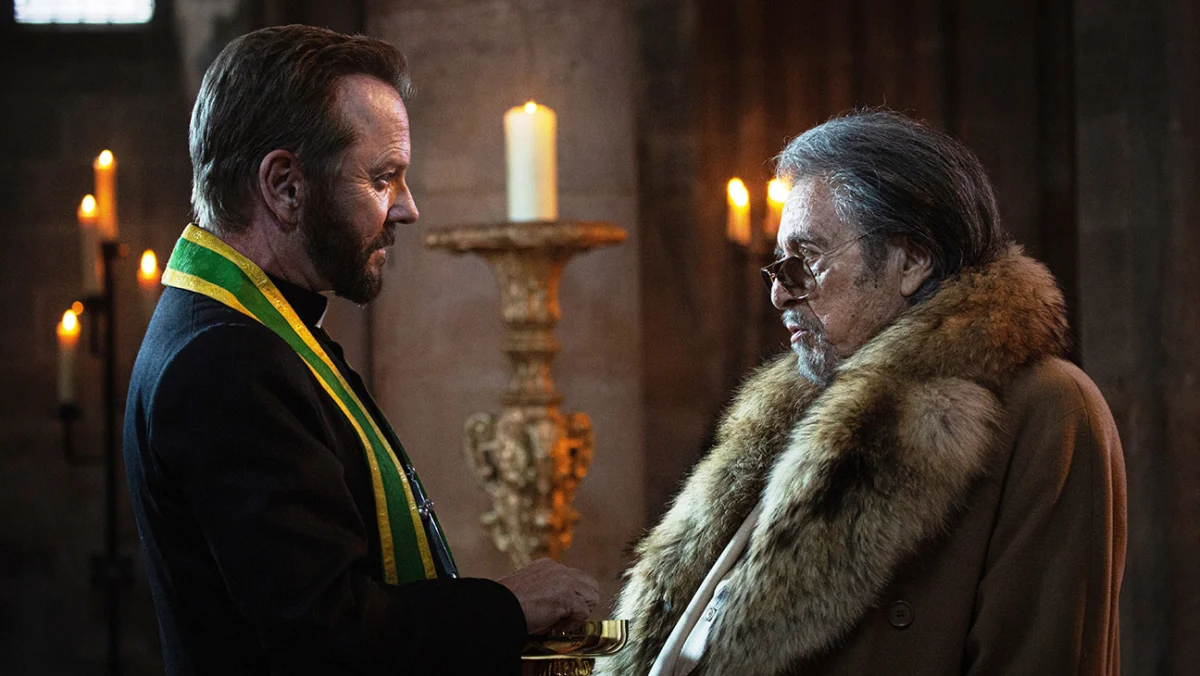
The premiere of Luc Besson’s latest production, "Father Joe," at the Venice Film Festival, has ignited a flurry of questions regarding the creative choices and career trajectories of its prominent cast members, notably Kiefer Sutherland and Al Pacino. Premiering out of competition in the prestigious Lido lineup, the film, written by Besson and directed by EuropaCorp regular Barthélemy Grossmann, has been met with considerable skepticism, prompting a deeper examination of its production, thematic elements, and the peculiar temporal inconsistencies that permeate its narrative. The film’s reception suggests a project struggling to find its footing, raising concerns about its viability beyond its festival debut.
Temporal Discrepancies and Creative Lineage
A striking aspect of "Father Joe" is its perplexing temporal setting. While the vehicular aesthetics strongly suggest a late 1970s or 1980s milieu, the presence of desktop personal computers and early Nokia mobile phones creates a jarring anachronism. This temporal ambiguity has led to speculation that the film’s script might have originated in the 1990s, a period when Besson helmed critically acclaimed stylized thrillers such as "La Femme Nikita" and "The Professional." The prevailing theory is that the script was conceived during that era and subsequently shelved, only to be resurrected for current production, likely driven by financial imperatives rather than artistic evolution. This retrospective approach, if accurate, could explain the film’s perceived lack of contemporary relevance and its reliance on dated genre tropes.
A Glimpse into the Narrative and Its Protagonist
Kiefer Sutherland takes on the titular role of Father Joe, a gun-toting priest whose character appears to be a composite of iconic action heroes like John Wick and Constantine, figures previously embodied by Keanu Reeves. The narrative delves into Father Joe’s past as a special forces operative, punctuated by what are described as "wonky flashbacks" detailing the loss of his daughter to a drug overdose. This trauma appears to have galvanized him into a personal crusade against drug syndicates operating within New York City. However, the film’s depiction of New York is itself a point of contention, appearing as a visual amalgam of computer-generated imagery and an unnamed Eastern European capital, further contributing to the film’s disorienting atmosphere.
The film’s plot unfolds with Father Joe initiating his mission by ambushing a mafia henchman’s warehouse, dispatching numerous individuals. His actions, however, are framed within his own interpretation of religious doctrine, suggesting a moral framework that permits violence in pursuit of a perceived greater good. This vigilante approach inevitably draws the attention of mob kingpin Giuseppe Falcone, portrayed by Al Pacino. The film presents a confrontation between the two, with Falcone challenging the priest in a confessional booth before embarking on a mission to neutralize him. A subplot involving organ harvesting, Russian traffickers, and an unlikely alliance with a rabbi, played by Fred Melamed, further complicates the narrative, attempting to weave together disparate elements of crime and moral ambiguity.
Critical Reception and Artistic Merit
The critical consensus surrounding "Father Joe" leans heavily towards its classification as a "bargain bin B-movie." Reviewers have highlighted the underwhelming dialogue, attributed to Besson’s pen, which both Sutherland and Pacino reportedly deliver with a distinct lack of enthusiasm. The film’s action sequences, while featuring some "bravura fight scenes," are largely characterized as loud, generic shootouts punctuated by splashes of gore. Attempts at humor are also described as falling flat, with a recurring gag involving a priest injecting enemies with a serum that compels them to attend Sunday mass proving tiresome after its initial novelty.
Sutherland’s performance is described as minimal, constrained by a costume that includes a clerical robe, leather vest, and a broad-brimmed black hat, leading to comparisons with Amish attire rather than Catholic clergy. Al Pacino’s portrayal is characterized by an apparent exhaustion, with his performance falling short of even a recognizable imitation of his signature style. The sole performance noted for its vitality is that of Ever Anderson, who plays a 16-year-old drug addict taken under Father Joe’s wing. However, her character is seen as a continuation of Besson’s tendency to feature underage female protagonists in his films, a recurring motif that has drawn scrutiny in the past.
Production Background and Industry Context
Luc Besson’s involvement as writer and producer places "Father Joe" within the broader context of EuropaCorp’s output. The studio has a history of producing genre films, often characterized by high-octane action and stylized visuals. However, "Father Joe" appears to fall short even of the studio’s more successful franchises, such as "The Transporter" series. The film’s reliance on crime movie clichés, particularly its portrayal of Italian mobsters, has been criticized as being overly simplistic, with comparisons suggesting that it makes films like "Gotti" appear more nuanced.
The film’s premiere at the Venice Film Festival, a platform known for showcasing auteur cinema and prestigious dramas, further underscores the incongruity of its inclusion. Premiering "out of competition" suggests that the festival programmers may have sought to include a diverse range of films, but it also indicates that "Father Joe" did not meet the criteria for official selection in the competitive sections. This positioning often signifies a film that, while potentially entertaining to a certain audience, may not align with the festival’s primary curatorial focus.
Potential Implications and Future Prospects
The lackluster reception of "Father Joe" raises questions about the future of projects emanating from Besson’s creative pipeline and the strategic decisions of EuropaCorp. While the film’s modest afterlife on streaming platforms is anticipated, its artistic and commercial potential appears limited. The film’s perceived shortcomings, including its temporal inconsistencies, derivative plotlines, and uninspired performances from its star power, suggest a fundamental lack of creative cohesion.
The industry will likely observe the film’s performance on digital platforms to gauge audience reception beyond the critical sphere. However, the prevailing sentiment suggests that "Father Joe" is unlikely to achieve significant commercial success or critical acclaim. Its primary value may lie in its cautionary tale for filmmakers and producers regarding the perils of relying on dated formulas and underutilizing established talent. The film serves as a stark reminder that even with the involvement of Hollywood veterans, a weak script and uninspired direction can undermine even the most ambitious of projects. The hope for audiences, and perhaps the filmmakers themselves, is that subsequent projects will demonstrate a more refined artistic vision and a clearer understanding of contemporary cinematic sensibilities.