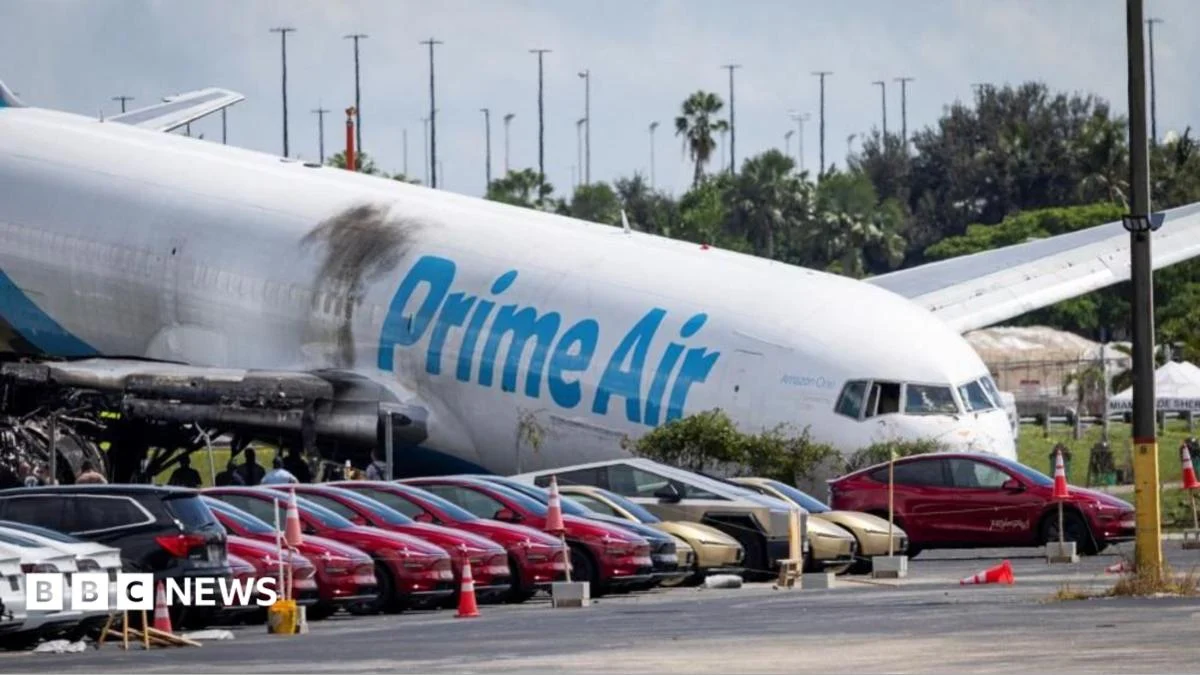
Investigators with the National Transportation Safety Board (NTSB) have successfully recovered the critical flight recorders from the Amazon-operated cargo plane that tragically crashed at Miami International Airport (MIA) on Sunday, September 1st, but the paramount focus remains on the meticulous and respectful recovery of the victims. The devastating incident involved a Boeing 767-300 freighter, operated by 21 Air on behalf of Amazon Air, which overran the runway shortly before 14:00 local time (19:00 BST), resulting in five fatalities and five serious injuries. The aircraft, arriving from San Juan, Puerto Rico, on its third flight of the day, struck multiple ground vehicles and airport infrastructure before coming to a rest significantly beyond the runway’s end.
The Catastrophic Runway Overrun and Immediate Aftermath
The incident unfolded with alarming speed as the Boeing 767-300, a workhorse of global air cargo logistics, failed to stop within the confines of the designated runway. The aircraft, carrying two crew members, careened off the pavement, first impacting critical navigational aids and other airport equipment. Its destructive path then led it to collide with a white Ford van, owned by a contract cleaning company, which was carrying seven individuals within the airport perimeter. This initial impact was followed by a breach of the airport’s perimeter fence, leading to a further collision with a Toyota Corolla carrying three passengers. The immense kinetic energy of the aircraft was finally dissipated approximately 1,300 feet (394 meters) beyond the runway’s threshold, leaving a trail of wreckage and devastation.
NTSB Chairwoman Jennifer Homendy, addressing a press conference at Miami International Airport on Monday, described the crash scene as profoundly "devastating." She emphasized the widespread debris field, comprising fragments of the aircraft, remnants of the struck vehicles, and sections of airport fencing, scattered across a wide area. "It’s hard to see, and I’m sure very difficult for the first responders as well," Homendy stated, highlighting the challenging and emotionally taxing environment for emergency personnel. The immediate priority, she reiterated, was the compassionate recovery of the victims’ bodies, underscoring that the "investigation and access to the aircraft, as well as evidence, can wait" until this solemn task is completed. This prioritization aligns with established NTSB protocols that place human considerations above technical investigation in the immediate aftermath of such a tragedy.
The Role of the NTSB and the Investigation’s Initial Phase
The National Transportation Safety Board is the independent U.S. government agency responsible for investigating civil aviation accidents and issuing safety recommendations aimed at preventing future occurrences. Upon notification of a major incident, the NTSB rapidly deploys a "Go-Team" of specialists to the crash site. In this instance, Chairwoman Homendy led the team to Miami, initiating a multi-faceted investigation that will delve into every conceivable factor contributing to the accident.
Homendy stressed that investigators are currently in the crucial "fact-finding stage," a meticulous process of gathering raw data and evidence without premature conclusions. "It was too early to draw conclusions about what caused the crash," she cautioned, emphasizing the complexity of aviation accident investigations. The recovery of the flight data recorder (FDR) and the cockpit voice recorder (CVR) represents a significant step in this process. These "black boxes," though typically orange in color, are engineered to withstand extreme forces and provide invaluable insights into the aircraft’s performance and the crew’s actions and communications leading up to and during the incident. Both recorders have been transported to the NTSB’s state-of-the-art laboratory in Washington D.C. for detailed analysis, where specialists will extract and interpret the vast amount of recorded information. The FDR captures hundreds of parameters, including airspeed, altitude, heading, engine performance, control surface positions, and autopilot settings, providing a precise timeline of the aircraft’s operational state. The CVR records all audio within the cockpit, including crew conversations, radio transmissions, and ambient sounds, offering critical context to the crew’s decision-making and awareness.
Comprehensive Scope of the Investigation
The NTSB’s investigation into the Miami International Airport crash will be exhaustive, covering several key areas of inquiry:
- Operational Factors: Investigators will meticulously examine the flight history of the specific Boeing 767-300, including its maintenance records, recent repairs, and operational performance. The crew’s experience, training records, flight hours, rest periods, and medical histories will also be scrutinized to assess any potential human factors. Air traffic control communications leading up to the landing will be analyzed for any pertinent instructions or anomalies.
- Aircraft Systems and Engines: Dedicated teams of NTSB specialists will focus on the structural integrity of the airframe, the functionality of all aircraft systems, and the performance of the engines. This includes examining flight control systems, braking mechanisms, landing gear, and instrumentation for any pre-impact malfunctions.
- Meteorological Conditions: A meteorologist assigned to the investigation will conduct a thorough assessment of the weather conditions prevailing at Miami International Airport at the time of the crash. Earlier analysis by BBC Verify indicated an active thunderstorm near the airport shortly before the incident, with winds gusting up to 26 knots. The NTSB will determine the precise impact of these conditions, including wind shear, precipitation, and visibility, on the landing approach and runway performance. Gusting crosswinds, in particular, can pose significant challenges during landing, potentially increasing landing distances or affecting directional control.
- Airport Infrastructure and Safety Features: A crucial aspect of the investigation will center on the runway environment itself. Homendy specifically stated that investigators will examine whether the runway should have been equipped with an Engineered Materials Arresting System (EMAS). EMAS is a passive safety feature designed to decelerate and stop aircraft that overrun a runway by collapsing under the aircraft’s weight, providing a controlled arrest. These systems are typically composed of lightweight, crushable concrete blocks strategically placed at the end of runways. The absence or presence, and the effectiveness, of such a system will be a "key" part of the NTSB’s inquiry, as it directly relates to mitigating the severity of runway overruns. Many major airports have installed EMAS beds, especially on runways with limited overrun areas, based on risk assessments and FAA recommendations. The investigation will evaluate whether this particular runway met the criteria for an EMAS installation or if its absence played a role in the extent of the overrun and subsequent damage.
The NTSB has also made a public appeal, urging members of the public to share any photographs or videos that might have captured events related to the crash. Such unsolicited evidence can sometimes provide unique perspectives and crucial visual data that aid investigators in reconstructing the sequence of events.
Broader Impact and Industry Response
The crash occurred during the busy Labor Day holiday weekend, traditionally one of the peak travel periods in the United States. Miami International Airport, a major international gateway and a significant cargo hub, experienced substantial disruption. Two of its four runways remained closed following the crash, leading to numerous flight cancellations and delays. Passengers were advised to anticipate further disruptions as the ripple effects impacted aircraft rotations and flight crew availability. The incident underscores the fragility of complex logistical networks and the profound impact a single event can have on global operations.
Amazon, a major player in the global e-commerce and logistics sector, expressed profound sorrow regarding the loss of life. "Amazon is heartbroken by the loss of life and that it was working closely with authorities," a company spokesperson stated. Amazon Air relies on a network of third-party carriers, such as 21 Air, to operate its growing fleet of cargo aircraft, facilitating rapid package delivery worldwide. This incident casts a spotlight on the safety protocols and operational oversight within its extensive air cargo network.
21 Air, the operator of the ill-fated Boeing 767-300, also extended its deepest condolences to the victims and their families. The company affirmed its full cooperation with the NTSB and all relevant authorities in the ongoing investigation, emphasizing its commitment to transparency and safety. As a certificated air carrier, 21 Air is subject to rigorous regulatory oversight by the Federal Aviation Administration (FAA), and the findings of the NTSB investigation will inevitably prompt reviews of its operational procedures, training programs, and maintenance practices.
The Pursuit of Prevention: NTSB’s Mandate
Ultimately, the NTSB’s primary objective is not merely to determine the "what" and "how" of an accident, but more importantly, the "why," to prevent similar tragedies from recurring. Chairwoman Homendy articulated this fundamental mission, stating, "That’s why we’re here – to prevent the next tragedy." She underscored the critical importance of implementing the agency’s safety recommendations. "Our recommendations must be implemented, or we’ll be here again," she warned, reflecting the NTSB’s historical role in driving significant safety improvements across all modes of transportation. These recommendations, stemming from meticulous analysis and often backed by extensive research, have led to numerous advancements in aircraft design, operational procedures, air traffic control, and airport infrastructure, collectively making air travel the safest mode of transportation globally.
The investigation into the Miami International Airport cargo plane crash is expected to be a lengthy and intricate process, potentially spanning 12 to 24 months before a final report detailing the probable cause and comprehensive safety recommendations is issued. In the interim, the aviation community and the affected families will await the NTSB’s findings, hopeful that this tragedy, while devastating, will ultimately contribute to a safer future for air cargo operations and those who work and travel around airports. The recovery of the flight recorders marks a crucial step in unraveling the complex narrative of this catastrophic event, providing the foundational data upon which all subsequent analysis will be built.