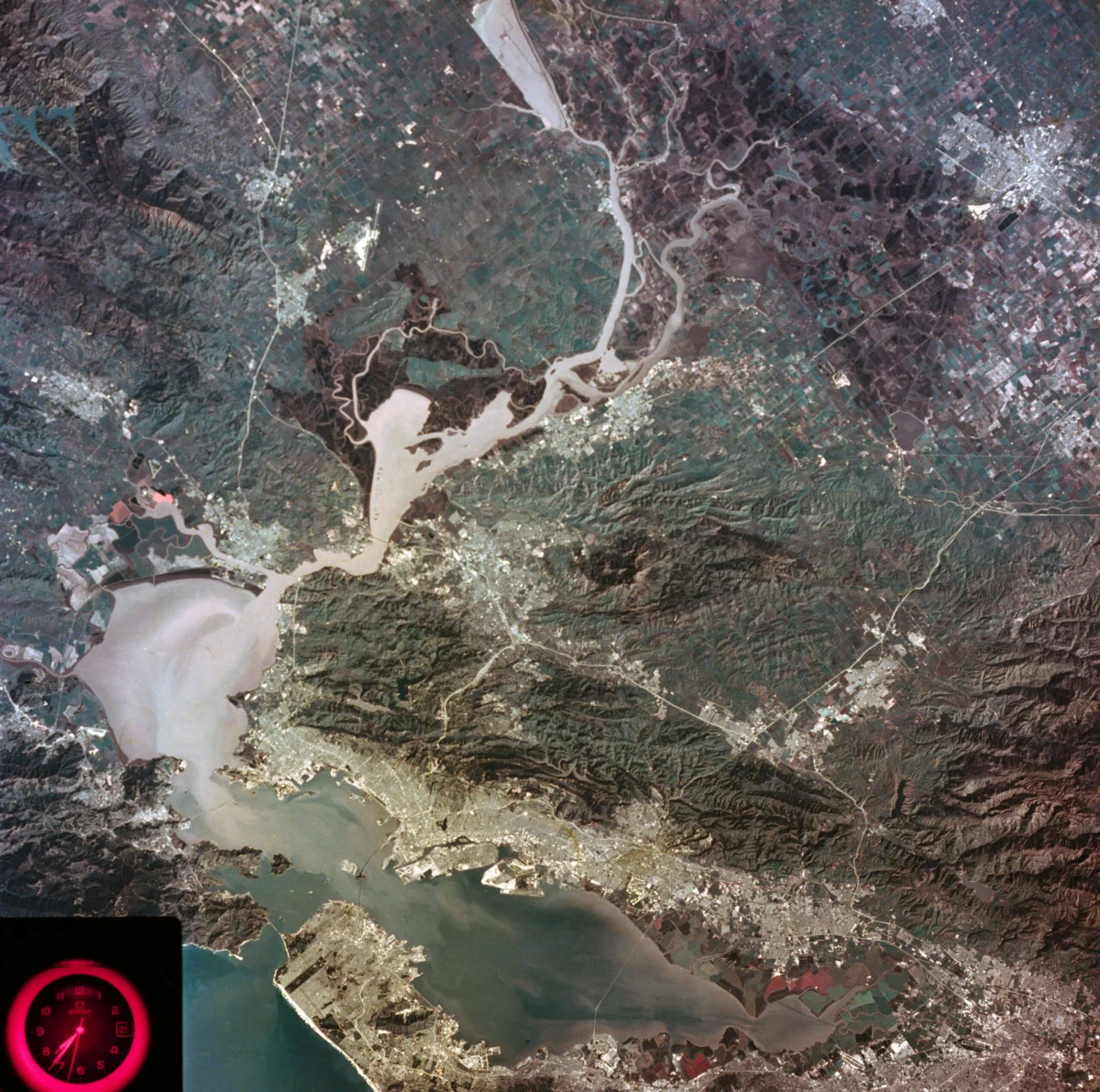
In May 1963, NASA astronaut L. Gordon Cooper, Jr., aboard his Faith 7 spacecraft, completed 22 orbits of Earth during the Mercury-Atlas 9 mission, capturing 29 vivid color photographs with a 70mm camera. Cooper’s observations from his orbital perch, approximately 100 miles above the planet, were nothing short of spectacular, prompting him to report seeing remarkably detailed features on Earth’s surface. Among his claims were sightings of vehicles motoring on dirt roads, plumes of smoke rising from trains, and even the distinct tops of houses. Perhaps most famously, he asserted he could discern a white automobile kicking up a dust cloud near the U.S.-Mexico border.
The Genesis of a Visionary Debate
Cooper’s extraordinary claims immediately sparked a robust debate within scientific and public circles. Many researchers and members of the public expressed profound skepticism regarding the feasibility of such fine-detail observations from orbital altitudes. Conventional wisdom among vision experts at the time suggested that an individual with standard 20/20 vision would be unable to clearly perceive objects with sides less than 150 feet long from a distance of 100 miles. While Cooper was noted for his exceptional 20/12 vision, a level of acuity significantly sharper than average, the notion of seeing individual cars or the structural details of houses seemed to defy the accepted limits of human sight.
The skepticism was not isolated to Cooper’s claims alone. Other pioneering Mercury astronauts, including John Glenn, had also reported observing the Earth in striking detail, further fueling the scientific conundrum. These consistent, yet seemingly improbable, assertions led to a more serious and unsettling concern among mental health professionals. A prominent story published in Air Force and Space Digest articulated the growing apprehension, noting that some psychiatrists began to speculate whether "weightlessness was causing the astronauts to hallucinate and that the space program was in for serious trouble." The nascent field of space medicine grappled with the unknown physiological and psychological effects of prolonged spaceflight, and the possibility of visual hallucinations presented a significant challenge to the credibility and future of crewed missions.
This period marked a critical juncture for NASA. Beyond the immediate concern for astronaut well-being and public perception, the scientific community recognized the immense potential of human observation from space. If astronauts could indeed discern such detail, their unique vantage point could offer unprecedented insights into Earth’s dynamic systems. This dual challenge – validating astronaut claims and understanding the true capabilities of human vision in orbit – spurred visual acuity experts to devise a series of rigorous experiments.
Designing Definitive Experiments: The Gemini Missions
To settle the debate and quantify the capabilities of human vision in space, NASA, in collaboration with its partners, developed two innovative visual acuity experiments. These were strategically integrated into the crewed Gemini V and Gemini VII missions, part of a program designed to push the boundaries of human spaceflight, including long-duration missions and rendezvous operations crucial for future lunar endeavors.
The first experiment was designed to assess basic visual acuity in the unique environment of space. It involved an optical device, somewhat reminiscent of high-powered binoculars, which astronauts looked through. The instrument presented an assortment of rectangles in various positions and levels of contrast. Astronauts were tasked with identifying the directional orientation of these rectangles, providing a quantitative measure of their visual performance under spaceflight conditions. This internal assessment aimed to determine if microgravity or other orbital factors negatively impacted visual acuity.
The second, and perhaps more ambitious, part of the experiment involved creating gigantic terrestrial eye charts. These "Eye-Q" charts were composed of enormous white rectangles, meticulously crafted by the Dow Chemical Corporation. The rectangles ranged in size from approximately 150 to 600 feet long, designed to be visible from orbital altitudes. To provide diverse viewing conditions and redundant data, two primary ground sites were selected. One set of these colossal rectangles was strategically placed on dark tilled soil near Laredo, Texas, offering a stark contrast for optimal visibility. The second array was established near Carnarvon, Australia, providing an opportunity for observations from a different hemisphere and varying lighting conditions. The Gemini V and Gemini VII astronauts were then tasked with identifying the directional orientation of these ground-based rectangles during their orbital passes.
Chronology of Key Events and Missions:
- May 15-16, 1963: Mercury-Atlas 9 mission (Faith 7) with astronaut L. Gordon Cooper, Jr. Cooper’s observations ignite the debate on human visual acuity in space.
- Mid-1963 to Mid-1965: Period of scientific skepticism, psychological concerns, and the conceptualization/design of visual acuity experiments.
- August 21-29, 1965: Gemini V mission (astronauts Gordon Cooper and Pete Conrad). First deployment of the in-space optical device and attempts to observe the terrestrial "Eye-Q" charts. This mission set a new endurance record of nearly eight days, crucial for testing long-duration effects.
- December 4-18, 1965: Gemini VII mission (astronauts Frank Borman and Jim Lovell). Continued experiments with the optical device and terrestrial charts, pushing the endurance record to 14 days, further informing the effects of extended spaceflight on human physiology, including vision.
- Late 1965 – Early 1966: Analysis of Gemini V and VII experiment data, confirming astronauts’ ability to see ground features and that vision did not significantly deteriorate during two-week missions.
- Late 1960s: Growing advocacy for Earth-observing instruments by NASA, USGS, ONR, and USDA, based on astronaut observations and the proven potential of remote sensing.
- July 23, 1972: Launch of Earth Resources Technology Satellite (ERTS-1), later renamed Landsat 1, marking the formal beginning of continuous, systematic satellite-based Earth observation.
Challenges and Breakthroughs in Orbit
Executing these experiments from orbit was not without its challenges. Astronauts on both Gemini missions encountered several factors that impacted their ability to consistently view the ground-based "Eye-Q" charts. Cloudy conditions frequently obscured large portions of the Earth’s surface. Sunlight scattered by the spacecraft window, particularly during certain orbital orientations, could create glare that hindered clear observation. Furthermore, unfavorable orbital orientations during overflight meant that the ground sites were not always optimally positioned for viewing, requiring precise timing and favorable conditions.
Despite these environmental and operational hurdles, the Gemini astronauts achieved significant breakthroughs. During some orbital revolutions, astronauts on both missions were indeed able to discern and report on portions of the ground site near Laredo, Texas. Their detailed reports on the Laredo "Eye-Q" site, combined with the quantitative data gathered from the binocular-like vision tester experiments conducted before, during, and after the flights, provided compelling evidence. The cumulative findings unequivocally demonstrated that astronauts could, in fact, see discernible features like roads and ships with their trailing wakes from orbital altitudes. Crucially, the experiments also determined that an astronaut’s vision did not undergo any significant deterioration during a two-week spaceflight, allaying many of the initial concerns about the effects of the space environment on human eyesight.
Beyond Human Sight: The Dawn of Remote Sensing
The implications of these findings extended far beyond simply validating astronaut reports or reassuring mental health professionals. The ability of human eyes to accurately perceive features on Earth from orbit held profound significance for a diverse array of scientific disciplines. Geologists could potentially identify subtle geological formations, fault lines, or mineral deposits that were difficult to map from the ground. Geographers gained a new perspective on land use, urban sprawl, and natural landscape evolution. Oceanographers recognized the potential for tracking currents, marine life patterns, and pollution plumes. The human eye, acting as a highly adaptable sensor, offered a preview of the capabilities that dedicated instruments could achieve.
The scientific community’s heightened interest, fueled by the compelling recollections and the initial photographs of Earth’s surface captured by the Mercury and Gemini astronauts, served as a powerful catalyst. It motivated NASA and its burgeoning network of scientific partners to advocate vigorously for the development of new, sophisticated Earth-observing instruments. Key agencies, including the U.S. Geological Survey (USGS), the Office of Naval Research (ONR), and the U.S. Department of Agriculture (USDA), quickly recognized the immense practical value of systematic surface images of the Earth captured from above. They articulated a compelling vision for how this data could be utilized: to inventory agricultural crops with unprecedented efficiency, to map geological features across vast regions, to monitor the spread and impact of natural disasters like floods and fires, and to gain a deeper, more comprehensive understanding of the ocean’s complex processes.
The Genesis of Landsat: A Lasting Legacy
This shared vision and the promise of these real-world applications directly motivated the creation of a groundbreaking new program: the Earth Resources Technology Satellite (ERTS). This ambitious undertaking, later famously renamed Landsat 1, represented a monumental leap from anecdotal human observation to systematic, instrument-driven remote sensing. Launched by NASA on July 23, 1972, Landsat 1 carried advanced instrumentation, most notably a Return Beam Vidicon (RBV) camera system and a Multi-Spectral Scanner (MSS). These instruments were designed to capture high-resolution images of the Earth’s surface across various spectral bands, providing data far beyond what the human eye could perceive.
The data streaming back from Landsat 1’s camera and multi-spectral scanner was immediately put to use. It complemented and enhanced information gathered by NASA’s Earth Resources Aircraft Program, which employed specialized aircraft to conduct aerial surveys. Together, these platforms provided an invaluable torrent of data used to monitor the vast expanses of the oceans, track changes in agricultural fields, assess the damage and recovery of natural disaster sites, and much more. Landsat 1 marked the beginning of an uninterrupted, multi-decade legacy of Earth observation, providing a continuous record of our planet’s changing surface.
In the six decades since America’s first pioneering human spaceflights, NASA’s commitment to observing Earth from orbit has only deepened. From sophisticated satellites like the current Landsat series, Terra, Aqua, and Sentinel missions, to high-altitude aircraft and even ground-level sensor networks, the quest to understand and solve problems here on Earth through comprehensive observation remains a core mission. The initial debate over an astronaut’s ability to spot a white car from space ultimately laid the foundational groundwork for what has become an indispensable global enterprise: the continuous monitoring of our home planet, driven by the insatiable human curiosity that Gordon Cooper so vividly embodied.
A Note on Long-Duration Spaceflight and Vision:
While the Gemini experiments concluded that vision did not deteriorate during two-week spaceflights, subsequent scientific research over the decades has revealed a more nuanced understanding of the long-term effects of spaceflight on the human eye and brain. Modern studies have documented that approximately 70% of astronauts experience Spaceflight Associated Neuro-ocular Syndrome (SANS) during longer spaceflights, particularly those lasting several months or more on the International Space Station. SANS is characterized by changes in vision, including hyperopic shifts (farsightedness), optic disc edema, choroidal folds, and globe flattening. These changes are believed to be related to alterations in cerebrospinal fluid dynamics and intracranial pressure in microgravity. This ongoing research underscores the complexity of human adaptation to space and the continuous need for medical monitoring and countermeasures as humanity ventures towards even longer missions to the Moon and Mars.