In a significant development that challenges the prevailing "bigger is better" paradigm in artificial intelligence, London-based AI lab Inherent has announced that its newly unveiled AI agent, Faraday, has achieved a remarkable feat: independently reproducing the findings of published scientific papers with greater accuracy than much larger, frontier-scale models from industry leaders Anthropic and OpenAI. This breakthrough, accomplished using a fraction of the computational resources, positions Inherent as a formidable, albeit previously understated, player in the global AI race, particularly notable given its founding by former Google DeepMind alumni.
The Rise of a Stealth Contender: Inherent’s Journey and Funding
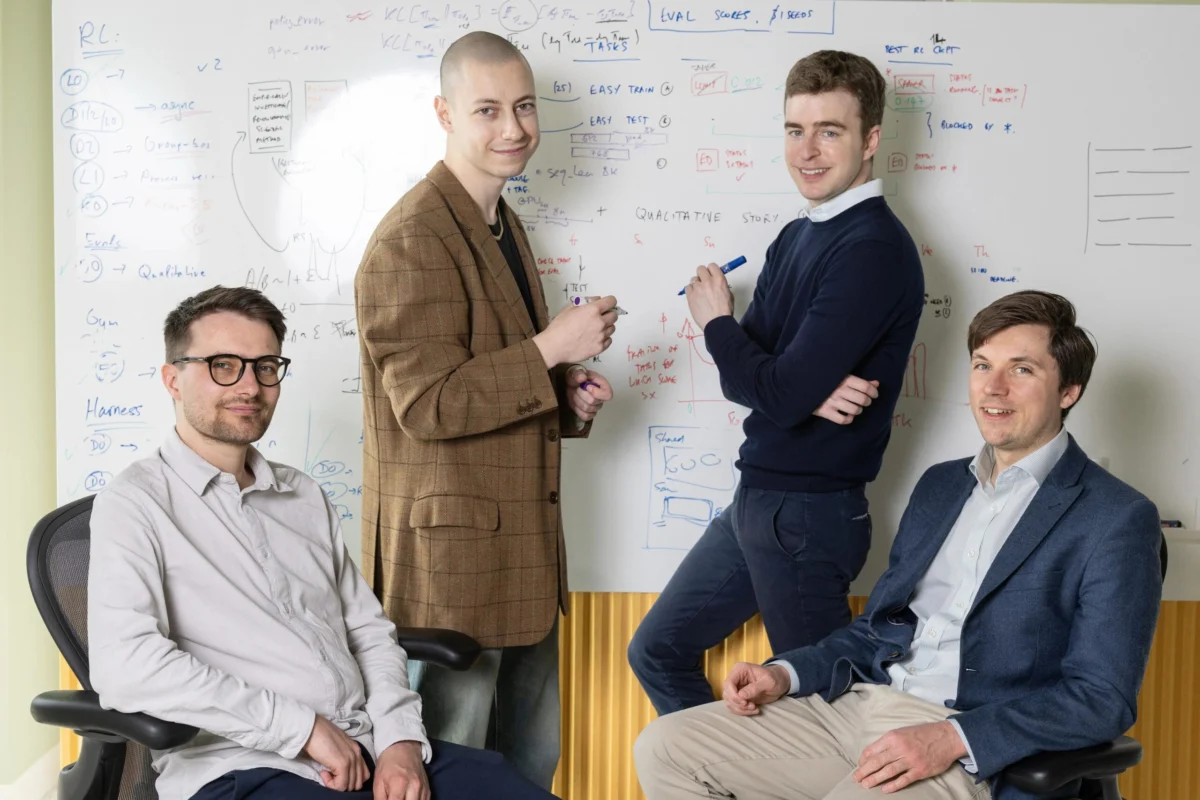
Inherent’s emergence from relative obscurity into the spotlight has been swift and impactful. Weeks prior to this announcement, the British startup had publicly revealed its existence, simultaneously disclosing a substantial $50 million seed funding round. This significant capital injection underscored investor confidence in the team’s vision and technological prowess, even before the public demonstration of Faraday’s capabilities. The company’s origins are deeply rooted in the fertile ground of Google DeepMind, a testament to London’s standing as a global AI hub. Co-founded by Edward Hughes, Louis Kirsch, Kaloyan Aleksiev, and Tantum Collins, all of whom bring extensive experience from DeepMind, Inherent’s trajectory mirrors a growing trend of elite AI researchers leveraging their expertise to launch independent ventures. This exodus of top talent from established giants like Google and Meta has become a defining characteristic of the current AI landscape, fueling a vibrant startup ecosystem across various tech capitals. Inherent, however, distinguished itself by maintaining a low profile while meticulously building its foundational technology, a strategy that has now culminated in a demonstrably superior AI agent.
Faraday’s Feat: Outperforming Giants with Efficiency
The core of Inherent’s breakthrough lies in Faraday, an AI agent designed not merely to process information but to engage in complex scientific reasoning and experimentation. The specific task where Faraday excelled involved independently replicating the results of published scientific papers—a benchmark that requires sophisticated understanding, methodological design, and validation, rather than simple information retrieval or summarization. Against this demanding metric, Faraday surpassed the performance of Anthropic’s Claude Opus 4.8 and OpenAI’s GPT-5.5. What makes this achievement particularly compelling is the stark contrast in model size. While Claude Opus 4.8 and GPT-5.5 represent frontier-scale systems, often comprising hundreds of billions, or even trillions, of parameters, Faraday operates on a comparatively diminutive model known as Qwen 3.6, boasting just 27 billion parameters.
In the realm of AI, "parameters" serve as a crucial proxy for a model’s complexity, its capacity for learning, and, critically, its training and operational costs. Larger parameter counts typically necessitate vast datasets, immense computational power (often involving thousands of high-end GPUs), and substantial energy consumption. Therefore, Faraday’s ability to outperform larger models with a 27-billion-parameter base, which is orders of magnitude smaller than its competitors, signals a potential paradigm shift. It suggests that architectural innovation, refined training methodologies, and a focus on specific agentic capabilities can yield superior results without the exorbitant resource demands traditionally associated with state-of-the-art AI. The Qwen series of models, developed by Alibaba Cloud, has gained recognition for its efficiency and strong performance, offering a robust foundation that Inherent has evidently leveraged and optimized to great effect. This choice underscores a strategic decision to build upon a solid, yet relatively compact, open-source base rather than engaging in the resource-intensive endeavor of developing a massive proprietary foundation model from scratch.
Beyond Replication: The Pursuit of "Research Taste"
While outperforming rivals at scientific replication is an impressive technical achievement, Inherent’s ambition extends far beyond mere verification. As co-founder and chief scientist Edward Hughes articulated, the ultimate goal is to build AI that can discover new scientific knowledge, not just validate existing results. He likened scientific paper replication to a standard training exercise for human scientists, noting that "Many PhD students actually start by doing this." This perspective reframes Faraday’s current success as a foundational step towards a grander vision.
Hughes emphasized that the true significance of their work wasn’t merely the "result of beating those frontier agents — which of course we liked — but was actually the way we went about building this." This "way" involves imbuing their AI agents with what Hughes terms "research taste"—an intangible, yet critical, instinct for identifying promising research avenues, designing effective experiments, and discerning valuable insights. Teaching such a nuanced quality to an AI system is exceptionally challenging, and Inherent’s approach relies heavily on reinforcement learning (RL). Unlike traditional supervised learning, which provides explicit correct answers, RL trains an AI by rewarding desired outcomes and penalizing undesirable ones, allowing the system to learn optimal strategies through trial and error. This reward-based approach, rather than primarily training on the study of scientific methodology itself, is a deliberate choice, reflecting Inherent’s belief that it will generalize more effectively to their long-term objective of developing agents capable of contributing across diverse scientific fields. This focus on "taste" also influences Inherent’s operational strategy, leading them to selectively integrate existing best-in-class tools. For instance, Faraday utilizes OpenAI’s GPT-5.5 Codex for coding tasks, mirroring how human scientists leverage specialized software rather than developing every tool themselves. This pragmatic, collaborative approach enables Inherent to concentrate its resources on its core innovation: developing AI agents with advanced reasoning and discovery capabilities.
London’s AI Crucible: Talent, Geography, and Policy Challenges
Inherent’s decision to base its operations in London, specifically in the King’s Cross neighborhood, is a deliberate one, reflecting the city’s burgeoning status as a global AI powerhouse. King’s Cross, once a rundown industrial area, has been revitalized into a vibrant tech hub, largely due to the presence of Google DeepMind, which itself was founded in London in 2010. This concentration of talent, capital, and research institutions has created a dynamic ecosystem that Inherent actively seeks to leverage. All of Inherent’s dozen employees work in-person, a choice that underscores the company’s belief in the power of collaborative, co-located innovation—a strategy often favored by DeepMind alumni startups.
Edward Hughes expressed strong conviction in London’s density of AI talent. However, he also vocalized a critical concern impacting the UK’s competitiveness: the practice of "garden leave." This common UK employment clause prevents departing employees from joining or establishing a rival company for several months after their resignation, effectively creating a talent freeze. Hughes, who was personally affected by this restriction, argued that it places UK startups at a disadvantage compared to their American counterparts, where researchers generally face fewer such impediments, allowing for quicker talent mobility and startup formation. This policy debate highlights a tension within the UK’s tech ecosystem: while it boasts world-class research and a growing venture capital scene, regulatory frameworks, inherited from more traditional industries, can sometimes hinder the rapid iteration and talent flow essential for a fast-moving sector like AI. Addressing such policy nuances could further solidify London’s position as a magnet for AI innovation.
Implications for the AI Landscape: A Paradigm Shift?
Inherent’s success with Faraday carries profound implications for the broader AI landscape. For years, the dominant narrative in AI development has been the "scaling hypothesis," which posits that simply increasing model size (parameters) and training data will inevitably lead to improved performance across a wider range of tasks. While scaling has undeniably yielded impressive results, Inherent’s demonstration challenges the notion that it is the only path, or even always the optimal path, to advanced AI.
The ability to achieve frontier-level performance with a significantly smaller model offers several critical advantages:
- Reduced Computational Costs: Smaller models require less compute power for training and inference, leading to lower operational expenses and making advanced AI more accessible to a broader range of organizations, including startups and academic institutions that lack the vast resources of tech giants.
- Environmental Impact: The energy consumption associated with training and running massive AI models is substantial. More efficient models like Faraday could contribute to a greener AI future, aligning with growing global concerns about sustainability.
- Faster Development and Iteration: Smaller models are quicker to train and fine-tune, accelerating the research and development cycle.
- Specialization and Agentic AI: Inherent’s focus on an "AI agent" for specific, complex tasks like scientific replication suggests a potential shift towards more specialized, efficient AI systems that excel in particular domains, rather than monolithic general-purpose models. This could pave the way for a new generation of "expert" AIs.
- Democratization of AI: If high-performance AI can be developed and deployed more cost-effectively, it could democratize access to cutting-edge capabilities, fostering innovation outside the traditional tech behemoths.
This development could spark renewed interest in research areas like model compression, efficient architectures, and novel training techniques, pushing the industry towards a more resource-aware and sustainable future. It also validates the strategic decision of investors to back companies pursuing alternative approaches to AI development.
The Future Horizon: AI Scientists and World Models
Looking ahead, Inherent is not slowing down. The company plans to significantly grow its headcount, aiming for "about 20 to 25" employees by the end of the year. This ambitious hiring drive is strategically timed. With Demis Hassabis, the co-founder of DeepMind, now taking on a broader leadership role within Google’s AI initiatives, reports have surfaced about some DeepMind staff feeling "unsettled." This internal churn at Google’s AI powerhouse could present a prime opportunity for Inherent to attract top-tier talent seeking new challenges and a more focused environment.
Inherent’s long-term ambitions include delving into "world models"—a concept representing an AI’s internal simulation or understanding of its environment. Developing sophisticated world models is considered a crucial step towards building truly intelligent, general-purpose AI that can reason, plan, and interact with complex realities. If Inherent can successfully translate its efficiency gains from Faraday into the development of compact yet powerful world models, it could redefine the path to advanced AI. Their vision of an "AI scientist agent" imbued with "taste" suggests a future where AI not only assists human researchers but actively contributes to the frontiers of scientific discovery, generating hypotheses, designing experiments, and interpreting results with a level of insight that complements, and eventually augments, human intellect. This trajectory positions Inherent not just as a disruptor of current AI benchmarks, but as a potential architect of the next generation of scientific research tools.
Conclusion: Redefining the Race for AI Supremacy
Inherent’s impressive debut with its Faraday AI agent marks a pivotal moment in the ongoing evolution of artificial intelligence. By demonstrating that superior performance can be achieved with significantly smaller models, the London-based startup has cast a powerful spotlight on the importance of efficiency, architectural innovation, and intelligent training methodologies over sheer scale. This achievement not only validates Inherent’s strategic approach but also ignites a crucial conversation within the AI community about resource optimization, the environmental impact of large models, and the democratization of advanced AI capabilities. As the company continues to grow and pursue its ambitious goals of building AI scientists and world models, Inherent is poised to play a significant role in shaping the future trajectory of AI, potentially leading the charge towards a new era of more agile, sustainable, and scientifically insightful artificial intelligence.