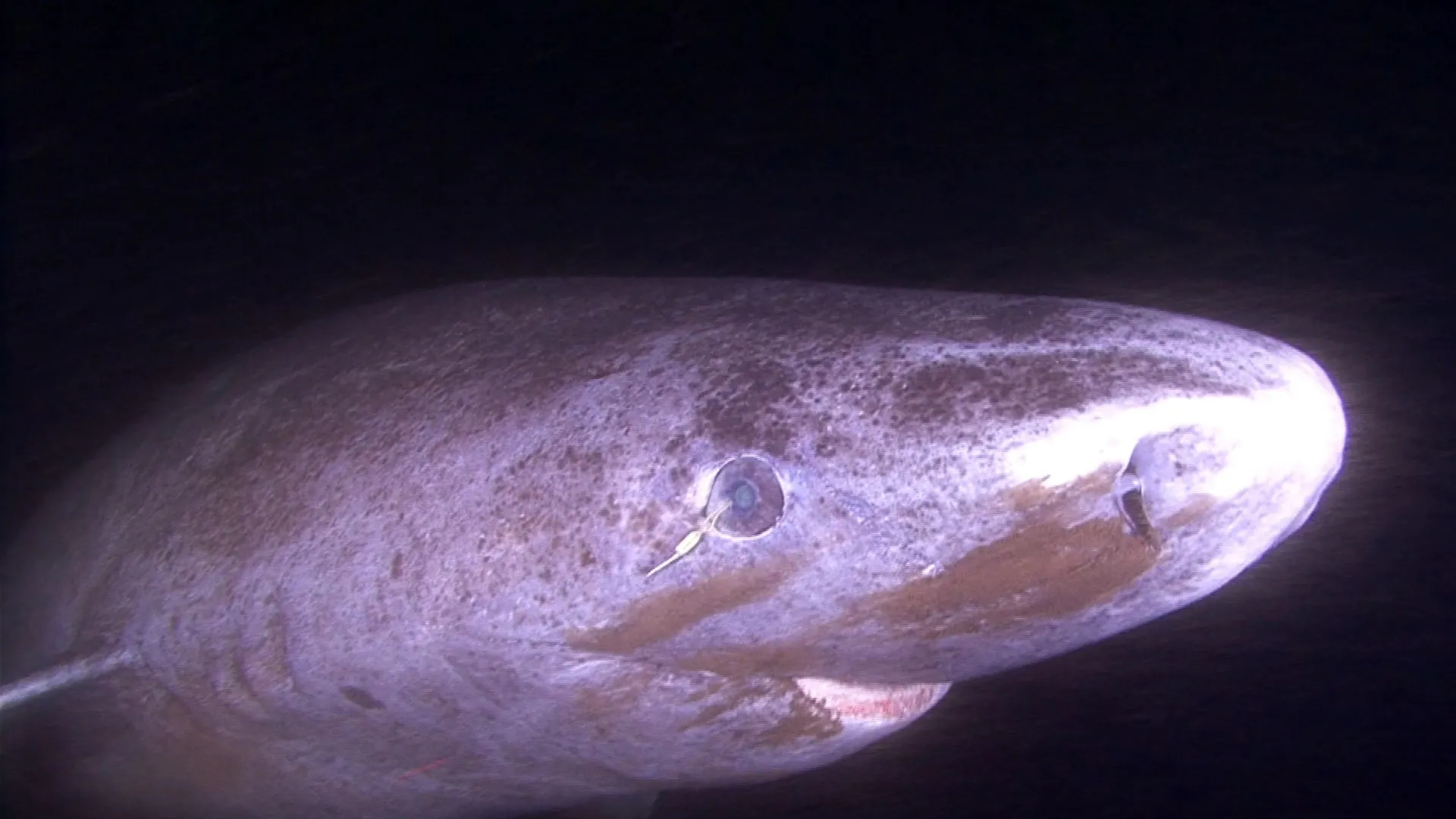
The extraordinary longevity of the Greenland shark, a creature that can live for centuries, has long been a subject of scientific fascination. Now, groundbreaking research led by Dorota Skowronska-Krawczyk, an associate professor of physiology and biophysics at the University of California, Irvine, is challenging long-held assumptions about the visual capabilities of these ancient Arctic inhabitants. Contrary to the prevailing theory that parasites and the dark, murky environment render them functionally blind, new findings suggest that Greenland sharks possess remarkably resilient visual systems, potentially holding clues to mechanisms of aging and vision preservation that could have profound implications for human health.
For decades, the scientific community has observed the Greenland shark’s seemingly compromised eyesight. The presence of copepod parasites, which often attach directly to their eyeballs, coupled with the abyssal depths of their Arctic habitat, led many to believe that these sharks were largely blind. However, Skowronska-Krawczyk’s team, through meticulous examination of preserved shark eyes and analysis of their molecular processes, has unveiled a far more sophisticated reality.
A Glimpse into the Arctic Depths: The Greenland Shark’s Enigmatic Existence
Greenland sharks (Somniosus microcephalus) are true marvels of the natural world. These formidable predators inhabit the frigid waters of the Arctic and North Atlantic oceans, often at depths exceeding 2,000 meters. Their thick, gray bodies, characterized by small heads and short, rounded snouts, are perfectly adapted to their extreme environment. Their eyes, often described as cloudy or dull, have historically been a focal point of debate regarding their sensory capabilities. The most striking aspect of their biology, however, is their unparalleled lifespan. Scientific estimates, primarily derived from radiocarbon dating of their eye lenses, suggest that some Greenland sharks can live for an astonishing 400 years, making them the longest-living vertebrates known to science. This remarkable longevity has naturally piqued the interest of researchers studying aging and age-related diseases.
Challenging Assumptions: New Research on Greenland Shark Vision
The impetus for Skowronska-Krawczyk’s investigation stemmed from a 2016 research paper by John Fleng Steffensen, published in the prestigious journal Science. This paper highlighted the prevalence of eye parasites in Greenland sharks and raised questions about their impact on vision. Skowronska-Krawczyk, whose own research focuses on the molecular underpinnings of age-related eye diseases, found herself intrigued by the paradox: if an organ is not essential, evolution typically leads to its reduction or loss. Yet, the Greenland shark, with its seemingly impaired eyes, thrived for centuries.
"One of my takeaway conclusions from the Science paper was that many Greenland sharks have parasites attached to their eyes — which could impair their vision," Skowronska-Krawczyk explained in a recent interview. "Evolutionarily speaking, you don’t keep the organ that you don’t need. After watching many videos, I realized this animal is moving its eyeball toward the light." This keen observation, a testament to the power of dedicated scientific inquiry, was the catalyst for a deeper dive into the sharks’ visual system.
A Collaborative Endeavor: Unveiling the Secrets of Ancient Eyes
The research, a significant collaboration between the University of California, Irvine, and the University of Basel in Switzerland, involved researchers Walter Salzburger and Lily G. Fogg, who contributed expertise on evolutionary aspects. The study, published in the esteemed journal Nature Communications, presents findings that fundamentally alter our understanding of Greenland shark vision and its potential connections to longevity.
The crucial specimens for this study were acquired through collaborations with marine biologists at the University of Copenhagen’s Arctic Station on Disko Island, Greenland. Sharks were caught between 2020 and 2024 using scientific long lines, a method designed to minimize harm to the animals. Among the key collaborators were Professor John Fleng Steffensen, a marine biology expert from the University of Copenhagen, Peter G. Bushnell from Indiana University South Bend, and Richard W. Brill from the Virginia Institute of Marine Science. These individuals were instrumental in the ethical and scientific collection of the sharks’ eyes.
A Glimpse into the Lab: Handling Centuries-Old Tissues
The logistical challenges of studying organs from such ancient creatures are considerable. Once collected, the sharks’ eyes were carefully dissected and preserved in a fixative solution, a critical step to prevent degradation and allow for later histological and molecular analysis. Emily Tom, a doctoral student in Skowronska-Krawczyk’s lab and a physician-scientist in training, vividly recalls the arrival of one of these extraordinary specimens.
"I opened the package, and there was a giant, 200-year-old eyeball sitting on dry ice just staring back at me," Tom recounted with a smile. She contrasted this with the much smaller eyeballs of the mice typically used in her lab, comparing them to "papaya seeds." The sheer scale of the Greenland shark eye, roughly the size of a baseball, presented a significant scaling challenge for the research team. Skowronska-Krawczyk’s hands-on approach to mentoring and laboratory work was particularly appreciated by Tom, highlighting a collaborative and supportive research environment.
The process of defrosting and handling the tissue required extreme precision. The lab environment had to be carefully controlled to prevent the samples from warming to room temperature, which could compromise their integrity. "The lab smelled like a fish market," Tom admitted with a laugh, underscoring the unique sensory experience of working with such specialized biological material.
No Signs of Retinal Degeneration: A Testament to Resilience
The histological and vision-specific analyses performed by Tom on the preserved eye tissue yielded remarkable results. Crucially, the researchers found no evidence of cell death in the retina, a common hallmark of aging and vision loss in many species. This finding directly contradicted the expectation that an animal living for centuries would exhibit significant retinal degeneration.
Furthermore, the study revealed that rhodopsin, a vital protein responsible for vision in dim light, remained active in the shark retina. Even more intriguingly, this rhodopsin appeared to be specifically tuned to detect blue light. This adaptation is highly significant, as blue light penetrates the deepest into the ocean’s water column, suggesting that Greenland sharks possess a visual system exquisitely optimized for their low-light, deep-sea environment. This specialization allows them to navigate and hunt effectively, even in conditions that would render many other species blind.
"Not a lot of people are working on sharks, especially shark vision," Tom emphasized. "We can learn so much about vision and longevity from long-lived species like the Greenland shark, so having the funds to do research like this is very important." Her statement underscores the importance of continued investment in fundamental scientific research, particularly in areas that explore the outer limits of biological possibility.
The Evolutionary Advantage: DNA Repair and Longevity
The presence of active rhodopsin and the absence of retinal degeneration point towards a sophisticated DNA repair mechanism as a potential key to the Greenland shark’s enduring vision and extraordinary lifespan. The researchers hypothesize that these sharks possess an exceptionally efficient system for repairing DNA damage, a primary driver of aging and cellular dysfunction. This mechanism could prevent the accumulation of errors in retinal cells, thereby preserving visual acuity over centuries.
This discovery has profound implications for our understanding of aging. While many long-lived species exhibit signs of cellular senescence and accumulated damage, the Greenland shark appears to have evolved a unique strategy to counteract these processes, at least within its visual system. The study suggests that the remarkable lifespan of the Greenland shark is not necessarily accompanied by the severe visual impairment that one might predict in such an ancient animal.
Implications for Human Health: Lessons from the Arctic
The findings from Skowronska-Krawczyk’s research extend far beyond the realm of marine biology. The potential for understanding how Greenland shark eyes remain healthy for centuries could pave the way for novel therapeutic strategies to combat age-related vision loss in humans. Diseases such as macular degeneration and glaucoma, which affect millions worldwide and are characterized by retinal cell damage, could potentially benefit from insights gleaned from these Arctic pioneers.
"For Skowronska-Krawczyk, the work raises the possibility that understanding how Greenland shark eyes remain healthy for centuries could eventually point researchers toward new strategies for preventing age-related vision loss," the original article stated. This is a critical takeaway. If the mechanisms that protect the Greenland shark’s vision can be elucidated and potentially replicated or mimicked, it could revolutionize the treatment of degenerative eye conditions.
Furthermore, the research prompts broader scientific inquiries into the fundamental processes of tissue maintenance and functional longevity. How do some organisms manage to keep their tissues in prime condition for hundreds or even thousands of years? Are there universal protective mechanisms that could be harnessed to improve human healthspan, not just lifespan? These are the questions that drive Skowronska-Krawczyk and her team.
Navigating the Future of Research: Funding and Discovery
Despite the groundbreaking nature of their discoveries, Skowronska-Krawczyk acknowledges the persistent challenges faced by researchers in securing consistent funding for fundamental scientific exploration. Uncertainty surrounding federal research grants can create apprehension about the future of such pioneering work. However, she remains resolute and optimistic.
"What I love about my work is that we are the first in the world to see results — at the forefront, finding new mechanisms, rules and discoveries," Skowronska-Krawczyk stated, her gaze returning to the paused image of the Greenland shark on her computer screen. "Then, being able to share this joy with students — that’s the best part of it." This sentiment encapsulates the passion and dedication that fuel scientific progress, highlighting the collaborative spirit and the profound satisfaction derived from pushing the boundaries of human knowledge. The ongoing research into the Greenland shark’s vision is not merely an academic pursuit; it is a quest to unravel one of nature’s most enduring mysteries, with the potential to illuminate pathways toward healthier aging and improved vision for generations to come.