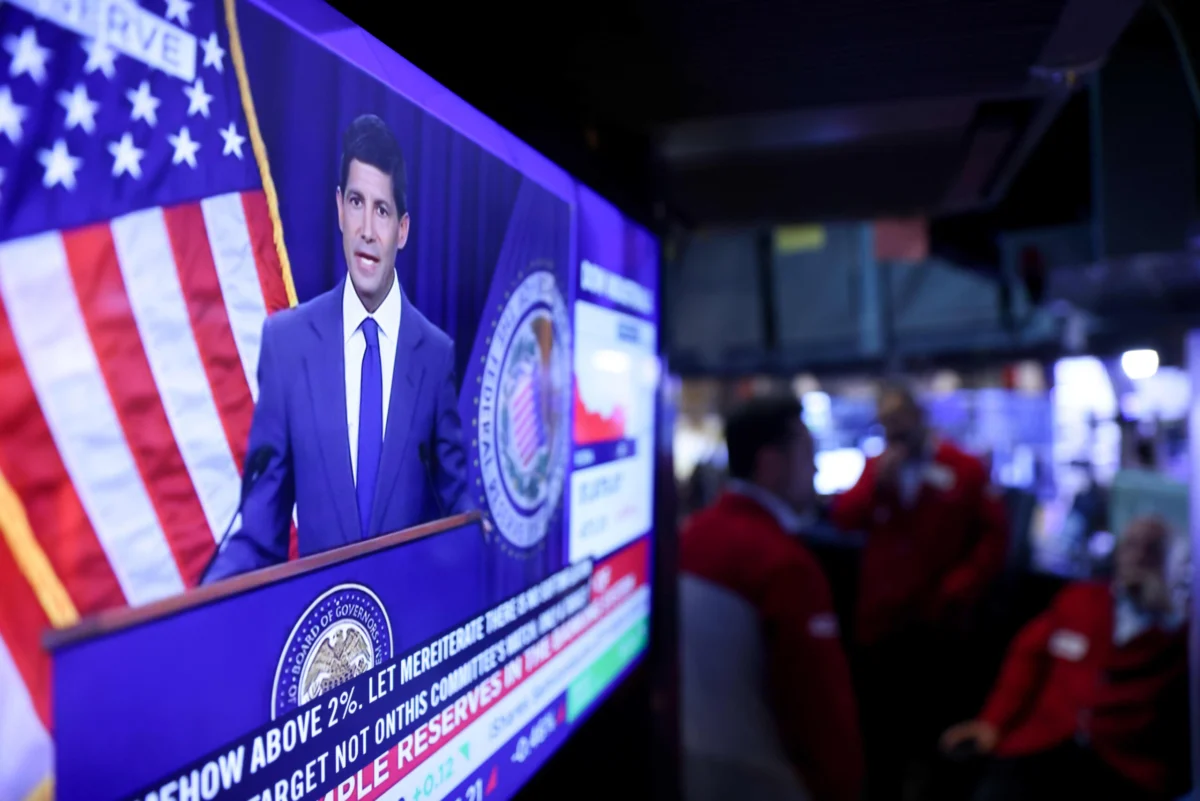
New York, US – The financial world received its latest glimpse into the Federal Reserve’s dramatically reshaped communication strategy on Wednesday, July 29, 2026, as the Federal Open Market Committee (FOMC) released its statement following its latest policymaking meeting. Broadcast across financial networks, with images of Chairman Kevin Warsh speaking from the floor of the New York Stock Exchange (NYSE), the event underscored a significant departure from the communication norms established by his predecessors. This second statement under Warsh’s leadership reinforces a deliberate move towards brevity and directness, challenging decades of ingrained market behavior that meticulously parsed every word for subtle shifts in policy outlook.
A Concise Declaration: The July 2026 FOMC Statement
The July FOMC statement, a mere fraction of the length characteristic of previous administrations, continued the trend set by Warsh’s inaugural release in June. Stripped of explicit forward guidance on the future path of interest rates or asset purchases, and notably devoid of details regarding individual FOMC member votes, the statement focused solely on the Committee’s immediate assessment of economic conditions and its policy decision. This stark contrast to the lengthy, formulaic communiqués of the Jerome Powell era has sent ripples through financial markets and economic analysis circles, forcing a re-evaluation of how investors and analysts extract signals from the world’s most influential central bank.
Under Warsh, the Fed’s messaging appears to pivot away from a prescriptive approach, instead offering what the Chairman himself described in June as "just the facts, as best we can judge it." This philosophy suggests a central bank less inclined to "hand-hold" markets through future policy trajectories, opting instead for a more agile and less committal stance, potentially allowing greater flexibility in response to evolving economic data. The July statement’s concise nature, while frustrating some who have grown accustomed to detailed guidance, is consistent with Warsh’s stated aim to make Fed communication simpler and more adaptable to the "current policy conjuncture."
Historical Context: The Evolution of Fed Communication
To fully appreciate the magnitude of Warsh’s reforms, it is essential to consider the historical trajectory of Federal Reserve communication. For much of its history, the Fed operated under a veil of deliberate opacity, a strategy often referred to as "Fedspeak." This era, epitomized by former Chairman Alan Greenspan, saw central bankers use deliberately ambiguous language to avoid locking the institution into future policy commitments and to maintain an aura of mystique that was believed to enhance their authority. Decisions were often announced with minimal explanation, leaving markets to speculate on underlying motivations.
The early 2000s marked a significant shift towards greater transparency. Under Chairman Ben Bernanke, in the wake of the 2008 financial crisis, the Fed began to experiment with clearer communication, introducing press conferences, publishing economic projections (the "dot plot"), and offering more explicit forward guidance on the expected path of interest rates. This move was partly driven by the need to manage expectations during periods of unconventional monetary policy, such as quantitative easing, where traditional interest rate tools were at their zero lower bound. The goal was to provide markets with a clearer roadmap, thereby enhancing the effectiveness of monetary policy by influencing longer-term interest rates and inflation expectations.
Janet Yellen and Jerome Powell continued this trajectory, refining forward guidance mechanisms and emphasizing the data-dependent nature of policy. FOMC statements grew in length, often exceeding 300 words, meticulously detailing the Committee’s views on inflation, employment, and risks to the economic outlook. Every adverb and adjective was scrutinized by legions of analysts, with even minor textual changes often triggering significant market reactions. This period established a predictable rhythm of detailed communication that became deeply embedded in market analysis and trading strategies.
Warsh’s approach, therefore, represents not just an incremental adjustment but a fundamental philosophical divergence from the past two decades. By paring down the FOMC statement to its bare essentials, he is challenging the very premise that extensive forward guidance is always beneficial or necessary, particularly in a potentially less crisis-driven environment where policy flexibility might be prioritized over long-term commitments.
The Warsh Doctrine: Simplicity and Agility
Chairman Warsh first articulated his vision for Fed communication during his inaugural press conference in June 2026. He candidly acknowledged the "difference" in the new statement, describing it as "a bit shorter, a bit simpler and it dispenses with some older language." His core rationale was that forward guidance was "not well suited for the current policy conjuncture." While the exact economic conditions of mid-2026 are not fully detailed, this phrasing suggests a belief that a highly prescriptive approach might hinder the Fed’s ability to respond dynamically to unforeseen economic shifts, or perhaps that the economy has reached a point where such explicit guidance is no longer the most effective tool.
Economists and market strategists have begun to unpack the implications of this "Warsh Doctrine." Some argue that excessive forward guidance can inadvertently create market dependencies, where investors become overly reliant on the Fed’s explicit promises rather than conducting their own fundamental analysis of economic data. By withdrawing detailed guidance, Warsh might be aiming to restore a degree of market self-reliance and reduce the risk of "moral hazard," where markets expect the Fed to always telegraph its moves far in advance.

Conversely, critics suggest that less explicit guidance could lead to increased market volatility and uncertainty. Without a clear signal from the central bank, investors might struggle to form consistent expectations about future policy, potentially leading to more erratic price movements in interest rates, equities, and currencies. The transparency of the Bernanke-Yellen-Powell era was designed, in part, to reduce such uncertainty, and Warsh’s shift represents a calculated risk in this regard.
Market and Analyst Reactions: Navigating the New Paradigm
The immediate aftermath of Warsh’s June statement saw investors grappling with a new communication paradigm. Traders, long accustomed to poring over dense paragraphs for subtle linguistic cues, found themselves confronted with a significantly truncated document. The absence of specific voting details, for instance, removed a key indicator of internal dissent or consensus within the FOMC, forcing analysts to seek these signals elsewhere, perhaps in individual speeches or press conference Q&As.
The financial community has been actively discussing how to adapt to this new normal. Some on Wall Street have reportedly "turned to artificial intelligence-powered tools" – perhaps "WarshGPT" as one CNBC article playfully suggested – to parse communication from the Warsh-led central bank. This highlights the perceived difficulty in deciphering the Fed’s intentions when explicit textual cues are minimized. The challenge now lies in interpreting the absence of information as much as the presence of it, and discerning Warsh’s broader economic philosophy from his more infrequent, yet potentially more impactful, public pronouncements.
The shift necessitates a greater focus on the economic data itself, as well as on the Chairman’s press conferences and speeches, which are now likely to become the primary vehicles for conveying nuanced policy outlooks. Instead of dissecting every word of a statement, analysts may now spend more time scrutinizing Warsh’s tone, emphasis, and choice of topics during live interactions. This places an even greater premium on the Chairman’s ability to articulate complex economic assessments clearly and concisely without resorting to the explicit guidance now absent from the FOMC statement.
The Role of Task Forces: Redefining Fed Operations
Beyond the communication strategy, Chairman Warsh has initiated a broader review of Federal Reserve operations. In June, he announced the formation of several task forces dedicated to examining key aspects of the institution. Earlier in July, he revealed some of the high-profile members appointed to these groups, including University of Washington professor Peter Fisher and former Bank of England Governor Mervyn King, who are notably part of the communication-focused group. Other luminaries such as Marc Andreessen and Doug McMillon were also named to other task forces, signaling a multidisciplinary approach to reimagining the Fed’s functions.
The inclusion of individuals like Mervyn King, known for his intellectual rigor and critical perspectives on central banking, suggests a deep and fundamental re-evaluation of the Fed’s role and methods. The communication task force, in particular, will be instrumental in shaping how the Fed projects its expectations and decisions to the public moving forward. Their recommendations could lead to further structural changes in how economic projections are presented, how press conferences are conducted, or even the format and content of the minutes of FOMC meetings. This holistic review indicates that the changes to the FOMC statement are not isolated, but rather part of a comprehensive strategy to modernize and streamline the central bank’s entire operational framework.
Broader Implications and the Road Ahead
Warsh’s communication revolution has profound implications for financial markets, economic forecasting, and the very perception of central banking. By moving away from highly detailed forward guidance, the Fed under Warsh might aim to foster greater market discipline, forcing investors to engage in more independent analysis rather than relying on explicit signals. This could, in theory, lead to more efficient capital allocation as markets become less reactive to every syllable from the central bank and more responsive to fundamental economic realities.
However, the transition period is likely to be characterized by heightened uncertainty. Market participants will need time to adjust to the new communication signals, and there may be periods of increased volatility as the market seeks to establish a new equilibrium for interpreting Fed policy. The burden of clear communication now shifts significantly to the Chairman’s public appearances and speeches, making these events even more critical for market guidance.
The success of Warsh’s reforms will ultimately be judged by their impact on economic stability and the Fed’s ability to achieve its dual mandate of maximum employment and price stability. If the simplified communication leads to clearer understanding and more effective policy transmission without undue market disruption, it could set a new global standard for central bank transparency. Conversely, if it creates persistent ambiguity and undermines market confidence, Warsh may face pressure to revert to more traditional methods.
As the Federal Reserve navigates this new era, the world will be watching closely. The July 2026 FOMC statement is not just a policy announcement; it is a declaration of intent, a bold step in reshaping how the most powerful financial institution communicates its vision and steers the global economy. The journey of adapting to Warsh’s new Fed has only just begun.