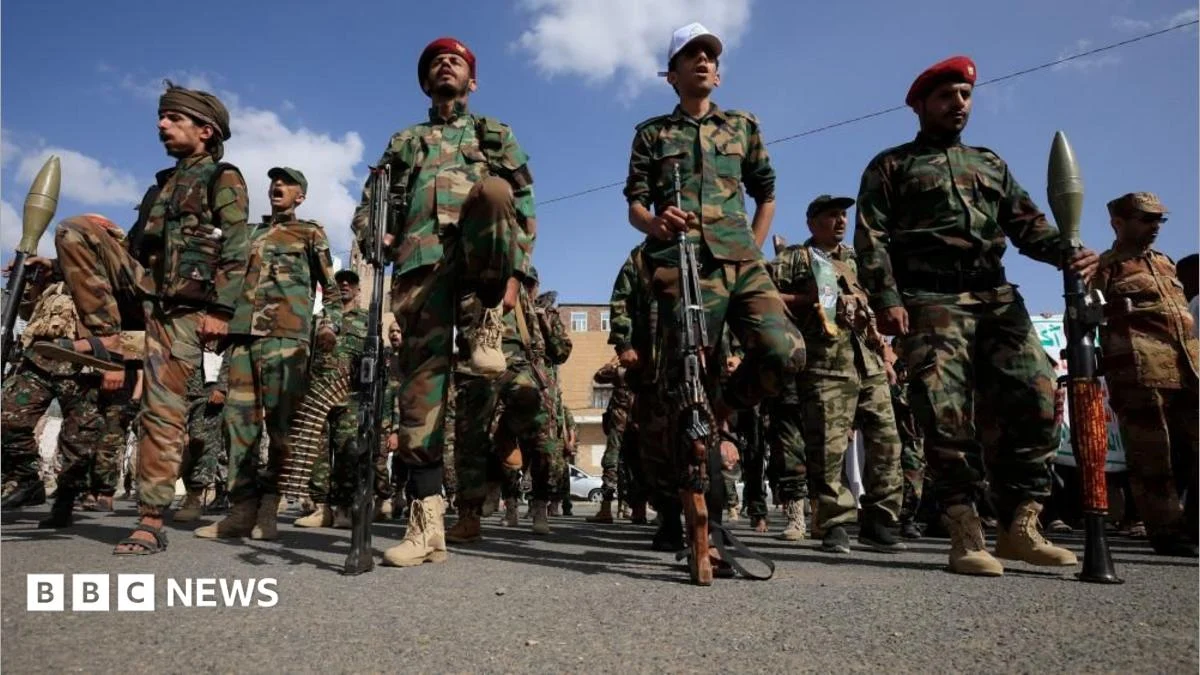
Yemen’s Houthi movement, backed by Iran, has announced a significant military advance along the western Red Sea coast, effectively cementing its control over a crucial international shipping route. This rapid territorial gain includes the seizure of Perim Island, strategically located at the mouth of the Bab al-Mandab Strait, a vital chokepoint for global maritime trade. The capture of Perim Island follows closely on the heels of the Houthis’ successful offensive to take the strategic port city of Mokha from Saudi-backed pro-government forces. According to a source within Yemen’s internationally recognised government who spoke to the BBC, Perim Island, also known as Mayyun, was overrun after pro-government forces withdrew. A Yemeni military official, relaying information to AFP news agency, confirmed that the Houthis now exert control over the entire coastline along this critical maritime corridor.
The Houthi advance marks a dramatic shift in the ongoing conflict in Yemen, with profound implications for regional stability, global energy markets, and international shipping. While the Houthi leadership has issued reassurances that international shipping remains safe, they have concurrently reiterated their explicit threat to target vessels originating from or destined for Saudi Arabia. This dual message underscores the escalating tensions in a waterway that sees billions of dollars in trade pass through annually. The gravity of the situation prompted Saudi Crown Prince Mohammed bin Salman, the Kingdom’s de facto ruler, to personally appeal to US President Donald Trump, urging direct military intervention against the Houthis’ swift territorial gains. However, sources familiar with the discussions, including CBS News, reported that President Trump has so far refrained from deploying US military forces directly, opting instead to provide intelligence and targeting assistance to Saudi Arabia. A senior Trump administration official later affirmed the US commitment to regional stability, stating, "We are in continuous dialogue with Saudi Arabia and the Republic of Yemen government regarding regional stability."
Strategic Significance of the Bab al-Mandab Strait
The Bab al-Mandab Strait, Arabic for "Gate of Tears," is one of the world’s most critical maritime chokepoints, connecting the Red Sea to the Gulf of Aden and the Arabian Sea. Approximately 12% of global seaborne trade and a substantial portion of the world’s oil supply, estimated at over 6.2 million barrels per day, pass through this narrow waterway. Its strategic importance has been further amplified by persistent tensions in other vital shipping lanes, particularly the Strait of Hormuz, which experienced significant disruptions amidst heightened US-Iran hostilities. For Saudi Arabia, the Bab al-Mandab Strait and the Red Sea represent an indispensable route for exporting crude oil to customers in Asia, reducing its sole reliance on routes through the Persian Gulf. Any disruption here carries significant geopolitical and economic ramifications, capable of sending ripple effects across global supply chains and energy markets. The seizure of Perim Island, a small volcanic island measuring approximately 13 square kilometers, is particularly noteworthy due to its geographical position at the narrowest point of the strait, where the distance between the Arabian Peninsula and the African continent shrinks to just 29 kilometers (18 miles). Control over Perim Island effectively grants the Houthis a vantage point and potential leverage over passing maritime traffic.
Chronology of a Rapid Houthi Offensive
The recent Houthi offensive began in earnest on September 3, with the group launching what its military spokesman, Yahya Sarea, described as a "large-scale" military operation. Sarea stated the operation was a direct response to Saudi Arabia’s "blatant aggression" against the Yemeni people. This offensive quickly gained momentum, leading to a series of significant victories for the Houthis:
- September 3: Houthi forces initiate a major offensive in the western regions of Yemen, targeting areas in Taiz and Hodeidah.
- September 5 (Approximate): Reports emerge of Houthi forces capturing the strategic port city of Mokha. Mokha, once a globally renowned coffee port, holds significant strategic value as a coastal stronghold and a potential logistical hub for military operations. Its fall was confirmed by military sources, marking a substantial setback for pro-government forces.
- September 6: Yemeni pro-government forces are reported to have withdrawn from Perim Island. Witnesses and news agencies subsequently reported Houthi forces moving onto the island, consolidating their control over this critical choke point.
- September 6 (Evening): The Houthis issue an official statement, declaring their military operation to expel Saudi-backed forces a "success." The statement explicitly asserted that "maritime navigation is safe for all companies except for Saudi vessels," reiterating their threat against Saudi shipping.
- Ongoing: Houthi military spokesman Yahya Sarea claims that hundreds of pro-government troops were killed, wounded, or captured during the offensive, and that Houthi forces successfully expelled "Saudi enemy" forces from six districts across the Taiz and Hodeidah regions. While the Houthi statement detailed broad successes, it notably did not specifically mention the capture of Perim Island, though other reports confirmed it. Saudi Arabia has, to date, not publicly commented on these latest developments, maintaining an official silence that has been interpreted by some analysts as a recognition of the severity of the setbacks.
Broader Context: The Yemen Conflict and Regional Proxy War
The Houthis’ recent gains are set against the backdrop of a brutal civil war that has ravaged Yemen since late 2014, when the Houthis, a Zaydi Shia group, swept down from their northern stronghold of Saada to seize the capital, Sanaa, and oust the internationally recognized government of President Abdrabbuh Mansur Hadi. In March 2015, a Saudi-led coalition, comprising several Sunni Arab states, intervened with a massive air campaign, dubbed "Operation Decisive Storm," with the stated aim of restoring the Hadi government and countering perceived Iranian expansionism in the region.
The conflict has since devolved into a protracted proxy war, with Saudi Arabia and its allies battling the Houthis, who are widely believed to receive military and logistical support from Iran. Despite billions of dollars spent and extensive military operations, the Saudi-led coalition has struggled to dislodge the Houthis, who have demonstrated remarkable resilience and an increasing capacity to project power beyond Yemen’s borders, including sophisticated drone and missile attacks on Saudi infrastructure. The conflict has triggered the world’s worst humanitarian crisis, with millions facing starvation, disease, and displacement. The United Nations estimates that hundreds of thousands have died directly or indirectly due to the conflict, and over three million people have been internally displaced. The recent Houthi offensive in the southwest has reportedly led to hundreds more casualties and thousands more displaced in just the past week, exacerbating an already dire situation.
International Reactions and Diplomatic Chessboard
The Houthi advance has naturally drawn significant attention from international powers, particularly the United States, a key ally of Saudi Arabia. The personal appeal from Crown Prince Mohammed bin Salman to President Trump underscores the perceived threat level in Riyadh. Saudi Arabia views Houthi control over the Bab al-Mandab as a direct security threat and a potential stranglehold on its vital oil exports. While the US has refrained from direct military engagement, its offer of intelligence and targeting support signals continued backing for its Gulf ally, albeit with a cautious approach to avoid deeper entanglement in a conflict that has proven intractable and highly controversial internationally. The Trump administration’s emphasis on "continuous dialogue" suggests a preference for diplomatic and indirect support over direct military intervention, likely influenced by the high human cost of the conflict and the desire to avoid another prolonged military commitment in the Middle East.
International maritime organizations and global trade bodies are expected to closely monitor the situation, potentially issuing advisories to shipping companies operating in the region. The explicit Houthi threat against Saudi vessels raises concerns about increased maritime insecurity, potentially leading to higher insurance premiums and longer transit times as shipping companies seek alternative, safer routes or enhanced security measures.
Economic Ramifications and Energy Security Concerns
The escalation of the conflict, particularly the Houthis’ control over a critical shipping lane, has already contributed to a surge in global oil prices. The market reacts sensitively to any perceived threat to supply, especially from a region as volatile and vital as the Middle East. Beyond the immediate impact on shipping, the broader implications for energy security were highlighted by a separate incident on Friday. Saudi Arabia’s foreign affairs ministry reported that drones, believed to have originated from Iraq, targeted the Kingdom’s East-West oil pipeline. This attack forced the pipeline, a critical conduit for moving oil from the eastern fields to the Red Sea coast, to be temporarily closed as a "precautionary measure," injuring several people.
The Iraqi government swiftly condemned the attack, with its prime minister launching an investigation. Significantly, the prime minister’s office announced the removal of the operations commander in the Maysan governorate, a province bordering Iran, following confirmation that the drone attack had indeed originated from that region. This detail raises serious questions about potential non-state actor involvement or cross-border proxy activities, further complicating regional security dynamics. Following a call from Iraq’s prime minister, Saudi Arabia’s foreign ministry stated it had chosen not to respond to the attacks at this stage, indicating a diplomatic approach to de-escalate tensions with Iraq, while implicitly acknowledging the severe nature of the incident. Such attacks on energy infrastructure underscore the vulnerability of global energy supplies to regional conflicts and the interconnectedness of various flashpoints.
Military Dynamics and Future Outlook
The Houthi forces have demonstrated a growing capacity for asymmetric warfare, utilizing drones, ballistic missiles, and now, strategic coastal control to exert pressure on the Saudi-led coalition. The Saudi-led coalition has continued its air strikes on Houthi-controlled areas in western Yemen in support of pro-government forces, but these have not been sufficient to halt the Houthi advance. The Houthis, in turn, have launched numerous missiles and drones at cities and oil facilities in southern Saudi Arabia, illustrating their capability to strike deep within Saudi territory.
The consolidation of Houthi control over the entire western Red Sea coastline, including Perim Island and Mokha, grants them significant strategic advantages. It not only strengthens their defensive posture but also provides potential platforms for future offensive operations or, critically, leverage in any future peace negotiations. This development presents a formidable challenge for the internationally recognized government of Yemen and its Saudi backers. Reclaiming these territories would require a significant military effort, with potentially high costs in terms of lives and resources.
Analysts suggest that this Houthi advance could lead to a protracted stalemate, with the Houthis holding key strategic assets, or it could trigger a renewed and more intense phase of the conflict. The international community, particularly the United Nations, will face increased pressure to find a diplomatic resolution to the Yemen conflict, which now carries even greater risks for global trade and regional stability. The strategic implications of Houthi control over the Bab al-Mandab are far-reaching, transforming a local conflict into one with palpable global consequences, especially for maritime security and the delicate balance of power in the Middle East.