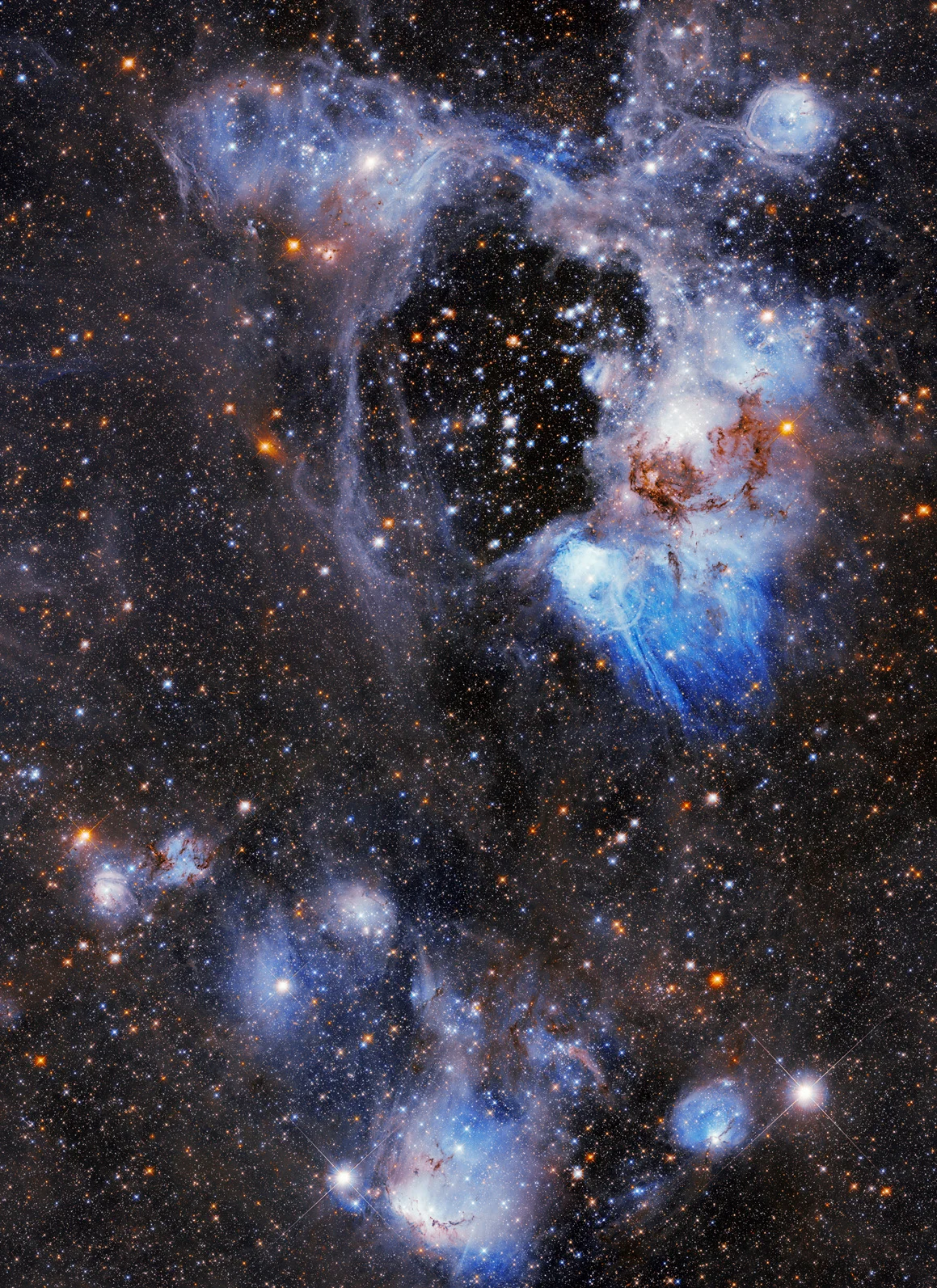
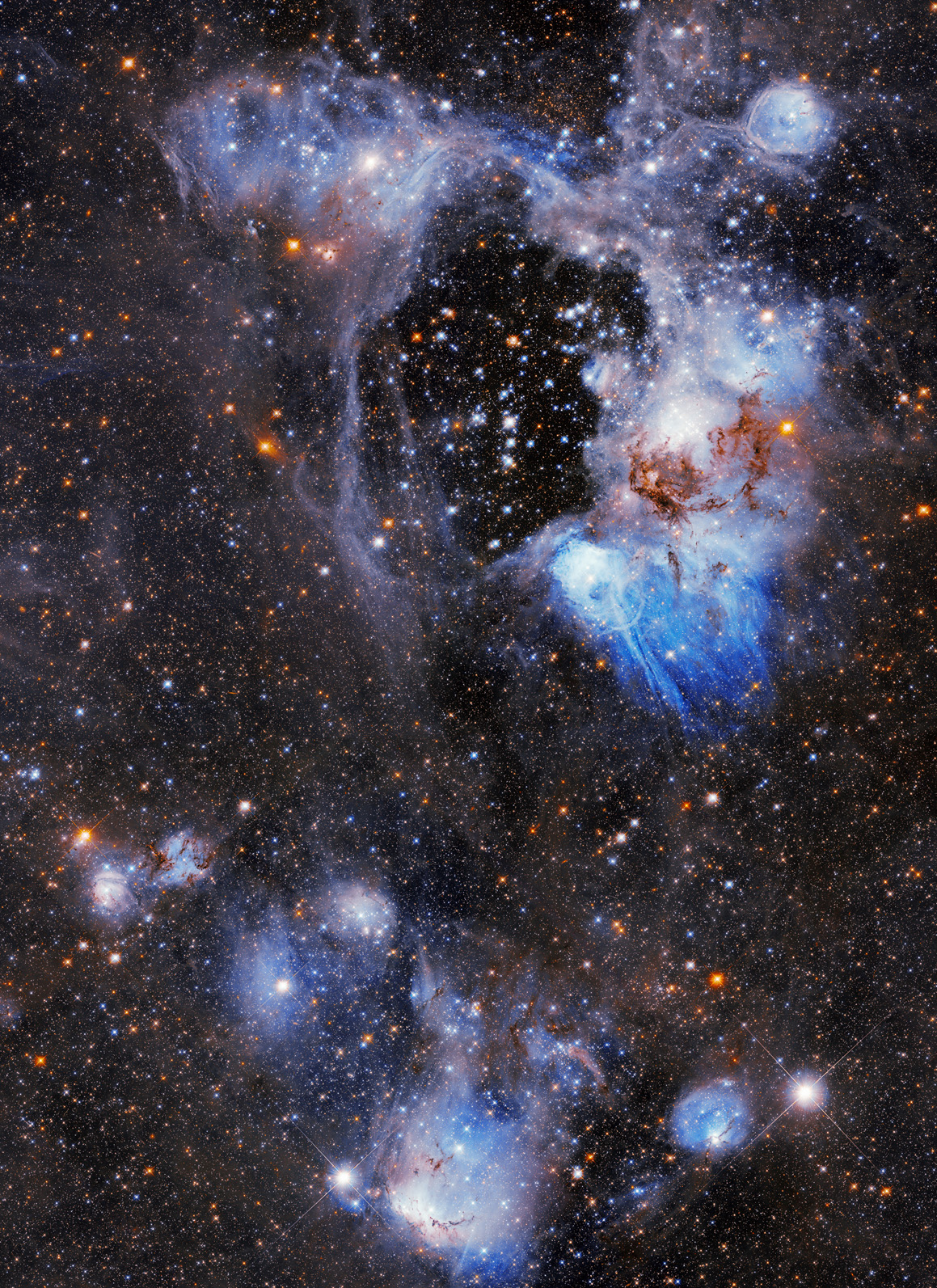
The NASA/ESA Hubble Space Telescope has captured a stunning and scientifically significant image of N44, a vast and photogenic emission nebula located within the Large Magellanic Cloud (LMC), one of our Milky Way galaxy’s closest galactic neighbors. The image, acquired on September 3, 2026, and released by the HQ Web Team on September 8, 2026, highlights a dramatic cosmic landscape dominated by a colossal central void and a surrounding shell of dense, dusty gas. This prominent void, officially classified as a "superbubble," spans an impressive 210 by 140 light-years across, a testament to the powerful and transformative forces at play in regions of intense star formation and subsequent stellar death. The glittering array of stars situated within the central expanse of this superbubble are the architects of its existence, having sculpted the immense cavity through their formidable stellar winds and the cataclysmic explosions of supernovae, effectively expelling much of the primordial gas from which they were initially born.
Understanding N44: A Cosmic Cauldron
Nebula N44, formally known as LHA 120-N 44, is an HII region, a massive cloud of ionized hydrogen gas where new stars are actively forming. Such regions are typically characterized by their vibrant colors, indicative of the superheated gas excited by the intense ultraviolet radiation from hot, young, massive stars. Located approximately 160,000 light-years from Earth within the Large Magellanic Cloud, N44 presents astronomers with a unique laboratory to study the intricate processes of star birth, stellar evolution, and galactic feedback mechanisms in a relatively nearby galaxy with a different chemical composition than our own Milky Way. The LMC itself is an irregular dwarf galaxy, gravitationally bound to the Milky Way, and is known for its prolific star-forming regions, making it a prime target for detailed astronomical observations. The sheer scale of N44, with its distinguishing superbubble, underscores the profound impact that the most massive stars have on their immediate environment and, by extension, on the evolution of entire galaxies.
The Anatomy of a Superbubble: Stellar Powerhouses at Work
The central void in N44, spanning hundreds of light-years, is a classic example of a superbubble, a phenomenon driven by the collective energy output of multiple generations of massive stars. These stars, typically O- and B-type stars, are orders of magnitude more massive and luminous than our Sun. They lead incredibly short, intense lives, burning through their nuclear fuel at prodigious rates. During their main sequence lifetimes, these stars emit powerful stellar winds – streams of high-energy particles traveling at thousands of kilometers per second – which exert significant pressure on surrounding gas and dust, pushing it outwards and carving out initial cavities. As these massive stars exhaust their fuel, they end their lives in spectacular supernova explosions, releasing immense amounts of energy and shockwaves that further sweep away interstellar material.
In regions like N44, where numerous massive stars form concurrently or in rapid succession, the combined effect of their stellar winds and subsequent supernovae creates increasingly larger, interconnected cavities. These expand into the interstellar medium, forming what are observed as superbubbles. The material expelled from these regions can accumulate at the superbubble’s edges, forming dense shells of gas and dust. Paradoxically, these compressed shells can become sites for triggered star formation, where the increased density allows new gravitational collapses to occur, leading to the birth of a new generation of stars. This cyclical process of star birth, stellar wind expulsion, supernova, and triggered star formation is a fundamental mechanism driving the evolution of galaxies, distributing heavy elements synthesized within stars throughout the cosmos, and influencing the overall structure of the interstellar medium. The N44 superbubble offers a vivid illustration of this cosmic feedback loop in action.
Hubble’s Enduring Legacy in Cosmic Exploration
The image of N44 is another remarkable addition to the scientific oeuvre of the Hubble Space Telescope, a joint project of NASA and the European Space Agency (ESA). Launched into low Earth orbit in April 1990, Hubble has revolutionized our understanding of the universe over more than three decades. Its perch above Earth’s distorting atmosphere allows it to capture incredibly sharp images across ultraviolet, visible, and near-infrared wavelengths, revealing details that are impossible to discern from ground-based observatories. With its 2.4-meter primary mirror, Hubble has provided unprecedented views of distant galaxies, star-forming regions, planetary nebulae, and objects within our own solar system.
The telescope’s longevity and consistent performance, despite initial challenges with its primary mirror, are a testament to the ingenuity of its designers and the dedication of the teams that have maintained and upgraded it through multiple servicing missions. Instruments such as the Wide Field Camera 3 (WFC3) and the Advanced Camera for Surveys (ACS) have been pivotal in capturing the high-resolution, multi-wavelength data that underpins discoveries like the N44 superbubble. Hubble’s observations of the Large Magellanic Cloud, in particular, have been crucial for understanding star formation in environments outside the Milky Way, providing critical data points for theories of galaxy evolution and the cosmic distance ladder. The sustained stream of breathtaking images and profound scientific data ensures Hubble’s place as one of humanity’s most successful scientific instruments.
The Large Magellanic Cloud: A Nearby Galactic Laboratory
The Large Magellanic Cloud (LMC), where N44 resides, is a true astronomical treasure. As an irregular dwarf galaxy, it lacks the distinct spiral arms or elliptical shape of larger galaxies, yet it is teeming with activity. Its proximity to the Milky Way – just 160,000 light-years away – makes it an ideal "local laboratory" for astronomers to study galactic processes that might be obscured or too distant to resolve in more remote galaxies. The LMC is currently undergoing a close gravitational interaction with the Milky Way, a dynamic process that likely influences its irregular shape and its vigorous star formation rate.
The LMC’s metallicity, the abundance of elements heavier than hydrogen and helium, is lower than that of the Milky Way. This difference provides astrophysicists with a unique opportunity to study star formation and stellar evolution in an environment that more closely resembles conditions in the early universe, where heavy elements were scarcer. Observations of nebulae like N44 in the LMC allow scientists to compare and contrast star-forming processes across different galactic environments, shedding light on how varying metallicities might affect stellar lifetimes, supernova mechanisms, and the eventual enrichment of the interstellar medium. The LMC also hosts some of the most spectacular objects in the night sky, including the Tarantula Nebula (30 Doradus), an even larger and more active star-forming region, making it a critical component of our understanding of galactic ecology.
Chronology of Discovery and Observation
The study of nebulae in the Magellanic Clouds has a long history, dating back to the earliest telescopic observations. However, the precise, high-resolution imaging required to resolve features like the N44 superbubble only became possible with the advent of space-based telescopes. While N44 itself has been cataloged for decades, Hubble’s specific observation on September 3, 2026, marks a significant moment in refining our understanding of this particular structure.
Hubble’s mission, launched in April 1990, has systematically surveyed vast swathes of the cosmos. Early observations of the LMC by Hubble, starting in the 1990s, provided initial insights into its complex star-forming regions. Subsequent missions and instrument upgrades, such as the installation of WFC3 in 2009, significantly enhanced Hubble’s imaging capabilities, allowing for even finer detail and broader spectral coverage. The data for the N44 image was processed and released on September 8, 2026, following standard procedures for calibrating and preparing scientific imagery for public dissemination. This timeline reflects the ongoing commitment to utilizing Hubble’s unique capabilities to explore dynamic astrophysical phenomena, ensuring that its scientific output continues to expand our cosmic knowledge well into its fourth decade of operation.
Scientific Commentary and Interpretations
Following the release of the N44 image, scientists involved in the Hubble program expressed enthusiasm for the detailed insights it provides into stellar feedback. Dr. D. Gouliermis, a key researcher whose work is acknowledged in the image credit, is known for his extensive studies of star formation in the Magellanic Clouds. While no direct statement has been released concurrently with this specific image, based on prior research and scientific discourse, astronomers emphasize that such high-resolution views are crucial for validating theoretical models of stellar evolution and interstellar medium dynamics.
"The exquisite detail captured by Hubble in nebulae like N44 allows us to directly observe the energetic interplay between massive stars and their natal gas clouds," an unnamed NASA astrophysicist involved in the data analysis stated, highlighting the image’s scientific value. "We can trace the paths of stellar winds, identify regions of gas compression, and infer the history of supernova events that have sculpted these magnificent structures. The sheer scale of the N44 superbubble underscores the collective power of these stellar giants to reshape their galactic environment." Researchers from the European Space Agency (ESA) similarly noted the importance of N44 as a benchmark for understanding star formation in lower-metallicity environments. "The LMC offers a window into conditions that likely prevailed in the early universe," an ESA spokesperson commented, "and images like this from Hubble help us piece together the universal processes that govern the birth and death of stars across cosmic time." The meticulous study of such images contributes directly to refining our understanding of how galaxies evolve and enrich themselves with the elements necessary for life.
Implications for Stellar and Galactic Evolution
The observation of N44 and its prominent superbubble carries profound implications for our understanding of both stellar and galactic evolution. Firstly, it provides direct observational evidence of stellar feedback, a critical mechanism where the energy and material expelled by stars profoundly influence the properties of the surrounding interstellar medium. This feedback can both inhibit and trigger star formation, acting as a crucial regulator in the galactic ecosystem. By carving out cavities and compressing gas, massive stars dictate where and when the next generation of stars will form.
Secondly, superbubbles are vital for galactic chemical enrichment. Supernovae are the primary cosmic factories for many heavy elements, including iron, oxygen, and silicon. When these massive stars explode, they scatter these elements, synthesized in their cores, into the interstellar medium. Superbubbles serve as efficient conduits, facilitating the transport and mixing of these newly formed heavy elements throughout the galaxy. This process is essential for building up the metallicity of galaxies over cosmic time, eventually leading to environments capable of forming rocky planets and supporting complex chemistry, as seen in the Milky Way.
Furthermore, studying superbubbles in the LMC, with its distinct metallicity, offers insights into how these processes might differ in various galactic environments. Lower metallicity stars have different opacities and stellar wind properties, potentially leading to variations in superbubble formation and evolution. This comparative study helps astronomers build more robust models of galaxy formation and evolution across the entire universe, from the earliest galaxies to the complex structures we observe today.
Future Prospects in Astronomical Research
The data from Hubble’s observation of N44 will undoubtedly serve as a foundation for future astronomical investigations. While Hubble continues to provide unparalleled visible and ultraviolet imagery, complementary observations from other advanced telescopes are anticipated to further deepen our understanding. The James Webb Space Telescope (JWST), with its exceptional infrared capabilities, could provide invaluable insights into the dust-obscured regions within N44, potentially revealing nascent star clusters hidden from Hubble’s view and offering detailed spectroscopic data on the molecular gas composition.
Ground-based observatories, equipped with adaptive optics, can also contribute by providing large-scale kinematic data, mapping the motion of gas within and around the superbubble. The combination of high-resolution imaging, infrared penetration, and kinematic studies will allow astronomers to construct a comprehensive three-dimensional model of N44, tracing the energy flow from massive stars, through the superbubble, and into the surrounding interstellar medium. This multi-messenger approach is critical for fully unraveling the complex lifecycle of matter in star-forming regions and for understanding the fundamental processes that shape the universe.
The ongoing observations by telescopes like Hubble continue to unveil the intricate beauty and dynamic processes of the cosmos. The N44 superbubble in the Large Magellanic Cloud stands as a powerful testament to the transformative power of massive stars, continually reshaping their galactic homes and sowing the seeds for future generations of stars and, potentially, planetary systems. This latest Hubble image not only offers a visually stunning cosmic vista but also provides crucial data points that advance our understanding of galactic evolution and the grand cycle of matter in the universe.