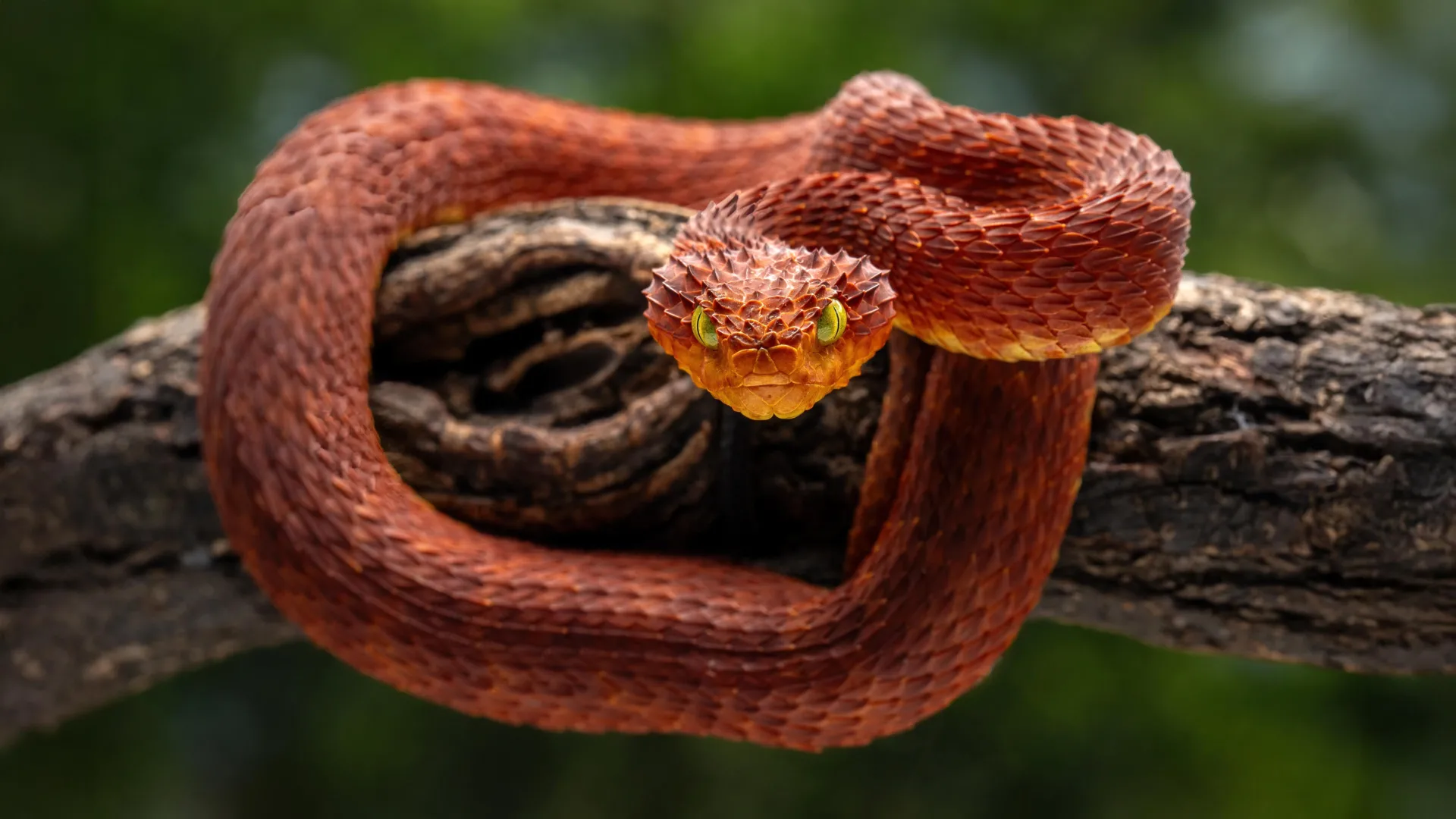
University of Maryland researchers have identified a promising new way to treat venomous snakebites by borrowing from snakes’ own natural defenses. Their approach uses toxin-blocking proteins that western diamondback rattlesnakes evolved to protect themselves from venom. By combining specific proteins found in rattlesnake blood, the researchers achieved unusually strong protection against venom from several dangerous snake species. This groundbreaking study, published in the Proceedings of the National Academy of Sciences and led by Distinguished University Professor of Biology Sean B. Carroll, could revolutionize the development of antivenoms, offering hope against a persistent global health crisis.
The Silent Scourge: Snakebite as a Neglected Tropical Disease
Snakebite envenoming remains one of the most significant yet overlooked global health emergencies. The World Health Organization (WHO) estimates that between 80,000 and 140,000 people die annually from venomous snakebites, with hundreds of thousands more suffering permanent disabilities such as amputations, blindness, and chronic pain. These debilitating effects disproportionately impact vulnerable populations in rural, low-resource settings, where access to timely and effective medical care, including antivenom, is often severely limited. The economic burden is also substantial, with lost productivity and disability-related costs running into billions of dollars worldwide.
The current standard of care for snakebite envenoming relies on antivenoms, typically produced by immunizing large animals, most commonly horses, with small doses of snake venom. The animals’ immune systems then generate antibodies, which are subsequently harvested, purified, and formulated into therapeutic injections. While these antivenoms have undoubtedly saved countless lives since their development in the late 19th century, they are not without significant drawbacks. Their production is a complex and costly process, often leading to shortages and high prices, especially in developing nations. Furthermore, the quality and potency of antivenoms can vary considerably depending on the manufacturing process and the specific snake species used for immunization. Critically, many existing antivenoms exhibit limited cross-reactivity, meaning they are only effective against the venom of the snake species used in their production. This necessitates the availability of a wide array of antivenoms for different geographical regions and snake populations, a logistical challenge that many healthcare systems struggle to meet. Moreover, antivenoms can trigger severe adverse reactions, including anaphylaxis and serum sickness, due to the presence of foreign proteins.
A Natural Blueprint: Unraveling the Rattlesnake’s Immunity
For decades, scientists have observed that vipers, including rattlesnakes, appear remarkably resistant to their own venom. This phenomenon, known anecdotally for a century, hinted at an intrinsic defense mechanism. Professor Carroll’s laboratory at the University of Maryland embarked on a quest to uncover the biological underpinnings of this natural immunity, recognizing that if snakes could protect themselves, nature might hold the key to a superior human treatment.
The pivotal breakthrough came in 2022 when Carroll’s team identified a specific protein within the blood of western diamondback rattlesnakes, dubbed FETUA-3. This protein demonstrated a remarkable ability to neutralize metalloproteinase toxins, a significant class of enzymes found in rattlesnake venom that can cause tissue damage, bleeding, and other severe physiological disruptions. Further investigations revealed that FETUA-3 could also bind to and inhibit toxins from the venoms of several other rattlesnake species, suggesting a broader protective capacity.
"We’ve known from anecdotes for 100 years that vipers tend to be resistant to their own venom," Professor Carroll explained in a statement. "But for a long time, nobody knew what exactly was circulating in their blood that protected them. Here was evolution’s way for snakes to protect themselves from accidental self-envenomation." This discovery prompted a crucial question: why rely on the complex and often problematic production of animal-derived antibodies when nature had already engineered a potent antidote within the snake itself?
The Synergy of Defense: Protein Combinations Unleash Potent Neutralization
The current study, building upon the identification of FETUA-3, delved deeper into the complex cocktail of protective proteins present in rattlesnake blood. Led by Professor Carroll and co-authored by Elda Sánchez, director of the National Natural Toxins Research Center at Texas A&M University-Kingsville, the research team meticulously analyzed the individual contributions of various FETUA proteins to venom resistance.
Their findings revealed that while individual FETUA proteins could counteract specific venom effects – for instance, one protein might mitigate bleeding while another interfered with enzymatic activity – none alone provided complete protection against lethal envenomation. The true power of nature’s defense lay in the synergistic action of multiple proteins working in concert.
When researchers combined specific FETUA proteins, the protective effects were dramatically amplified. This was a critical realization, as snake venom is notoriously complex, often containing upwards of 100 different toxin proteins organized into multiple families. The composition of venom varies significantly not only between different snake species but also within populations of the same species. This intricate biological arsenal necessitates a similarly sophisticated defense.
"The ingredients are there," Professor Carroll remarked. "We just have to keep testing various mixtures." Through extensive laboratory experiments, the team optimized combinations of these naturally occurring proteins. The results were extraordinary. These optimized protein mixtures proved to be approximately 10 times more potent than current sheep-derived rattlesnake antivenom. In laboratory settings, these novel combinations not only completely neutralized the lethal effects of western diamondback rattlesnake venom but also offered broad-spectrum protection against the venoms of multiple viper species. Remarkably, this protection extended to species that have evolved separately for over 50 million years, underscoring the deep evolutionary conservation of these defensive mechanisms.
The remarkable evolutionary persistence of these inhibitory proteins, conserved over such vast geological timescales, highlights the constant evolutionary pressure snakes face from their own venom. While the precise mechanisms of accidental self-envenomation in snakes are still being fully elucidated, potential routes include incidental contact with venom during feeding, cannibalism, or even direct contact with mouth tissues during the act of biting.
The Road Ahead: Towards a New Generation of Safer, More Effective Antivenoms
The current research focused on metalloproteinases, a crucial class of venom toxins. However, the underlying strategy – identifying and harnessing natural protein inhibitors – is being extended to target other major toxin families prevalent in viper venoms. Professor Carroll expressed optimism, stating, "We’re getting remarkably close to having effective solutions for the three major toxin families in vipers. What we’ve learned here, together with research we’re doing now, gives us real confidence that nature-based recombinant [lab-produced] antivenoms are within reach."
The implications of this research are profound. The development of nature-based recombinant antivenoms holds the promise of overcoming many of the limitations associated with current treatments. These new antivenoms could be:
- More Potent and Broader Spectrum: Offering significantly enhanced protection against a wider range of venoms, potentially reducing the need for numerous specialized antivenoms.
- Safer: By using purified, humanized, or specifically engineered proteins, the risk of severe immune reactions seen with animal-derived antivenoms could be substantially minimized.
- More Accessible and Affordable: Recombinant production in laboratory settings, such as using engineered yeast or bacteria, can be scaled up more efficiently and cost-effectively than traditional animal immunization. This could lead to a significant reduction in the cost of antivenoms, making them more accessible to those who need them most.
- Easier to Standardize and Store: Recombinant products can offer greater consistency in quality and potency, and potentially have longer shelf lives and require less stringent storage conditions.
Professor Carroll anticipates that the initial commercial applications of this "nature’s antivenom" might emerge in veterinary medicine, providing much-needed treatments for pets and livestock affected by snakebites. Subsequently, these advancements could pave the way for highly effective and accessible treatments for human snakebite envenoming.
"We could make train cars-worth of this stuff and help solve a massive global health problem," Professor Carroll envisioned. "Many of our most important medicines have come from nature. I’m delighted that the components for a better-than-commercial antivenom were in these snakes all along."
The research team at the University of Maryland included visiting faculty specialists Fiona Ukken and Yetunde Ayinuola from the Department of Biology. The work was generously supported by the Howard Hughes Medical Institute and the Viper Resource Center (Grant #P40OD01960-22). This collaborative effort represents a significant leap forward in the fight against snakebite envenoming, demonstrating the power of studying natural biological systems to address critical human health challenges. The findings offer a beacon of hope for millions worldwide affected by this devastating neglected tropical disease.