


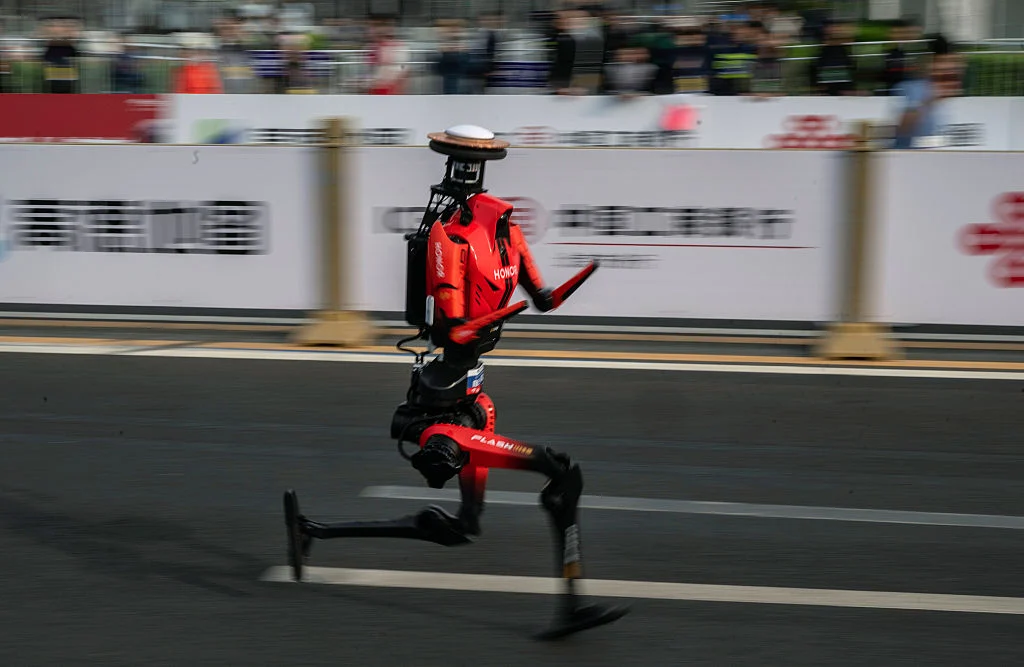
A new era in bipedal robotics dawned today in Beijing as a humanoid robot completed a half-marathon in an astonishing 50 minutes and 26 seconds, a time that significantly surpasses the current human world record of 57 minutes recently set by Jacob Kiplimo. The achievement, which occurred at the annual Beijing Half-Marathon for Humanoid Robots, marks a dramatic leap forward in robotic locomotion and autonomy, signaling rapid advancements in the field of artificial intelligence and advanced mechanics. This breakthrough performance, delivered by an autonomous robot developed by Chinese smartphone giant Honor, not only sets a new benchmark for machine endurance but also intensifies discussions about the future capabilities and integration of humanoid robots into various facets of society.
A New Benchmark for Bipedal Machines
The winning robot, a product of Honor’s burgeoning robotics division, crossed the finish line of the 21.0975-kilometer course in 50 minutes and 26 seconds, an unprecedented speed for an autonomous bipedal machine in a competitive endurance event. While the robot’s time represents the fastest autonomous completion, it was not the absolute quickest of the day. Another Honor-built robot, operated via remote control, clocked an even faster time of 48 minutes and 19 seconds. However, due to the weighted scoring system of the competition, which prioritizes autonomous capabilities, the 50:26 robot was declared the official winner. This distinction underscores the core objective of the event: to push the boundaries of self-governing robotic systems rather than merely demonstrating raw mechanical speed under direct human guidance.
The sheer speed achieved by Honor’s autonomous entry is particularly striking when juxtaposed against human athletic performance. Jacob Kiplimo’s world record of 57 minutes for a human half-marathon, a testament to years of dedicated training and peak physiological conditioning, now stands nearly seven minutes behind that of a machine. This comparison, while often met with analogies like "my car can outrun a cheetah too" – highlighting the fundamental differences between biological and engineered systems – nonetheless serves as a potent indicator of the accelerating pace of robotic development. The ability of a humanoid robot to maintain such a high average speed over a sustained period, autonomously navigating the course, represents a significant engineering triumph.
The Beijing Half-Marathon for Humanoid Robots: A Crucible of Innovation
The Beijing Half-Marathon for Humanoid Robots is not merely a spectacle but a critical proving ground for advanced robotics. Organized by the Beijing E-Town tech hub, a designated zone for high-tech industrial development and innovation, the event aims to accelerate research and development in bipedal locomotion, autonomous navigation, power management, and human-robot interaction. It brings together leading robotics companies, research institutions, and universities from across China and, increasingly, internationally, to showcase their latest advancements and compete in a challenging real-world scenario.
The competition typically features a diverse array of humanoid robots, ranging from nimble, lightweight designs optimized for speed to more robust models focusing on stability and payload capacity. Participants must contend with a variety of factors inherent in an outdoor endurance race, including variable terrain, potential obstacles, and the sheer demand for sustained, energy-efficient movement. The half-marathon distance is chosen specifically because it pushes the limits of current battery technology and motor efficiency, forcing engineers to optimize every aspect of their robot’s design for prolonged performance. The event also serves as a talent magnet, drawing in engineers and researchers passionate about pushing the boundaries of what humanoid robots can achieve.
From Stumbles to Strides: A Rapid Evolution
The trajectory of robot performance in this event has been nothing short of exponential. Just last year, the fastest robot to complete the half-marathon did so in two hours and 40 minutes. At the time, this speed was considered a significant achievement, yet it was widely noted as "not an impressive time for a human." The leap from 2 hours and 40 minutes to 50 minutes and 26 seconds in just one year represents a staggering improvement of over 68%. This dramatic acceleration in performance is indicative of breakthroughs across multiple engineering disciplines.
Key advancements contributing to this rapid evolution include:
- Sophisticated AI and Machine Learning: Enhanced algorithms for gait optimization, real-time balance control, and autonomous path planning have enabled robots to move more efficiently and adaptively.
- Advanced Sensor Fusion: Improved integration of cameras, lidar, accelerometers, and gyroscopes allows robots to perceive their environment with greater accuracy, anticipate challenges, and react instantaneously.
- Efficient Motors and Actuators: Miniaturization and increased power-to-weight ratios in electric motors, coupled with more precise control systems, have led to smoother, more powerful, and less energy-intensive movements.
- Lightweight and Durable Materials: The use of advanced composites and alloys reduces overall robot weight, decreasing the energy required for locomotion while maintaining structural integrity.
- Battery Technology: Significant improvements in energy density and power output of lithium-ion batteries have extended operating times and allowed for higher sustained power delivery.
Despite these advancements, the race was not without its challenges. According to reports from Beijing’s E-Town tech hub, approximately 40% of the participating robots competed autonomously, while the remaining 60% were remote-controlled. Not all entries performed as flawlessly as Honor’s frontrunners. One robot reportedly fell at the starting line, highlighting ongoing issues with initial stability and coordination under competitive pressure. Another incident saw a robot collide with a barrier, underscoring the complexities of dynamic obstacle avoidance and real-time environmental awareness, especially in a crowded race scenario. These minor setbacks serve as crucial data points for engineers, providing insights into areas requiring further refinement and robustness.
Engineering Excellence: Honor’s Strategic Push into Robotics
Honor, primarily known globally as a prominent Chinese smartphone manufacturer, might seem an unlikely frontrunner in the humanoid robotics race. However, their success in this competition reflects a broader strategic diversification within the technology sector. Like many leading tech companies, Honor is heavily investing in artificial intelligence, advanced manufacturing, and the Internet of Things (IoT). Humanoid robotics represents a natural extension of these core competencies, leveraging their expertise in hardware design, software development, and AI integration.
The company’s foray into robotics is likely driven by several factors:
- Diversification of Revenue Streams: Reducing reliance on the competitive smartphone market by exploring new, high-growth sectors.
- Leveraging Core AI Capabilities: Applying advanced AI algorithms developed for smartphone cameras, voice assistants, and user experience to robotic perception, decision-making, and interaction.
- Smart Manufacturing and Automation: Developing robots that can eventually be integrated into their own manufacturing processes, improving efficiency and reducing costs.
- Strategic National Imperatives: Aligning with China’s national strategy to become a global leader in AI and advanced robotics, securing government support and access to talent pools.
While specific technical details of Honor’s winning robot remain proprietary, industry analysts suggest its superior performance is likely due to a combination of highly optimized gait algorithms, a lightweight yet robust chassis, advanced sensor arrays for environmental perception, and a sophisticated power management system that maximizes battery life under strenuous conditions. Their ability to produce both the fastest autonomous and remote-controlled robots suggests a strong foundational engineering capability across their robotics division.
The Broader Context: China’s Ambition in AI and Robotics
The Beijing Half-Marathon for Humanoid Robots is more than just a race; it’s a microcosm of China’s ambitious national strategy to dominate the global AI and robotics landscape. The Beijing E-Town tech hub plays a pivotal role in this vision, serving as a magnet for R&D, manufacturing, and commercialization in high-tech industries. The government has poured significant resources into fostering an ecosystem conducive to technological innovation, offering incentives, funding, and infrastructure to companies and research institutions in strategic sectors.
China’s "Made in China 2025" initiative, along with subsequent national AI development plans, explicitly prioritizes robotics as a key industry for future economic growth and national security. The goal is not only to replace human labor in dangerous or repetitive tasks but also to create entirely new industries and capabilities. Events like the robot half-marathon serve multiple purposes within this strategy: they act as public showcases of progress, inspire the next generation of engineers, and provide a competitive environment for pushing technological limits. The rapid advancements seen in these competitions are a direct result of sustained investment, focused research, and a clear national directive.
Comparing Apples and Circuits: The Nuance of Human vs. Robot Performance
The viral social media comparison, "my car can outrun a cheetah too," while pithy, encapsulates a crucial point: direct comparisons between human and robot performance must be nuanced. Human biology, with its intricate systems of muscles, bones, nerves, and organs, operates under entirely different principles and constraints than an electro-mechanical machine. Humans require sustenance, rest, and are susceptible to fatigue, injury, and environmental factors like temperature and altitude in ways robots are not. Conversely, robots are constrained by battery life, material durability, and the fidelity of their programming.
However, the comparison, even if inherently "unfair," is still valuable. It serves as a stark metric for tracking the progress of robotic engineering. When a machine surpasses a human record, it signifies a milestone in efficiency, endurance, speed, or intelligence within the realm of engineered systems. For robotics, it means that engineers are effectively solving complex problems related to bipedal stability, energy management, and autonomous decision-making at an accelerating pace. It’s not about robots replacing humans on the Olympic track, but rather about understanding the potential for robots to perform tasks with machine-level precision, speed, and endurance in contexts where human capabilities are limited or undesirable. These contexts range from industrial automation to disaster response, and eventually, potentially, even companionship.
Statements and Expert Reactions: A Glimpse into the Future
The remarkable performance has drawn significant attention from industry experts and stakeholders.
Mr. Li Wei, Director of the Advanced Robotics Initiative at Beijing E-Town, commented, "This year’s Half-Marathon for Humanoid Robots is a testament to the incredible pace of innovation in our tech hub. Honor’s autonomous victory, specifically, demonstrates a maturity in AI-driven locomotion that few would have predicted just a few years ago. Our goal is to foster an environment where such breakthroughs become commonplace, pushing China to the forefront of global robotics."
A spokesperson for Honor, who preferred to remain unnamed, stated, "Our investment in cutting-edge AI and advanced manufacturing is yielding tangible results. The performance of our robots today showcases the potential of integrating sophisticated AI with robust hardware. We believe humanoid robots will play an increasingly vital role in various industries, and our success here reaffirms our commitment to leading that charge."
Dr. Anya Sharma, a leading robotics ethicist and professor at a prominent technical university, offered a more cautious but equally enthusiastic perspective: "While the comparison to human records is captivating, the true significance lies in the engineering feat itself. To achieve sustained autonomous bipedal motion at this speed and duration speaks volumes about advancements in gait algorithms, power efficiency, and real-time control. We are moving beyond lab demonstrations to practical, enduring performance. This will undoubtedly accelerate discussions about the responsible deployment and integration of these increasingly capable machines into our daily lives."
Implications Beyond the Track: Shaping Industries and Society
The implications of a humanoid robot capable of such high-speed, sustained autonomous locomotion extend far beyond the racetrack. This advancement signals a paradigm shift for numerous industries and societal structures:
Logistics and Warehousing
Faster, more agile humanoid robots could revolutionize warehousing and logistics. They could navigate complex environments, pick and place items with greater speed and precision than current robotic arms, and even assist with last-mile delivery in urban settings, especially where stairs or uneven terrain make wheeled robots impractical.
Hazardous Environments
Robots with enhanced endurance and speed are invaluable for tasks in hazardous environments, such as search and rescue operations in disaster zones, inspection of dangerous industrial sites, or even exploration in extreme conditions like deep-sea or space missions, where human presence is impossible or high-risk.
Service and Healthcare
In the service sector, particularly in elderly care or hospitality, humanoid robots could perform tasks requiring mobility and interaction, such as delivering meals, assisting with patient transfers, or providing companionship, easing the burden on human caregivers.
Manufacturing and Industrial Automation
The improved stability and speed of bipedal robots open new avenues for automation in manufacturing, especially in factories designed for human workers, allowing for flexible deployment without extensive retooling for traditional wheeled or tracked robots.
Ethical and Societal Considerations
As robots become more capable and integrated, critical discussions will intensify regarding job displacement, the need for new skills training, ensuring safety protocols, and the ethical frameworks governing human-robot interaction. The development of such advanced robots necessitates proactive policy-making and public engagement to ensure a smooth and beneficial transition.
The Road Ahead: Challenges and Future Horizons
Despite this monumental achievement, the journey for humanoid robotics is far from over. Significant challenges remain:
- Energy Autonomy: While battery technology has improved, achieving truly long-duration, high-performance operation without frequent recharging remains a hurdle.
- Robustness and Reliability: Ensuring robots can withstand diverse environments, resist damage from falls or collisions, and operate reliably over years of service is crucial for widespread adoption.
- Cost Reduction: Current humanoid robots are expensive prototypes. Mass production and cost-effective materials are necessary to make them economically viable for broader applications.
- Dexterity and Fine Manipulation: While locomotion is advancing rapidly, human-level dexterity in hands and fingers for complex manipulation tasks is still an active area of research.
- Adaptability to Unstructured Environments: Navigating highly unpredictable, unstructured, and dynamic environments with the same ease as humans remains a grand challenge for AI.
The long-term vision for humanoid robots includes seamless integration into daily life, assisting humans in homes, workplaces, and public spaces. The Beijing Half-Marathon for Humanoid Robots serves as a powerful reminder of how quickly this future is approaching. The 50-minute, 26-second finish is not just a record; it is a profound indicator of humanity’s relentless pursuit of replicating and eventually enhancing its own capabilities through sophisticated engineering, pushing the boundaries of what machines can achieve and redefining the very concept of performance. The next few years promise even more astonishing breakthroughs as the race for robotic supremacy continues to accelerate.